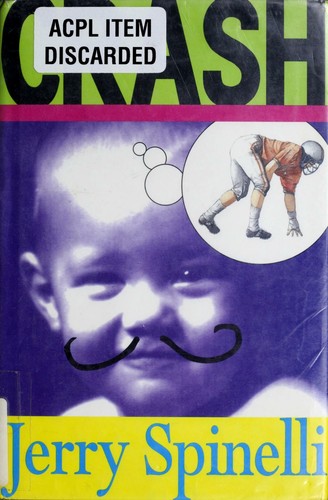
Crash
by Jerry Spinelli
★ Top 25 book of 1996 · #14 on Best Books of 1996
Seventh-grade jock Crash Coogan has been running over people since he earned his nickname, especially his quiet Quaker neighbor Penn Webb. Told through Crash's eyes, this humorous story looks at stereotypes and life's surprises.
Best for: Middle-grade readers curious about what drives a bully and a jock
Crash is #14 on BookWard's Best Books of 1996, out of 39 1996 books that cleared our data bar.
What Crash is about
Crash Coogan is a cocky seventh-grade super-jock who earned his nickname by flattening his cousin Bridget with his first football helmet, and he has been running over people ever since. His favorite target is Penn Webb, a dweeby, vegetarian Quaker kid who lives down the block. The story is told from Crash's own point of view, which gives readers an honest look at life inside a bully's head. Jerry Spinelli, a Newbery medalist, uses that view to explore bullying, snap judgments about other people and the way life can surprise you. It is a good fit for middle-grade readers and for the adults who care about them.
Crash on the Best Books of 1996
Crash came out in 1996. Of the 39 books first published in 1996 that met BookWard's data bar, it ranks #14 on our Best Books of 1996 list.
Why it made the list: 231 readers have shelved it on Open Library; readers rate it 4.9 out of 5 (12 ratings). The list ranks each year’s books on how many readers have picked them up, how highly readers rate them, and how many are reading them right now.
Nearby on the 1996 list
- The Night Stalker Philip Carlo, #12
- 100 Ways to Motivate Yourself Steve Chandler, #13
- Bridget Jones's Diary Helen Fielding, #15
- The Highly Sensitive Person Elaine N. Aron, #16
See all Best Books of 1996 Best books by year
More years: Best Books of 1995 Best Books of 1997.
The numbers behind it
- Readers: 195 want to read it, 19 are reading it now and 17 have read it, according to Open Library.
- Ratings: 4.9 out of 5 from 12 Open Library ratings.
| Signal | This book (0 to 100) | Weight |
|---|---|---|
| Reach | 41 | 55% |
| Reader love | 100 | 25% |
| Being read right now | 72 | 20% |
Questions about Crash
When was Crash published?
Crash by Jerry Spinelli was first published in 1996.
Was Crash one of the best books of 1996?
Crash is #14 on BookWard's Best Books of 1996, out of 39 1996 books that cleared our data bar. 231 readers have shelved it on Open Library; readers rate it 4.9 out of 5 (12 ratings).
Why is Crash on the Best Books of 1996 list?
231 readers have shelved it on Open Library; readers rate it 4.9 out of 5 (12 ratings).
More of the best books of 1996
- A Game of Thrones George R. R. Martin, #1
- The Green Mile Stephen King, #2
- Forbidden Knowledge Roger Shattuck, #3
- Fight Club Chuck Palahniuk, #4
- Push Sapphire, #5
- Neverwhere Neil Gaiman, #6
See the full Best Books of 1996, the Top 100, or new books on Rising.
How we know
This page uses public data: Open Library reader counts and ratings, and Wikipedia page views for recent years. The description is paraphrased from real source text. Rankings reflect reading interest, not quality or sales, and can be affected by data gaps. Lists update monthly.
It suits middle-grade readers.
Depends on the edition you pick.
A bully's own story, told with humor and real heart. 69% taste match
 BookWard’s take
A bully's own story, told with humor and real heart
Crash is a middle-grade novel that puts you inside the head of Crash Coogan, a cocky seventh-grade football star who runs over people, especially his neighbor Penn Webb, a vegetarian Quaker kid. The hook is immediate: Crash earned his nickname by flattening his cousin Bridget with his first football helmet, and that swagger sets the tone. Its authorial voice is distinctive, funny and a little unreliable, which fits BookWard's love of a narrator you have to watch. Character depth is the real payoff, since a type (the jock) gets complicated without a lecture. It sits lower on familiar tropes because the bully-and-nerd setup is well worn, but it uses that familiarity to push against stereotype. The pace is brisk.
A compact middle-grade novel that moves fast and stays lean, which suits BookWard's taste for tight books.
A lively voice and a streamlined story keep it moving, close to the quick pace BookWard likes.
The bully's-eye view gives a familiar school story a fresher angle than the premise suggests.
The language is plain and conversational, built for readability over ornament.
What happens turns on who Crash is and how he changes, more than on plot mechanics.
It leans toward growth and understanding, with a warm outlook on people changing.
A straightforward school story without formal tricks.
Crash's bravado and the comic friction with Penn give it a distinctly humorous streak.
Bullying is present, but the tone stays suited to young readers and never turns bleak.
Feeling builds without tipping into melodrama.
See all 50 dialsEvery position, side by side with this book
Where it lines up
- PaceBookWard 8 · book 8
- Character depthBookWard 8 · book 8
- EndingBookWard 8 · book 8
Where it pulls apart
- Familiar tropesBookWard 10 · book 5
- OpeningBookWard 10 · book 8
- Internal logicBookWard 10 · book 8
A compact middle-grade novel that moves fast and stays lean, which suits BookWard's taste for tight books.
Crash's swagger and the story behind his nickname give it a voice that grabs you early, which BookWard loves.
The jock-versus-nerd setup is a familiar one, though the book sets out to challenge the stereotype it uses.
Events follow cleanly from Crash's character and choices, with no rules or turns that feel arbitrary.
A lively voice and a streamlined story keep it moving, close to the quick pace BookWard likes.
The bully's-eye view gives a familiar school story a fresher angle than the premise suggests.
Crash starts as a type and is steadily filled in, which is the kind of drawing BookWard rewards.
Middle-grade novels like this tend to land on a clear, satisfying resolution, which suits BookWard.
It reaches for heart but keeps it fairly grounded, so it feels earned more than syrupy.
Its rough moments come from character and consequence, never from cheap shock.
This is fiction, so rigor does not apply.
Crash's cocky, funny narration gives the book a recognizable personality from the first page.
Story leads here; the themes about stereotypes arrive through events rather than argument.
Ideas are shown through scenes and Crash's own behavior instead of being explained to the reader.
Its compact length and steady incidents leave little room for the middle to drag.
The language is plain and conversational, built for readability over ornament.
What happens turns on who Crash is and how he changes, more than on plot mechanics.
It leans toward growth and understanding, with a warm outlook on people changing.
A straightforward school story without formal tricks.
Crash's bravado and the comic friction with Penn give it a distinctly humorous streak.
Easy to read, with a young audience in mind and no dense passages to work through.
The story stays with Crash's perspective throughout.
A school story like this is told in a straightforward way, without time-shifting tricks.
Entirely grounded in ordinary school and neighborhood life.
A small circle of classmates, family and neighbors surrounds Crash.
The stakes are personal and local, set in one boy's school and neighborhood.
It balances football and schoolyard action with Crash's shifting view of himself.
Plenty of banter and exchanges between kids carry the scenes.
Romance is not the point; the focus is on rivalry, family and friendship.
A familiar suburban school world that most readers will recognize.
Published in 1996, it reads as late-20th-century childhood but is easy to relate to today.
The bully-and-stereotype theme keeps it relevant for new generations of young readers.
Crash sees himself in a flattering light the reader gradually questions, which gives a mild unreliability.
It nudges toward a clear point about judging people, though it lets Crash stay complicated.
Scenes are sketched economically, with detail used mainly where it serves character or humor.
This is fiction, so nonfiction style does not apply.
This is fiction, so nonfiction perspective does not apply.
A character-led school story like this trades big plot reversals for smaller shifts in how people see each other.
It is a comfortable read that asks gentle questions about how we treat others.
Bullying is present, but the tone stays suited to young readers and never turns bleak.
Feeling builds without tipping into melodrama.
The comedy is lively and a bit exaggerated, driven by Crash's bluster.
There is schoolyard roughness and football contact, but nothing graphic.
There is no sexual content in this middle-grade book.
Politics stays out of it, though questions of difference and judgment run underneath.
The language is plain and kid-friendly throughout.
Crash's attitude colors everything, so the narration is strongly opinionated.
It stays rooted in Crash's everyday world while leaning toward who he might become.
It believes people can see past labels and change, which gives it an idealistic streak.
Review written by BookWard, dial version 1, November 2026.
Who is Crash right for?
It suits middle-grade readers. It deals with bullying and schoolyard roughness, so it may spark conversations about how kids treat each other.
Easy to read, with a young audience in mind and no dense passages to work through.
Bullying is present, but the tone stays suited to young readers and never turns bleak.
Feeling builds without tipping into melodrama.
There is schoolyard roughness and football contact, but nothing graphic.
Book CompanionCrash: ideas, characters, themes
Seen from the inside, a school bully is a more complicated person than the label suggests.
- The bully's point of view. The story is told through Crash, so readers hear his confidence and his excuses firsthand.
- How he got his name. His nickname comes from knocking his cousin Bridget flat with his first football helmet, and it sums up how he treats people.
- The target next door. Penn Webb, the vegetarian Quaker kid down the block, is the person Crash runs over most often.
- Stereotypes under pressure. The jock and the dweeb are both familiar types, and the book invites you to look past them.
- A lively voice. Crash's bravado and humor drive the story and give it its energy.
Characters
Crash Coogan
Narrator and seventh-grade football star
Cocky and aggressive, he is nicknamed for how he plows through people.
Penn Webb
Neighbor and frequent target
A vegetarian Quaker kid who lives down the block and is often on the receiving end of Crash.
Bridget
Crash's cousin
The person Crash knocked down with his first football helmet, which earned him his nickname.
Themes
How and why one kid treats another badly.
The labels we put on people and what they hide.
How Crash sees himself versus how others see him.
The surprises that can shift how a person thinks and acts.
Discussion questions
- Why does the book tell the story from the bully's side, and what does that change?
- How does Crash's nickname shape the way he acts?
- What makes Penn a target, and how does he respond?
- Which stereotypes does the book use, and which does it push against?
- Can you like a narrator who behaves badly? Why or why not?
Personalize your Book Companion
This is the general edition. In BookWard, the Companion is written for you: your reading profile, your notes, and spoiler-safe to the page you are on.
Buy, listen or borrow Crash
Each link opens a search for this book on that store, in a new tab.
Read on a device
Borrow
Reviews and community
If you liked Crash
A graphic memoir where a stomachache becomes a story about anxiety
Double ActJacqueline WilsonTwo ten-year-old twins, one accounts book, and a family coming apart
Paper TownsJohn GreenA midnight caper that turns into a search for a person
There's a Boy in the Girl's Bathroom (Cascades)Louis SacharA short, funny school story about a kid everyone has written off
Find your own best books
Add what you have read, rate it, and BookWard will recommend what to read next.
Free to start. No credit card needed.