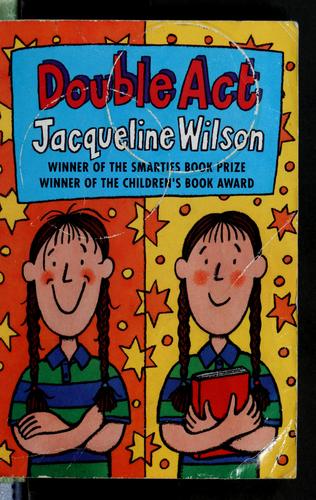
Double Act
by Jacqueline Wilson
Ten-year-old identical twins Ruby and Garnet do everything together, a bond that has only grown tighter since their mother died three years ago. As life around them shifts, they must face whether being a pair can last forever.
Best for: Young readers who enjoy lively stories about twins, sisters and family change
Double Act ranked #21 on BookWard's Best Books of 1995 when we last measured it, in October 2026.
What Double Act is about
Ruby and Garnet are ten-year-old identical twins who share a secret language and see no need for friends at school, because they have each other. Their mother, Opal, has died, and they live with their father and grandmother. Ruby is bold, sociable and sure she will be an actress. Garnet is quieter and happy to let her sister lead. The story is told in diary style, with the twins taking turns to write in an accounts book, so you hear both voices and see how differently they read the same events.
Then things start to shift. Their father finds a new girlfriend, Rose, and a new job, and the family moves to a bookshop in the country, leaving their grandmother behind. Ruby pushes for an audition for a TV adaptation of The Twins at St. Clare's. Clare's, and later sets her heart on a scholarship to Marnock Heights, though only one place is on offer. Warm, funny and honest about jealousy and grief, it asks what happens when two people who have always been a pair start to become themselves. Illustrated by Sue Heap and Nick Sharratt.
Double Act on the Best Books of 1995
Double Act came out in 1995. When we last measured it, in October 2026, it ranked #21 on our Best Books of 1995 list. It is not among the top books of 1995 on this month’s list, and the numbers on this page are the latest we have.
The numbers behind it
- Readers: 137 want to read it, 11 are reading it now and 21 have read it, according to Open Library.
| Signal | This book (0 to 100) | Weight |
|---|---|---|
| Reach | 18 | 55% |
| Reader love | 36 | 25% |
| Being read right now | 39 | 20% |
Questions about Double Act
When was Double Act published?
Double Act by Jacqueline Wilson was first published in 1995.
Was Double Act one of the best books of 1995?
Double Act ranked #21 on BookWard's Best Books of 1995 when we last measured it, in October 2026. 169 readers have shelved it on Open Library.
Why is Double Act on the Best Books of 1995 list?
169 readers have shelved it on Open Library.
More of the best books of 1995
- The Lost World Michael Crichton, #1
- Emotional Intelligence Daniel Goleman, #2
- Northern Lights Philip Pullman, #3
- Rose Madder Stephen King, #4
- Mindhunter John E. Douglas, #5
- Wicked Gregory Maguire, #6
See the full Best Books of 1995, the Top 100, or new books on Rising.
How we know
This page uses public data: Open Library reader counts and ratings, and Wikipedia page views for recent years. The description is paraphrased from real source text. Rankings reflect reading interest, not quality or sales, and can be affected by data gaps. Lists update monthly.
It suits readers of roughly nine to eleven who enjoy family stories with humor and heart.
Depends on the edition you pick.
Two ten-year-old twins, one accounts book, and a family coming apart. 63% taste match
 BookWard’s take
Two ten-year-old twins, one accounts book, and a family coming apart
Double Act is a short, quick children's novel told by identical twins Ruby and Garnet, who take turns writing in an accounts book. The hook comes at once: two girls with a secret language, a mother who has died, and a father who now has a girlfriend. The voice is the book's great pleasure, because Ruby's loud, headstrong narration and Garnet's quieter one feel truly different on the page. Character depth is the real strength, since the whole story turns on whether a double act can survive change. Dialogue runs heavy, and the tone is funnier than the premise suggests. It also leans hopeful: grief is present but handled gently, never for shock. Some familiar tropes are mixed in, though the dual-diary format feels fresher.
A brisk children's novel with illustrations, far shorter than BookWard's own tight-and-short preference requires it to be, so it fits.
Short diary entries keep things moving, though it settles into a gentler rhythm than a true page-turner.
The alternating accounts-book format and the twin dynamic feel fresh, even if the family plot is familiar.
The language is plain and conversational, suited to ten-year-old narrators, a bit plainer than BookWard's middle ground.
The plot exists to test the twins' bond, so character leads, which fits BookWard's lean.
Grief and upheaval give way to a warm outlook, matching BookWard's taste for hopeful books.
Alternating entries in an accounts book is a mildly inventive frame, more than conventional but not experimental.
Ruby's bluntness and the girls' bickering bring plenty of humor, which BookWard enjoys.
A dead mother frames it, but the tone stays gentle and suited to young readers.
Grief, jealousy and loyalty are all felt strongly, matching BookWard's emotional range.
See all 50 dialsEvery position, side by side with this book
Where it lines up
- Character depthBookWard 8 · book 8
- EndingBookWard 8 · book 8
- Shock for effectBookWard 9 · book 9
Where it pulls apart
- Familiar tropesBookWard 10 · book 5
- Internal logicBookWard 10 · book 7
- OriginalityBookWard 9 · book 6
A brisk children's novel with illustrations, far shorter than BookWard's own tight-and-short preference requires it to be, so it fits.
The twins' voices, their secret language and their lost mother set the situation up from the first pages, which is how BookWard likes to open.
A new stepmother, bullies and a move to the country are familiar territory, though the twin narrators freshen them.
Events follow cleanly from the twins' feelings and choices, which suits BookWard's liking for cause and effect.
Short diary entries keep things moving, though it settles into a gentler rhythm than a true page-turner.
The alternating accounts-book format and the twin dynamic feel fresh, even if the family plot is familiar.
Ruby and Garnet are drawn with real contrast, one dominant and wild, one shy and kind, which BookWard rewards.
The twins' arc reaches a clear emotional resolution, which fits BookWard's preference for endings that land.
It touches grief and family warmth openly, so it is more tender than the restraint BookWard prefers.
Sad subject matter is handled with care and serves the story rather than being used for effect.
Not applicable to a children's novel.
Two clearly distinct first-person voices, one brash and one gentle, give it a strong identity that BookWard enjoys.
This is firmly story-led, built on family events rather than abstract ideas, matching BookWard's taste.
Feelings and backstory come through the girls' own entries in scene rather than outside explanation.
Short entries and steady incident keep the middle moving, in line with BookWard's taste.
The language is plain and conversational, suited to ten-year-old narrators, a bit plainer than BookWard's middle ground.
The plot exists to test the twins' bond, so character leads, which fits BookWard's lean.
Grief and upheaval give way to a warm outlook, matching BookWard's taste for hopeful books.
Alternating entries in an accounts book is a mildly inventive frame, more than conventional but not experimental.
Ruby's bluntness and the girls' bickering bring plenty of humor, which BookWard enjoys.
Easy to read, written for children, which sits below BookWard's moderate effort level but costs nothing.
Two narrators trade turns, so it is limited to a pair of views, fewer than BookWard's taste.
The story unfolds mostly in order through diary entries, close to BookWard's more linear side.
Entirely grounded in everyday family and school life, plainer than BookWard's range.
The focus stays on a handful of family members and a few school figures, a small cast.
A deeply intimate story about one family and two sisters, smaller than BookWard's usual range.
The weight falls on the twins' feelings and relationship, more than on action.
The girls' squabbles and exchanges carry a lot of the story, close to BookWard's liking for talk.
The father's new relationship is background; the central bond is between sisters.
A familiar British home, school and village setting, less unfamiliar than BookWard's preference.
Written in the 1990s with a contemporary feel, so it sits nearer present day than the past.
Grief, sibling bonds and growing up hold up well, which BookWard values.
The twins are honest, if self-serving, narrators, so their accounts can be trusted, with some bias.
Right and wrong are mostly clear, with some blurring in how the girls treat each other.
Setting is sketched lightly through the girls' eyes rather than described at length.
Not applicable to fiction.
First-person diary entries make this about as personal as a book gets.
Double Act stands as its own story.
The plot is character-driven with few big surprises, fewer than BookWard's taste.
A comforting read overall, gentler than BookWard's pull toward challenge.
A dead mother frames it, but the tone stays gentle and suited to young readers.
Grief, jealousy and loyalty are all felt strongly, matching BookWard's emotional range.
The humor is lively and a little broad, driven by Ruby's big personality.
Little more than mud-throwing and schoolyard trouble, very light.
Nothing of the kind appears in a book for this age.
Politics do not figure in this family story.
Plain, chatty language aimed at young readers.
Ruby especially narrates with strong opinions, in clear contrast to neutral narration.
It centers on the present and moves toward a hopeful future for the girls.
It leans optimistic about family and change, a little warmer than neutral.
Review written by BookWard, dial version 1, November 2026.
Who is Double Act right for?
It suits readers of roughly nine to eleven who enjoy family stories with humor and heart. A parent's death and family tension are handled gently but are central.
Easy to read, written for children, which sits below BookWard's moderate effort level but costs nothing.
A dead mother frames it, but the tone stays gentle and suited to young readers.
Grief, jealousy and loyalty are all felt strongly, matching BookWard's emotional range.
Little more than mud-throwing and schoolyard trouble, very light.
Book CompanionDouble Act: ideas, characters, themes
Two identical twins who have always been a double act must work out who they are apart when their family changes.
- Format. Ruby and Garnet alternate writing in an accounts book, so every entry is in their own voice.
- Setup. The ten-year-old twins live with their father and grandmother since their mother, Opal, died three years earlier.
- Upheaval. Their father's new girlfriend, Rose, and a move to the country shake their close bond.
- Contrast. Ruby is loud and dreams of acting, while Garnet is shy and content to follow.
- Recognition. It won the Nestlé Smarties Book Prize and the Red House Children's Book Award, and was a Carnegie runner-up.
Characters
Ruby
Narrator
Loud, outgoing, headstrong twin who wants to be an actress.
Garnet
Narrator
Shy, quiet, kind twin who lets Ruby lead.
Rose
Father's girlfriend
The new woman in the family, whom the twins resist.
Their father
Parent
A widower whose new relationship and job change the family's life.
Themes
The pull between closeness and the need to be your own person.
How losing a mother still shapes the girls' choices.
Finding out who you are when you have always been half of a pair.
Learning to cope when a familiar life is upended.
Making a place in a new home and school.
Discussion questions
- Why does Ruby resist the changes so strongly while Garnet adapts more?
- How does the diary format change the way we trust each twin?
- What does Rose represent to the girls at the start?
- Is being a double act a comfort or a limit?
- How does the twins' grief shape their behavior?
Personalize your Book Companion
This is the general edition. In BookWard, the Companion is written for you: your reading profile, your notes, and spoiler-safe to the page you are on.
Buy, listen or borrow Double Act
Each link opens a search for this book on that store, in a new tab.
Read on a device
Borrow
Reviews and community
If you liked Double Act
A bully's own story, told with humor and real heart
GutsRaina TelgemeierA graphic memoir where a stomachache becomes a story about anxiety
There's a Boy in the Girl's Bathroom (Cascades)Louis SacharA short, funny school story about a kid everyone has written off
Everything I Know About LoveDolly AldertonA funny, warm memoir of friendship, bad dates and growing up
Find your own best books
Add what you have read, rate it, and BookWard will recommend what to read next.
Free to start. No credit card needed.