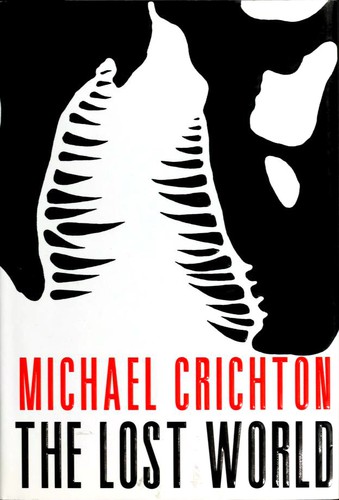
The Lost World
by Michael Crichton
★ Most-read book of 1995 · #1 on Best Books of 1995
Michael Crichton returns to the world of his 1990 hit Jurassic Park with this 1995 techno-thriller, his tenth novel under his own name. Published by Knopf, it was later bundled with its predecessor in a single combined edition.
Best for: Readers who loved Jurassic Park and want its techno-thriller sequel
The Lost World is #1 on BookWard's Best Books of 1995, out of 28 1995 books that cleared our data bar.
What The Lost World is about
Ian Malcolm, the chaos theorist who lived through the disaster at Jurassic Park, is drawn back into the story when a young paleontologist named Richard Levine challenges him. Levine believes InGen kept a secret production site for its dinosaurs, and that somewhere out there lies a lost world where the animals live on, a place that could teach us what extinction really is.
When Levine slips off to Isla Sorna, one of the five islands known as Las Cinco Muertes, Malcolm follows with Doc Thorne, Eddie Carr and Sarah Harding in specially equipped RV trailers. Two teenagers have stowed away in one of them. A rival company, Biosyn, is also on the island, and its team under Lewis Dodgson has come to steal eggs. Crichton's sequel, the only one he ever wrote, is a suspenseful techno-thriller about corporate greed, scientific overreach and the limits of human control over nature.
The Lost World on the Best Books of 1995
The Lost World came out in 1995. Of the 28 books first published in 1995 that met BookWard's data bar, it ranks #1 on our Best Books of 1995 list.
Why it made the list: 576 readers have shelved it on Open Library; readers rate it 4.4 out of 5 (34 ratings); 29 are reading it right now. The list ranks each year’s books on how many readers have picked them up, how highly readers rate them, and how many are reading them right now.
It earns Most-read of 1995 and reader favorite.
Nearby on the 1995 list
- Emotional Intelligence Daniel Goleman, #2
- Northern Lights Philip Pullman, #3
See all Best Books of 1995 Best books by year
More years: Best Books of 1994 Best Books of 1996.
The numbers behind it
- Readers: 464 want to read it, 29 are reading it now and 83 have read it, according to Open Library.
- Ratings: 4.4 out of 5 from 34 Open Library ratings.
| Signal | This book (0 to 100) | Weight |
|---|---|---|
| Reach | 89 | 55% |
| Reader love | 100 | 25% |
| Being read right now | 82 | 20% |
Questions about The Lost World
When was The Lost World published?
The Lost World by Michael Crichton was first published in 1995.
Was The Lost World one of the best books of 1995?
The Lost World is #1 on BookWard's Best Books of 1995, out of 28 1995 books that cleared our data bar. 576 readers have shelved it on Open Library; readers rate it 4.4 out of 5 (34 ratings); 29 are reading it right now.
Why is The Lost World on the Best Books of 1995 list?
576 readers have shelved it on Open Library; readers rate it 4.4 out of 5 (34 ratings); 29 are reading it right now.
More of the best books of 1995
- Emotional Intelligence Daniel Goleman, #2
- Northern Lights Philip Pullman, #3
- Rose Madder Stephen King, #4
- Mindhunter John E. Douglas, #5
- Wicked Gregory Maguire, #6
- The Demon-Haunted World Carl Sagan, #7
See the full Best Books of 1995, the Top 100, or new books on Rising.
How we know
This page uses public data: Open Library reader counts and ratings, and Wikipedia page views for recent years. The description is paraphrased from real source text. Rankings reflect reading interest, not quality or sales, and can be affected by data gaps. Lists update monthly.
Suits teens and adults who enjoy action and science-flavoured thrillers.
Depends on the edition you pick.
Crichton's only sequel trades wonder for a fast island chase. 47% taste match
 BookWard’s take
Crichton's only sequel trades wonder for a fast island chase
The Lost World returns to the world of Jurassic Park, with chaos theorist Ian Malcolm pulled into a hunt for a hidden island of dinosaurs. It is a quick, plot-first techno-thriller: it moves fast and grabs you early. Where it loses ground is familiarity. A sequel built on an expedition, rival corporate schemers and a rescue mission is comfortable territory, and it feels well short of original. The characters are also fairly thin, serving the machinery of the chase more than the other way round. Where it does pay off is in its internal logic, with a gadget-heavy, carefully equipped expedition that hangs together, and in a firm ending. Read it as an efficient follow-up, not a reinvention.
Built as an action novel, it keeps events coming and rarely lingers, matching BookWard's appetite for speed.
Returning to the world of Jurassic Park makes it a derivative follow-up, so it sits below BookWard's high bar.
The writing is plain and functional, which suits the pace, and sits below BookWard's middle ground.
Events drive everything; the characters mostly exist to move through the expedition.
It is a survival story with peril throughout, leaning cautious more than hopeful.
A conventional expedition narrative that proceeds in order from setup to the island.
Tone is serious and tense, with only occasional dry asides from its characters.
Deadly animals and killings make it tense, though the tone stays adventure-thriller rather than grim.
Fear and urgency carry the book more than deep feeling.
See all 50 dialsEvery position, side by side with this book
Where it lines up
- EndingBookWard 8 · book 8
- PaceBookWard 8 · book 9
- SentimentBookWard 8 · book 7
Where it pulls apart
- Familiar tropesBookWard 10 · book 3
- LengthBookWard 1 · book 5
- OriginalityBookWard 9 · book 4
It opens on a lecture and a challenge from a brash paleontologist, then pushes toward an island quickly, close to BookWard's taste.
A sequel built on an expedition to a hidden island of dinosaurs leans on familiar genre moves, short of BookWard's bar.
The expedition is carefully equipped with a purpose-built mobile lab and vehicles, and the premise holds together reasonably well.
Built as an action novel, it keeps events coming and rarely lingers, matching BookWard's appetite for speed.
Returning to the world of Jurassic Park makes it a derivative follow-up, so it sits below BookWard's high bar.
Characters are defined by roles such as the mathematician, the biologist and the spy, which is thinner than BookWard likes.
It is a brisk thriller with little room for feeling, and that fits BookWard's restraint.
Danger and attacks are central to the premise, so the darkness is part of the genre's machinery more than a deep payoff.
Crichton's clipped, information-rich style is recognisable, though it reads more as house style than a singular voice.
Ideas about extinction and chaos theory frame the story, but the engine remains an adventure plot.
Crichton leans on explaining the science and the setup outright, which runs against BookWard's preference for showing.
The chase structure keeps tension up across the journey, though sequels in this mode can coast in the middle.
The writing is plain and functional, which suits the pace, and sits below BookWard's middle ground.
Events drive everything; the characters mostly exist to move through the expedition.
It is a survival story with peril throughout, leaning cautious more than hopeful.
A conventional expedition narrative that proceeds in order from setup to the island.
Tone is serious and tense, with only occasional dry asides from its characters.
It is an easy, propulsive read that asks little beyond following the action.
The story moves between the expedition, the kids, the stranded paleontologist and the corporate spies.
The plot runs forward in time, with only a short jump of eighteen months early on.
Its dinosaurs are science-fiction creations, but the world around them is otherwise realistic.
Expedition members, the young assistants, a stranded paleontologist and corporate schemers add up to a fairly full cast.
The story stays on one island and one expedition, so the stakes stay contained.
It is overwhelmingly about action and survival, with little interior reflection.
Characters explain and argue the science and the plan, so conversation carries real weight.
Romance is not a driver here; the story is about the expedition and the animals.
A remote island chain with a secret dinosaur site is an unfamiliar and appealing setting.
Set in the early 1990s, it reads as a period piece more than the present day.
A popular sequel tied to its moment and its predecessor, with lasting appeal but less independent staying power.
The narration is straightforward and reliable, there to guide the reader through the action.
The question of whether to meddle with nature is posed fairly clearly, with little ambiguity.
The book uses description to set up the island and its creatures, but stays practical rather than lush.
It is a direct sequel to Jurassic Park and depends on that story.
The corporate rivalry and the island's dangers supply a steady run of turns.
A thrill-ride sequel meant to entertain, with little that unsettles.
Deadly animals and killings make it tense, though the tone stays adventure-thriller rather than grim.
Fear and urgency carry the book more than deep feeling.
Humor is minimal and dry, mostly from Malcolm's sardonic manner.
Animal attacks and deaths are central to the plot, so there is a fair amount on the page.
Sexual content is essentially absent from this adventure story.
Corporate espionage and science ethics are present, but not the point.
The prose is plain and accessible, with technical terms explained along the way.
Crichton openly argues about science, nature and human overreach through his characters.
It looks back at the original disaster while warning about the future of genetic science.
A cautionary, skeptical view of human ambition and technology runs through the book.
Review written by BookWard, dial version 1, November 2026.
Who is The Lost World right for?
Suits teens and adults who enjoy action and science-flavoured thrillers. Expect animal attacks, deaths and sustained peril.
It is an easy, propulsive read that asks little beyond following the action.
Deadly animals and killings make it tense, though the tone stays adventure-thriller rather than grim.
Fear and urgency carry the book more than deep feeling.
Animal attacks and deaths are central to the plot, so there is a fair amount on the page.
Book CompanionThe Lost World: ideas, characters, themes
A mathematician is pulled back toward dinosaurs when a paleontologist sets out to find a secret island where InGen made them.
- The setup. Ian Malcolm, a survivor of Jurassic Park, is challenged at a lecture on extinction by a young paleontologist named Richard Levine.
- The hidden site. They learn of a secret Site B, where InGen made the dinosaurs for Jurassic Park.
- Levine goes missing. Levine leaves for an island without telling Malcolm, and his guide is attacked by an unseen animal.
- The rescue party. Malcolm, Thorne, Eddie Carr and Sarah Harding set out to find Levine with a mobile lab and gear.
- Watching eyes. Spy Ed James reports to corporate research thief Lewis Dodgson, who wants data on Levine and Malcolm.
Characters
Ian Malcolm
Chaos theorist and survivor of Jurassic Park
A mathematician drawn back into the dinosaur affair by Levine's challenge.
Richard Levine
Paleontologist
A young, pompous researcher who sets off alone for the island he believes is Site B.
Sarah Harding
Behavioral biologist
A specialist in large predators brought in by Thorne to join the rescue.
Jack Thorne
Retired professor
Called 'Doc', he builds the specially equipped trailers that serve as the team's mobile lab.
Lewis Dodgson
Corporate research thief
A rival who uses the spy Ed James to chase data on Levine and Malcolm.
Themes
The question of why species vanish drives the quest.
Malcolm's theory frames how plans and nature slip out of human hands.
The urge to discover, and to profit, pushes people into danger.
Rivals chase data and advantage while others risk their lives.
Preparation and gadgets meet creatures that do not care.
Discussion questions
- Is a sequel stronger when it repeats a successful formula or when it changes it?
- How does Malcolm's chaos theory shape the way the story treats plans and control?
- What does Levine's recklessness say about the pull of discovery?
- Do the corporate spies add tension, or distract from the island story?
- Does the book ask for sympathy for the animals, the people, or both?
Personalize your Book Companion
This is the general edition. In BookWard, the Companion is written for you: your reading profile, your notes, and spoiler-safe to the page you are on.
Buy, listen or borrow The Lost World
Each link opens a search for this book on that store, in a new tab.
Read on a device
Borrow
Reviews and community
If you liked The Lost World
A cautionary techno-thriller that runs on ideas and teeth
CongoMichael CrichtonA fast, gadget-laden lost world adventure, more machine than mood.
Angels & DemonsDan BrownA one-day Vatican chase that runs on clues and speed
Raise the Titanic!Clive CusslerA big, brisk Cold War salvage adventure with a ridiculous, irresistible premise
Find your own best books
Add what you have read, rate it, and BookWard will recommend what to read next.
Free to start. No credit card needed.