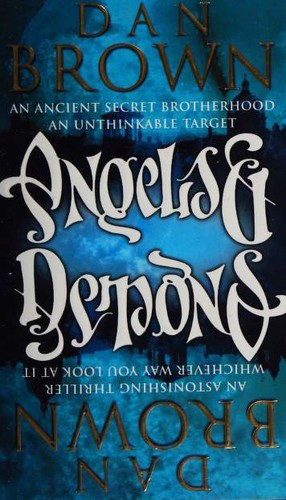
Angels & Demons
by Dan Brown
★ Top 10 book of 2000 · #8 on Best Books of 2000
This 2000 bestseller from Dan Brown marks the debut of Robert Langdon. Expect secret society conspiracies, the Catholic Church, and a story squeezed into a single day, with ancient history, architecture, and symbology woven throughout.
Best for: Readers who love conspiracy-driven mysteries packed with symbols, architecture, and history
Angels & Demons is #8 on BookWard's Best Books of 2000, out of 46 2000 books that cleared our data bar.
What Angels & Demons is about
A physicist at CERN is found murdered, a strange ambigram branded into his skin: the word "Illuminati". Soon a canister of antimatter, the substance he had learned to create, goes missing, and its battery gives the thief a deadline of one day. The institute's director summons Robert Langdon, a Harvard professor, along with the dead man's adopted daughter, Vittoria.
From there the story moves through Rome and Vatican City as Langdon and Vittoria trace a trail of clues laid across the city's churches. Four cardinals, all favorites to become the next Pope, have been taken by a figure called the Hassassin, acting for the leader of the Illuminati. Art, architecture and symbols do much of the talking, and the old quarrel between science and the Church sits underneath the chase. This is the novel that first introduces Langdon, and it suits readers who like a ticking clock, a secret society and a history lesson tucked inside the suspense.
Angels & Demons on the Best Books of 2000
Angels & Demons came out in 2000. Of the 46 books first published in 2000 that met BookWard's data bar, it ranks #8 on our Best Books of 2000 list.
Why it made the list: 1,910 readers have shelved it on Open Library; readers rate it 3.6 out of 5 (271 ratings); 121 are reading it right now. The list ranks each year’s books on how many readers have picked them up, how highly readers rate them, and how many are reading them right now.
It earns Being read right now.
Nearby on the 2000 list
- Esperanza Rising Pam Muñoz Ryan, #6
- Rich Dad's Guide to Investing Robert T. Kiyosaki, #7
- Stormbreaker Anthony Horowitz, #9
- Kitchen Confidential Anthony Bourdain, #10
See all Best Books of 2000 Best books by year
More years: Best Books of 1999 Best Books of 2001.
The numbers behind it
- Readers: 1,395 want to read it, 121 are reading it now and 394 have read it, according to Open Library.
- Ratings: 3.6 out of 5 from 271 Open Library ratings.
| Signal | This book (0 to 100) | Weight |
|---|---|---|
| Reach | 96 | 55% |
| Reader love | 4 | 25% |
| Being read right now | 96 | 20% |
Questions about Angels & Demons
When was Angels & Demons published?
Angels & Demons by Dan Brown was first published in 2000.
Was Angels & Demons one of the best books of 2000?
Angels & Demons is #8 on BookWard's Best Books of 2000, out of 46 2000 books that cleared our data bar. 1,910 readers have shelved it on Open Library; readers rate it 3.6 out of 5 (271 ratings); 121 are reading it right now.
Why is Angels & Demons on the Best Books of 2000 list?
1,910 readers have shelved it on Open Library; readers rate it 3.6 out of 5 (271 ratings); 121 are reading it right now.
More of the best books of 2000
- Harry Potter and the Goblet of Fire J. K. Rowling, #1
- The 48 Laws of Power Robert Greene, #2
- Because of Winn-Dixie Kate DiCamillo, #3
- The Gruffalo Julia Donaldson, #4
- Life of Pi Yann Martel, #5
- Esperanza Rising Pam Muñoz Ryan, #6
See the full Best Books of 2000, the Top 100, or new books on Rising.
How we know
This page uses public data: Open Library reader counts and ratings, and Wikipedia page views for recent years. The description is paraphrased from real source text. Rankings reflect reading interest, not quality or sales, and can be affected by data gaps. Lists update monthly.
Suits adult and older teen readers who enjoy fast thrillers.
Depends on the edition you pick.
A one-day Vatican chase that runs on clues and speed. 42% taste match
 BookWard’s take
A one-day Vatican chase that runs on clues and speed
Dan Brown's 2000 thriller drops Harvard symbologist Robert Langdon into a murder at CERN and a ticking antimatter canister that threatens the Vatican, all inside a single day. The hook is where it shines: the branded ambigram arrives almost at once and the book rarely lets up, so it moves fast and never really sags. It is less kind to a reader's patience with familiar tropes, since secret societies and a Church conspiracy are well-worn ground, and the exposition leans toward characters explaining history aloud rather than letting scenes carry it. Character depth stays modest because the puzzle outranks the people. It is a quick, propulsive read for anyone who wants Rome, art history and a countdown, less so for those after originality or restraint.
A full-sized thriller rather than a lean one, which sits well above BookWard's preference for tight and short.
A single-day frame and a 24-hour countdown keep it moving, comfortably meeting BookWard's liking for speed.
The Vatican-versus-science premise has some freshness, but the genre machinery is well known, so it falls short of BookWard's high bar.
The prose is plain and functional rather than ornate, a little plainer than BookWard's slight middle lean.
The plot is firmly in charge here, well away from BookWard's character-driven tilt.
Despite the killings, the story points toward survival and a defended order, nudging it toward the hopeful side, close to BookWard.
The story is told in a straightforward sequence of clue, location and consequence, more conventional than BookWard's mild lean.
This is a serious, tense book with little levity, well below BookWard's taste for humor.
Ritual murders and a threatened massacre make it fairly dark, close to BookWard's middle.
Tension is high, but feelings are rarely deep, landing near BookWard's moderate emotion.
See all 50 dialsEvery position, side by side with this book
Where it lines up
- EndingBookWard 8 · book 8
- OpeningBookWard 10 · book 9
- PaceBookWard 8 · book 9
Where it pulls apart
- Familiar tropesBookWard 10 · book 3
- LengthBookWard 1 · book 6
- Internal logicBookWard 10 · book 5
A full-sized thriller rather than a lean one, which sits well above BookWard's preference for tight and short.
A murder with a branded ambigram opens the story and the stakes escalate fast, matching BookWard's taste for an immediate grab.
Secret societies, a Church conspiracy and a ticking clock are familiar thriller furniture, which cuts against BookWard's wish to avoid tropes.
The clue trail is engaging, but its leaps and coincidences ask for goodwill, short of the airtight standard BookWard wants.
A single-day frame and a 24-hour countdown keep it moving, comfortably meeting BookWard's liking for speed.
The Vatican-versus-science premise has some freshness, but the genre machinery is well known, so it falls short of BookWard's high bar.
Langdon and Vittoria serve the plot more than they unfold as people, thinner than the depth BookWard prefers.
The final confrontation and the antimatter threat are brought to a clear close, in line with BookWard's taste for resolution.
Emotion stays mostly in service of the chase, neither syrupy nor especially austere, a middling fit with BookWard's restraint.
The ritual killings are staged for effect more than earned, which sits uneasily with BookWard's wish for darkness that is earned.
It is a novel, so this dial does not apply.
The prose is brisk and serviceable but not strongly individual, short of the distinctiveness BookWard values.
Ideas about science and faith feed the plot, but the story clearly leads, which sits close to BookWard's story-first lean.
Langdon often explains symbols and history outright, which is the opposite of BookWard's preference for showing in scene.
Each clue leads straight to the next location, so the middle keeps moving, which suits BookWard.
The prose is plain and functional rather than ornate, a little plainer than BookWard's slight middle lean.
The plot is firmly in charge here, well away from BookWard's character-driven tilt.
Despite the killings, the story points toward survival and a defended order, nudging it toward the hopeful side, close to BookWard.
The story is told in a straightforward sequence of clue, location and consequence, more conventional than BookWard's mild lean.
This is a serious, tense book with little levity, well below BookWard's taste for humor.
It reads easily and quickly, even with the symbology, which is lighter than BookWard's modest appetite for effort.
The story moves between several perspectives, including the antagonist's side, close to BookWard's liking for many viewpoints.
Events unfold in strict order across one day, more linear than BookWard's slight preference for shifting time.
Set in a recognisable Rome and a real-seeming CERN, it is grounded despite its secret-society conceit, below BookWard's middle lean.
A handful of leads plus the cardinals and the assassin make a moderate cast, near BookWard's smaller preference.
A threat to the Vatican gives it large stakes, more epic than BookWard's lean toward intimate.
Action, pursuit and discovery dominate over interior reflection, well toward outer, beyond BookWard's lean.
Much of the information and tension passes through conversation and explanation, nearing BookWard's liking for heavy dialogue.
A light connection between the leads sits in the background of the chase, below BookWard's middle.
The Vatican, CERN and Rome's churches give an inside-the-institutions feel that sits near BookWard's liking for the unfamiliar.
Written in 2000 and set in then-contemporary times, it sits close to the present-day side BookWard favors.
Its appeal is tied to a turn-of-the-millennium moment, so its staying power is middling against BookWard's taste.
Narration follows events straightforwardly with no trickery, far from BookWard's liking for unreliable narrators.
Good and evil are drawn fairly clearly, with little ambiguity, below BookWard's taste for moral grey.
Rome's churches, art and architecture are described in loving detail, richer than BookWard's middle lean.
It introduces Langdon, who returns in later novels, so it belongs to a wider run, above BookWard's mild lean.
Reversals and reveals arrive constantly, matching or exceeding BookWard's appetite for surprises.
It is an entertaining, easy-to-follow adventure rather than a challenging one, more comforting than BookWard's lean.
Ritual murders and a threatened massacre make it fairly dark, close to BookWard's middle.
Tension is high, but feelings are rarely deep, landing near BookWard's moderate emotion.
Several killings, some graphic, appear on the page, roughly matching BookWard's middle.
Sexual content is minimal, a little under BookWard's middle.
The Church, science and power struggles play a role, but the book is not about politics, a bit under BookWard's middle.
The language is plain and quick to follow, with only occasional technical terms, easier than BookWard's middle.
The narration mostly tells the story straight, with only mild editorializing, a bit below BookWard's middle.
Its conflict between old institutions and new science looks back more than forward, below BookWard's lean.
Faith and reason are ultimately treated with respect rather than cynicism, landing near BookWard's idealist lean.
Review written by BookWard, dial version 1, November 2026.
Who is Angels & Demons right for?
Suits adult and older teen readers who enjoy fast thrillers. It contains several killings, some described in grim detail, and a dark conspiracy plot.
It reads easily and quickly, even with the symbology, which is lighter than BookWard's modest appetite for effort.
Ritual murders and a threatened massacre make it fairly dark, close to BookWard's middle.
Tension is high, but feelings are rarely deep, landing near BookWard's moderate emotion.
Several killings, some graphic, appear on the page, roughly matching BookWard's middle.
Book CompanionAngels & Demons: ideas, characters, themes
A symbologist races a one-day deadline to decode a trail of Illuminati clues before a stolen antimatter canister destroys the Vatican.
- A murder at CERN. A physicist who created antimatter is killed and branded with an ambigram of the word Illuminati, starting the chase.
- A ticking canister. Stolen antimatter will explode in 24 hours when its battery runs out, setting the countdown.
- The Path of Illumination. Langdon and Vittoria follow clues through Rome's churches tied to the Altars to Science.
- Kidnapped cardinals. Four leading papal candidates are taken by the Hassassin, who plans to kill them under orders from Janus.
- Symbology as method. History, art and architecture are the tools used to read each clue and anticipate the next move.
Characters
Robert Langdon
Harvard professor of symbology and religious history
The expert called in to authenticate the ambigram and follow the clues across Rome.
Vittoria Vetra
Adopted daughter of the murdered physicist
Joins Langdon in the hunt for the missing antimatter canister.
Maximilian Kohler
Director of CERN
Summons Vittoria and Langdon after the murder.
The Hassassin
Assassin
Abducts the cardinals and carries out the killings.
Janus
Leader of the Illuminati
The figure whose orders drive the Hassassin.
Themes
The book stages a clash between faith and scientific discovery.
Hidden organizations are cast as drivers of history and conspiracy.
Reading signs correctly is the key to survival.
A single day and a countdown shape every choice.
The Church and CERN stand as rival centers of authority.
Discussion questions
- How well does the one-day clock keep tension alive across the whole book?
- Does the clue-by-clue structure feel clever or formulaic?
- How fairly does the book treat both science and the Church?
- Which scenes rely on explanation rather than action, and do they slow things down?
- Would the story work as well without its Rome setting?
Personalize your Book Companion
This is the general edition. In BookWard, the Companion is written for you: your reading profile, your notes, and spoiler-safe to the page you are on.
Buy, listen or borrow Angels & Demons
Each link opens a search for this book on that store, in a new tab.
Read on a device
Borrow
Reviews and community
If you liked Angels & Demons
A murder in the Louvre launches a relentless chase
The Lost SymbolDan BrownLangdon's Washington race: fast, familiar, built to be devoured
InfernoDan BrownLangdon wakes with no memory and a chase through Florence
Deception PointDan BrownA fast, twisty Arctic thriller that trades subtlety for momentum
Find your own best books
Add what you have read, rate it, and BookWard will recommend what to read next.
Free to start. No credit card needed.