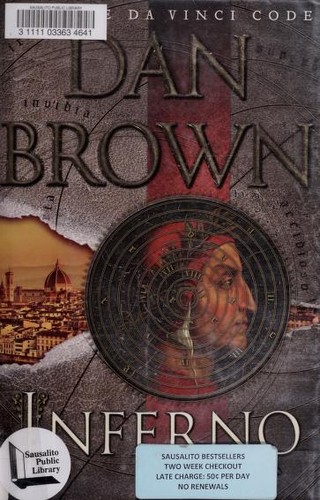
Inferno
by Dan Brown
★ Top 25 book of 2013 · #15 on Best Books of 2013
Symbology professor Robert Langdon wakes up in Italy tangled in a puzzle built around Dante's Inferno. He moves through classic art and secret passageways, unsure whom to trust as a dangerous clock ticks.
Best for: Fans of fast-paced puzzle thrillers mixing art, history and codes
Inferno is #15 on BookWard's Best Books of 2013, out of 46 2013 books that cleared our data bar.
What Inferno is about
Robert Langdon wakes in a Florence hospital with a head wound and no memory of the past few days. Before he can make sense of anything, an assassin named Vayentha attacks, and Dr. Sienna Brooks helps him slip away. In his belongings he finds a Faraday Pointer that projects a altered version of Botticelli's Map of Hell, drawn from Dante's Inferno.
The trail leads through the Palazzo Vecchio, Dante's death mask, and the Florence Baptistry, where a riddle left by billionaire geneticist Bertrand Zobrist waits. Zobrist believed humanity's growth should be halted, and he was rumored to be building an engineered disease before taking his own life a week earlier. Dr. Elizabeth Sinskey of the WHO explains what his plague plan may involve. Published in 2013 as the fourth Langdon novel, it mixes art, history, and science with puzzle-solving pace. It suits readers who enjoy a chase through famous landmarks.
Inferno on the Best Books of 2013
Inferno came out in 2013. Of the 46 books first published in 2013 that met BookWard's data bar, it ranks #15 on our Best Books of 2013 list.
Why it made the list: 712 readers have shelved it on Open Library; readers rate it 3.7 out of 5 (69 ratings); 32 are reading it right now. The list ranks each year’s books on how many readers have picked them up, how highly readers rate them, and how many are reading them right now.
Nearby on the 2013 list
- The Ocean at the End of the Lane Neil Gaiman, #13
- Bully Penelope Douglas, #14
- And the Mountains Echoed Khaled Hosseini, #16
- Contagious Jonah Berger, #17
See all Best Books of 2013 Best books by year
More years: Best Books of 2012 Best Books of 2014.
The numbers behind it
- Readers: 545 want to read it, 32 are reading it now and 135 have read it, according to Open Library.
- Ratings: 3.7 out of 5 from 69 Open Library ratings.
| Signal | This book (0 to 100) | Weight |
|---|---|---|
| Reach | 85 | 55% |
| Reader love | 9 | 25% |
| Being read right now | 83 | 20% |
Questions about Inferno
When was Inferno published?
Inferno by Dan Brown was first published in 2013.
Was Inferno one of the best books of 2013?
Inferno is #15 on BookWard's Best Books of 2013, out of 46 2013 books that cleared our data bar. 712 readers have shelved it on Open Library; readers rate it 3.7 out of 5 (69 ratings); 32 are reading it right now.
Why is Inferno on the Best Books of 2013 list?
712 readers have shelved it on Open Library; readers rate it 3.7 out of 5 (69 ratings); 32 are reading it right now.
More of the best books of 2013
- House of Hades Rick Riordan, #1
- Hard Luck Jeff Kinney, #2
- Crown of Midnight Sarah J. Maas, #3
- The Screaming Staircase Jonathan Stroud, #4
- Unravel Me Tahereh Mafi, #5
- The Goldfinch Donna Tartt, #6
See the full Best Books of 2013, the Top 100, or new books on Rising.
How we know
This page uses public data: Open Library reader counts and ratings, and Wikipedia page views for recent years. The description is paraphrased from real source text. Rankings reflect reading interest, not quality or sales, and can be affected by data gaps. Lists update monthly.
Suits adult and older teen readers who enjoy fast thrillers.
Depends on the edition you pick.
Langdon wakes with no memory and a chase through Florence. 42% taste match
 BookWard’s take
Langdon wakes with no memory and a chase through Florence
Inferno opens at full speed: Robert Langdon wakes in a Florence hospital with a head wound, no memory, and an assassin already at the door. As hooks go, it's hard to beat, and the pace barely lets up as clues from Dante and Botticelli's Map of Hell pull him across the city. Anyone who has read the earlier Langdon books will recognize the structure, and the novel leans hard on the formula of puzzle, pursuit and reveal. It's an idea-led book, and the characters work mostly as vehicles for the chase, so don't expect much depth from them. The exposition is heavy, with art history and symbolism explained outright mid-flight. I prefer scenes that show rather than tell, so that part chafes, though the plot moves quickly enough to carry you past it.
A full-size airport thriller built around a long chase, though not sprawling; BookWard favors tighter books.
Pursuit scenes and puzzle solving keep it moving at close to BookWard's preferred speed.
The Dante and Botticelli angle is a fresh hook, but the machinery is recycled from earlier Langdon novels.
Plain, quick-moving sentences designed to be read at speed rather than savored.
Events and revelations drive the book far more than any inner change in its characters.
It is a race against catastrophe, but the tone is adventurous rather than despairing.
A straightforward pursuit with chapter-ending cliffhangers and no formal experiment.
A serious, high-stakes thriller with little room for comedy.
Dante's Inferno frames the story, which carries threat and menace without being relentlessly grim.
Tension is high, but feeling stays on the surface.
See all 50 dialsEvery position, side by side with this book
Where it lines up
- OpeningBookWard 10 · book 10
- EndingBookWard 8 · book 8
- PaceBookWard 8 · book 9
Where it pulls apart
- Familiar tropesBookWard 10 · book 3
- LengthBookWard 1 · book 6
- Internal logicBookWard 10 · book 5
A full-size airport thriller built around a long chase, though not sprawling; BookWard favors tighter books.
It opens on amnesia, a head wound and an assassin in the hospital, matching BookWard's taste for instant hooks.
Codes, symbolism professor, secret passageways and a ticking clock follow the series template closely, which BookWard finds a weakness.
The clue trail is engaging, but it runs on convenient coincidences and leaps that BookWard's airtight standard would question.
Pursuit scenes and puzzle solving keep it moving at close to BookWard's preferred speed.
The Dante and Botticelli angle is a fresh hook, but the machinery is recycled from earlier Langdon novels.
Langdon and his companion mainly serve the chase, so they are drawn lightly compared with what BookWard values.
A thriller of this kind resolves its central mystery, which suits BookWard's liking for resolution.
Mostly brisk and plot-focused, with only occasional emotional notes.
The darkness is tied to the plot's stakes rather than gratuitous, though some twists lean on shock.
Not a nonfiction work; the art-history detail is presented in service of the plot.
Brown's prose is functional and recognizable but not strongly distinctive.
The Dante-driven puzzle and the stakes behind it matter more than the people living through them.
Art, history and symbolism are frequently explained outright mid-chase, the opposite of BookWard's show-it preference.
The chase mostly keeps momentum, though stops to explain art and clues can slow the middle.
Plain, quick-moving sentences designed to be read at speed rather than savored.
Events and revelations drive the book far more than any inner change in its characters.
It is a race against catastrophe, but the tone is adventurous rather than despairing.
A straightforward pursuit with chapter-ending cliffhangers and no formal experiment.
A serious, high-stakes thriller with little room for comedy.
Easy to follow and built to be read in big gulps.
Mainly follows Langdon, with some cutaways to other threads in the pursuit.
Told in a forward-moving present, with Langdon's lost days as the gap to uncover.
Set in the real world, using real art and locations, with a futuristic-science edge.
A focused core of protagonists, pursuers and a shadowy adversary rather than a sprawling roster.
The stakes reach global scale, though the action stays within a few city locations.
Driven by escapes, chases and searches rather than reflection.
Much of the clue-solving and exposition happens in conversation between characters.
Romance is not the engine; the story is the chase and the puzzle.
Florence's art, passageways and history give an unfamiliar, tour-like setting for many readers.
A contemporary-set thriller published in 2013.
Tied to the airport-thriller moment, though the Dante material has lasting appeal.
A conventional narration that tells you what the protagonist knows and discovers.
The conflict is framed with fairly clear sides, though the central dilemma invites debate.
Art, architecture and locations are described in guidebook-like detail.
Not a nonfiction work.
Not a nonfiction work.
Part of the Robert Langdon series, following Angels & Demons, The Da Vinci Code and The Lost Symbol.
Reversals and shifting loyalties are the book's main currency.
A page-turner designed to entertain rather than unsettle.
Dante's Inferno frames the story, which carries threat and menace without being relentlessly grim.
Tension is high, but feeling stays on the surface.
Humor is rare and incidental.
There is an assassin and killings, but the focus stays on the chase.
Minimal sexual content.
Institutions and agencies feature in the plot, but politics is not the point.
Plain, accessible language throughout.
The narration stays neutral and lets plot and clues speak.
It draws on Renaissance art and Dante while worrying about the future's fate.
Characters weigh ideals against drastic action, with a moderately optimistic outlook.
Review written by BookWard, dial version 1, November 2026.
Who is Inferno right for?
Suits adult and older teen readers who enjoy fast thrillers. It includes an assassin and killings, so some scenes involve violence and menace.
Easy to follow and built to be read in big gulps.
Dante's Inferno frames the story, which carries threat and menace without being relentlessly grim.
Tension is high, but feeling stays on the surface.
There is an assassin and killings, but the focus stays on the chase.
Book CompanionInferno: ideas, characters, themes
A symbology professor with amnesia must decode clues from Dante's Inferno across Florence before a threat to the world plays out.
- A memory gap as the engine. Langdon wakes in a Florence hospital with a head wound and no memory of recent days, so the reader pieces the story together alongside him.
- Immediate danger. An assassin turns up at the hospital early on, forcing Langdon to flee with Dr. Sienna Brooks before he understands why.
- The mysterious cylinder. A biohazard-marked container in his jacket holds a bone cylinder with a projector that displays a modified Map of Hell.
- Art as a clue trail. Botticelli's Map of Hell, based on Dante, leads to an anagram and then to a painting by Vasari in the Palazzo Vecchio.
- Who can be trusted. Langdon concludes the U.S. government may be hunting him, so he must decide whom to trust while the clock runs.
Characters
Robert Langdon
Harvard symbology professor and protagonist
Wakes with amnesia and must decode Dante-inspired clues while being hunted.
Sienna Brooks
Doctor who helps Langdon
Helps him escape the hospital and shelters him at her apartment.
Vayentha
Assassin
Appears at the hospital and later at the place Langdon names to the consulate.
Themes
Paintings and symbols carry hidden messages that guide the plot.
Not knowing his own recent actions forces Langdon to question what he has done.
Allies and authorities may not be what they seem.
A medieval poem shapes a modern mystery.
Futuristic science raises the stakes of the search.
Discussion questions
- How does Langdon's amnesia change the way the mystery unfolds?
- Does the use of Dante and Botticelli deepen the story or serve as decoration?
- Which clue or location in Florence felt most vivid to you?
- How much does the book rely on formula from the earlier Langdon novels?
- Who would you trust if you woke up in Langdon's position?
Personalize your Book Companion
This is the general edition. In BookWard, the Companion is written for you: your reading profile, your notes, and spoiler-safe to the page you are on.
Buy, listen or borrow Inferno
Each link opens a search for this book on that store, in a new tab.
Read on a device
Borrow
Reviews and community
If you liked Inferno
A murder in the Louvre launches a relentless chase
Angels & DemonsDan BrownA one-day Vatican chase that runs on clues and speed
OriginDan BrownA fast, gadget-bright chase that trades depth for momentum
The Lost SymbolDan BrownLangdon's Washington race: fast, familiar, built to be devoured
Find your own best books
Add what you have read, rate it, and BookWard will recommend what to read next.
Free to start. No credit card needed.