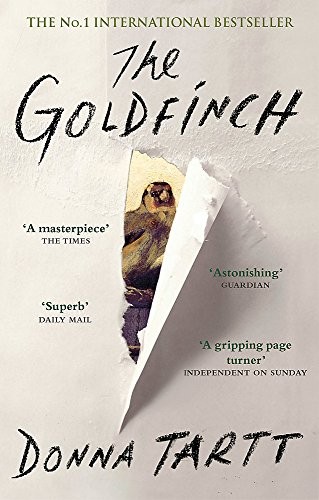
The Goldfinch
by Donna Tartt
★ Top 10 book of 2013 · #6 on Best Books of 2013
Thirteen-year-old Theo Decker survives an accident that kills his mother and clings to a small, captivating painting that reminds him of her. As an adult he is drawn into the art underworld, where danger closes in around him.
Best for: Readers who like long, immersive literary novels with suspense, art, and emotional depth
The Goldfinch is #6 on BookWard's Best Books of 2013, out of 46 2013 books that cleared our data bar.
What The Goldfinch is about
Thirteen-year-old Theo Decker is at the Metropolitan Museum of Art with his mother, looking at Dutch masterpieces, when a bomb goes off. Theo survives, but his mother does not. In the confusion he leaves with a small, precious painting, Carel Fabritius's The Goldfinch, and a ring pressed on him by a dying stranger.
Told by Theo looking back, the novel follows him as he is taken in by a wealthy Park Avenue family, then dragged west to Las Vegas by his unreliable father. Along the way he forms bonds with people who matter to him, among them Hobie, Pippa, and the volatile Boris. Years later, grown up and carrying his troubles with him, he finds the past is not finished with him. Grief, guilt, addiction, and the pull of beautiful things run through this melancholy, immersive story.
The Goldfinch on the Best Books of 2013
The Goldfinch came out in 2013. Of the 46 books first published in 2013 that met BookWard's data bar, it ranks #6 on our Best Books of 2013 list.
Why it made the list: 889 readers have shelved it on Open Library; readers rate it 4 out of 5 (74 ratings); 47 are reading it right now. The list ranks each year’s books on how many readers have picked them up, how highly readers rate them, and how many are reading them right now.
Nearby on the 2013 list
- The Screaming Staircase Jonathan Stroud, #4
- Unravel Me Tahereh Mafi, #5
- Hopeless Colleen Hoover, #7
- Losing Hope Colleen Hoover, #8
See all Best Books of 2013 Best books by year
More years: Best Books of 2012 Best Books of 2014.
The numbers behind it
- Readers: 744 want to read it, 47 are reading it now and 98 have read it, according to Open Library.
- Ratings: 4 out of 5 from 74 Open Library ratings.
| Signal | This book (0 to 100) | Weight |
|---|---|---|
| Reach | 91 | 55% |
| Reader love | 43 | 25% |
| Being read right now | 89 | 20% |
Questions about The Goldfinch
When was The Goldfinch published?
The Goldfinch by Donna Tartt was first published in 2013.
Was The Goldfinch one of the best books of 2013?
The Goldfinch is #6 on BookWard's Best Books of 2013, out of 46 2013 books that cleared our data bar. 889 readers have shelved it on Open Library; readers rate it 4 out of 5 (74 ratings); 47 are reading it right now.
Why is The Goldfinch on the Best Books of 2013 list?
889 readers have shelved it on Open Library; readers rate it 4 out of 5 (74 ratings); 47 are reading it right now.
More of the best books of 2013
- House of Hades Rick Riordan, #1
- Hard Luck Jeff Kinney, #2
- Crown of Midnight Sarah J. Maas, #3
- The Screaming Staircase Jonathan Stroud, #4
- Unravel Me Tahereh Mafi, #5
- Hopeless Colleen Hoover, #7
See the full Best Books of 2013, the Top 100, or new books on Rising.
How we know
This page uses public data: Open Library reader counts and ratings, and Wikipedia page views for recent years. The description is paraphrased from real source text. Rankings reflect reading interest, not quality or sales, and can be affected by data gaps. Lists update monthly.
Best suited to mature teens and adults who can handle a long, dark story.
Depends on the edition you pick.
A huge, immersive novel about grief, a stolen painting, and consequences. 55% taste match
 BookWard’s take
A huge, immersive novel about grief, a stolen painting, and consequences
The Goldfinch opens with a bomb in a museum and never really lets go of that catastrophe. Its hook is immediate: Theo Decker, thirteen, loses his mother and leaves with a small Dutch painting. For BookWard, the opening and the voice are the draw, since Tartt's narration is unmistakably her own. The cost is length, and this book is about as far from tight as a novel gets, with the pace swinging between propulsive stretches and long, brooding ones. Character depth is the real reward: Theo, his makeshift families, and his friends are drawn with patience and detail. If you value a Tight length and a fast, spare pace, this will test you. If you want a big, absorbing story that earns its darkness, it delivers.
It runs to a very long, sprawling page count, the opposite of BookWard's love of tight, short books.
Tense set pieces alternate with slow, immersive stretches, so it moves slower than BookWard's taste for speed.
The mix of art-world underworld, grief, and picaresque wandering feels fresh, even where individual beats are familiar.
Lush, detailed sentences lean toward the ornate, richer than BookWard's slightly plainer taste.
Theo's inner life and relationships carry the book more than the plot machinery does.
Loss, addiction, and guilt weigh heavily, though the book allows some light, so it leans bleak.
A retrospective first-person account told in sequence keeps the structure conventional.
Moments of dark wit appear, but the overall tone is serious.
Death, addiction, neglect, and crime give it a heavy, shadowed tone.
Grief and yearning run through the book with real intensity.
See all 50 dialsEvery position, side by side with this book
Where it lines up
- Authorial voiceBookWard 9 · book 9
- OpeningBookWard 10 · book 9
- Character depthBookWard 8 · book 9
Where it pulls apart
- LengthBookWard 1 · book 10
- Familiar tropesBookWard 10 · book 6
- Internal logicBookWard 10 · book 6
It runs to a very long, sprawling page count, the opposite of BookWard's love of tight, short books.
A museum bombing in the opening chapters grabs attention at once, which BookWard rewards.
The orphan-and-stolen-art setup is familiar ground, though Tartt's execution lifts it above standard thriller or coming-of-age tropes.
Events follow from Theo's choices, though some coincidences stretch belief, short of the airtight plotting BookWard prefers.
Tense set pieces alternate with slow, immersive stretches, so it moves slower than BookWard's taste for speed.
The mix of art-world underworld, grief, and picaresque wandering feels fresh, even where individual beats are familiar.
Theo and the people around him are drawn with rich, patient detail, squarely what BookWard values.
The story reaches a resolution but closes on reflection rather than neat answers, slightly looser than BookWard prefers.
Grief and longing are felt deeply, and the book occasionally leans toward the sentimental over the restrained.
The bombing and later turns are dark but rooted in character and consequence rather than shock for its own sake.
Not applicable: this is a novel, not nonfiction.
Tartt's retrospective narration is unmistakable and confident, a clear match for BookWard's love of distinctive voice.
Story drives the book, though art, fate, and meaning run through it as ideas.
Much is shown in scene, though Theo's reflective narration does explain and philosophize at length.
The middle stretches can feel long and indulgent, short of the sustained drive BookWard likes.
Lush, detailed sentences lean toward the ornate, richer than BookWard's slightly plainer taste.
Theo's inner life and relationships carry the book more than the plot machinery does.
Loss, addiction, and guilt weigh heavily, though the book allows some light, so it leans bleak.
A retrospective first-person account told in sequence keeps the structure conventional.
Moments of dark wit appear, but the overall tone is serious.
Its length and dense, reflective passages ask for steady commitment without being difficult to follow.
Everything is filtered through Theo alone, so the viewpoint is single.
The story moves forward in time with the narrator looking back, rather than jumping around.
Entirely grounded in real places and ordinary, if extreme, human events.
A sizable cast of friends, guardians, dealers, and drifters surrounds Theo across several cities.
Spanning years and cities, it is ambitious, though its heart stays one boy's story.
Theo's thoughts, guilt, and longing take center stage over external action.
Conversation carries many key scenes, especially among the boys, with a fair share of narration too.
Longing and attachment matter, but romance is one thread among several.
New York, Las Vegas, and the antiques trade offer a mix of the familiar and the unfamiliar.
It is set in a recent, contemporary-feeling America, not the distant past.
Its themes of grief, art, and survival give it staying power beyond its moment.
Theo is candid but self-justifying, so his account is mostly reliable with some blind spots.
Theo's choices are often wrong and the book refuses to resolve them into clean judgments.
Rooms, light, cities, and objects are rendered in rich, lavish detail.
A standalone novel.
Revelations arrive steadily, though the book is not built around twists.
It asks readers to sit with grief and moral discomfort rather than offering comfort.
Death, addiction, neglect, and crime give it a heavy, shadowed tone.
Grief and yearning run through the book with real intensity.
What humor exists is dry and wry, tucked into Theo's observations.
There are explosive and criminal episodes, but violence is not constant.
Sexual content is present but minor and not explicit.
Politics stays in the background, with art and personal fate far more central.
The language is literate and rich, with a few foreign and slang flourishes, but readable.
Theo's narration is full of personal views and reflection, making it opinionated.
Theo is haunted by the past and looks back far more than forward.
A faith in beauty and art holds against a largely cynical view of people.
Review written by BookWard, dial version 1, November 2026.
Who is The Goldfinch right for?
Best suited to mature teens and adults who can handle a long, dark story. It deals with the death of a parent, drug and alcohol use by teenagers, neglect, and crime.
Its length and dense, reflective passages ask for steady commitment without being difficult to follow.
Death, addiction, neglect, and crime give it a heavy, shadowed tone.
Grief and yearning run through the book with real intensity.
There are explosive and criminal episodes, but violence is not constant.
Book CompanionThe Goldfinch: ideas, characters, themes
A boy who loses his mother in a museum bombing carries a stolen painting and the weight of that day through his entire life.
- The opening catastrophe. A bombing at the Metropolitan Museum of Art kills Theo's mother and changes everything for him at thirteen.
- The painting. Theo leaves with Carel Fabritius's The Goldfinch, a work his mother loved, and it becomes his secret.
- A series of homes. He moves from a wealthy Park Avenue family to Las Vegas with his father and his father's girlfriend.
- Friendship with Boris. In Las Vegas he forms an intense bond with Boris, a similarly neglected boy.
- Looking back. Theo tells his story in retrospective first person, shaping how we see his choices.
Characters
Theo Decker
Narrator and protagonist
A thirteen-year-old who survives the museum bombing and takes The Goldfinch.
Boris Pavlikovsky
Friend
The cosmopolitan, neglected son of a Ukrainian émigré who becomes Theo's close companion in Las Vegas.
Hobie
Antiques partner
James Hobart, the old man's business partner, who befriends Theo after the ring is returned.
Pippa
Red-haired girl
The girl Theo notices at the museum, who lived with Welty and Hobie.
Andy Barbour
School friend
The friend whose wealthy family takes Theo in on Park Avenue.
Themes
How loss of a parent shapes a life long after the event.
Whether a work of art can hold meaning and consolation.
The burden of what Theo hides and how it grows.
The makeshift households that replace the one Theo lost.
How much of a life is chance and how much is decision.
Discussion questions
- Why does Theo keep the painting, and what does it come to mean to him?
- How reliable is Theo as a narrator of his own life?
- What do the different homes Theo lives in say about family?
- Is Theo's friendship with Boris a help or a harm to him?
- Does the book want us to forgive Theo, and do you?
Personalize your Book Companion
This is the general edition. In BookWard, the Companion is written for you: your reading profile, your notes, and spoiler-safe to the page you are on.
Buy, listen or borrow The Goldfinch
Each link opens a search for this book on that store, in a new tab.
Read on a device
Borrow
Reviews and community
If you liked The Goldfinch
A Gothic classic where a dead woman outshines the living
The HunterTana FrenchA slow-burning Irish thriller about a retired cop and a girl's revenge
The Secret HistoryDonna TarttA murder told up front, and why it still grips
Different SeasonsStephen KingFour King novellas, one for each season, with horror held back
Find your own best books
Add what you have read, rate it, and BookWard will recommend what to read next.
Free to start. No credit card needed.