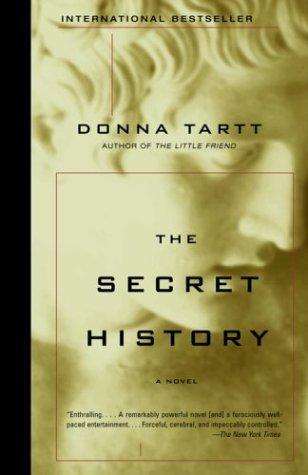
The Secret History
by Donna Tartt
★ Top 5 book of 1992 · #2 on Best Books of 1992
A circle of clever, eccentric students at an elite New England college falls under the spell of their charismatic classics professor. Crossing the lines of ordinary morality, they drift from obsession into corruption, betrayal, and evil.
Best for: Readers who like dark campus stories about obsession, moral decline, and betrayal
The Secret History is #2 on BookWard's Best Books of 1992, out of 43 1992 books that cleared our data bar.
What The Secret History is about
Richard Papen leaves his ordinary life in California for Hampden College, a small elite school in Vermont, where he is accepted into the classes of the charismatic Professor Julian Morrow. There he is drawn into a tight circle of five other students: the twins Charles and Camilla, Francis, Henry and Edmund, known as Bunny. They are brilliant, aloof and a little strange, and Richard wants badly to belong to them.
He tells the story years afterward, and from the start we know that something terrible happened. The question is how a group of cultured young people let their devotion to beauty and to each other lead them somewhere so dark. Readers who enjoy atmospheric, bookish suspense about obsession, guilt and betrayal will feel at home.
The Secret History on the Best Books of 1992
The Secret History came out in 1992. Of the 43 books first published in 1992 that met BookWard's data bar, it ranks #2 on our Best Books of 1992 list.
Why it made the list: 2,040 readers have shelved it on Open Library; readers rate it 4 out of 5 (90 ratings); 92 are reading it right now. The list ranks each year’s books on how many readers have picked them up, how highly readers rate them, and how many are reading them right now.
It earns Being read right now.
Nearby on the 1992 list
- Welcome to Dead House Robert Lawrence Stine, #1
- Snow Crash Neal Stephenson, #3
- The Indispensable Calvin and Hobbes Bill Watterson, #4
See all Best Books of 1992 Best books by year
More years: Best Books of 1991 Best Books of 1993.
The numbers behind it
- Readers: 1,795 want to read it, 92 are reading it now and 153 have read it, according to Open Library.
- Ratings: 4 out of 5 from 90 Open Library ratings.
| Signal | This book (0 to 100) | Weight |
|---|---|---|
| Reach | 100 | 55% |
| Reader love | 70 | 25% |
| Being read right now | 100 | 20% |
Questions about The Secret History
When was The Secret History published?
The Secret History by Donna Tartt was first published in 1992.
Was The Secret History one of the best books of 1992?
The Secret History is #2 on BookWard's Best Books of 1992, out of 43 1992 books that cleared our data bar. 2,040 readers have shelved it on Open Library; readers rate it 4 out of 5 (90 ratings); 92 are reading it right now.
Why is The Secret History on the Best Books of 1992 list?
2,040 readers have shelved it on Open Library; readers rate it 4 out of 5 (90 ratings); 92 are reading it right now.
More of the best books of 1992
- Welcome to Dead House Robert Lawrence Stine, #1
- Snow Crash Neal Stephenson, #3
- The Indispensable Calvin and Hobbes Bill Watterson, #4
- The Shadow Rising Robert Jordan, #5
- The Artist's Way Julia Cameron, #6
- Small Gods Terry Pratchett, #7
See the full Best Books of 1992, the Top 100, or new books on Rising.
How we know
This page uses public data: Open Library reader counts and ratings, and Wikipedia page views for recent years. The description is paraphrased from real source text. Rankings reflect reading interest, not quality or sales, and can be affected by data gaps. Lists update monthly.
Best suited to mature teens and adults who can handle themes of murder, guilt and moral corruption.
Depends on the edition you pick.
A murder told up front, and why it still grips. 64% taste match
 BookWard’s take
A murder told up front, and why it still grips
Donna Tartt's debut tells you early that a group of Classics students killed their friend, then spends the whole book making you understand how. That inverted structure keeps the opening gripping, and the internal logic is tight, with each step of the group's slide feeling earned. The real reward is character: Richard Papen narrates a closed circle of brilliant, damaged people, and Tartt's voice is unmistakable. The book's originality and its capacity to shock suit my own taste, because the darkness comes from the people rather than from spectacle. It is long and rich in description, and that is where this book and I part ways. Settle in for the ending, which resolves what the opening promises.
A substantial novel that takes its time with a small circle; BookWard prefers tighter books, so this is a deliberate mismatch.
The build is deliberate and atmospheric rather than brisk, though the dread keeps it moving.
An inverted detective story set among Classics students, credited with launching the dark academia sub-genre.
Literate, layered and a little ornate, in step with a book steeped in Greek and Latin.
The plot runs on character: the murder grows out of who these people are and what they want.
The story bends steadily toward guilt and ruin, with little light offered.
Told in retrospect with the key event revealed first, but otherwise a conventional, linear telling.
Wry touches appear, yet the mood is serious and ominous.
Murder, guilt and corrosive group dynamics define the tone.
Controlled but tense, with dread and grief building under the surface.
See all 50 dialsEvery position, side by side with this book
Where it lines up
- EndingBookWard 8 · book 8
- SentimentBookWard 8 · book 8
- Authorial voiceBookWard 9 · book 9
Where it pulls apart
- LengthBookWard 1 · book 8
- Familiar tropesBookWard 10 · book 7
- Internal logicBookWard 10 · book 8
A substantial novel that takes its time with a small circle; BookWard prefers tighter books, so this is a deliberate mismatch.
The murder is announced up front and the story works backward through how it happened, which pulls you in at once.
The campus setting is familiar, but the inverted detective shape and the group's moral decay feel fresh.
Events follow from the group's choices and pressures in order, so the slide into disaster feels earned.
The build is deliberate and atmospheric rather than brisk, though the dread keeps it moving.
An inverted detective story set among Classics students, credited with launching the dark academia sub-genre.
Narrator Richard Papen and his five circle-mates are drawn with rich, uncomfortable specificity.
Because the crime is revealed from the start, the book resolves its central question and its fallout with clarity.
The tone is cool and watchful; feeling is held back and never milked.
The darkness comes from the choices these characters make, not from effects added for impact.
A novel, so this dial does not apply.
Richard's retrospective narration, learned and haunted, is unmistakably Tartt's own.
Ideas about beauty and morality matter, but the plot and its people lead.
Much is shown through scenes and dialogue, though the narrator often reflects aloud on what it all meant.
The long middle stays tense because the group's pressures keep tightening.
Literate, layered and a little ornate, in step with a book steeped in Greek and Latin.
The plot runs on character: the murder grows out of who these people are and what they want.
The story bends steadily toward guilt and ruin, with little light offered.
Told in retrospect with the key event revealed first, but otherwise a conventional, linear telling.
Wry touches appear, yet the mood is serious and ominous.
Classical references and a measured pace ask for attention without being hard to follow.
Everything is filtered through one narrator, Richard.
Told in retrospect with the central event flagged early, but the telling itself runs in order.
Firmly grounded in a real-feeling Vermont college, even as the group chases ancient ecstasy.
The core is six students and their professor, a tight circle with few extras.
Intimate: a closed group on a small campus and the consequences that follow.
Most of the weight sits in Richard's perceptions, motives and guilt.
Long, charged conversations among the students carry a lot of the book.
Attachments and longing run through it, but love is not the engine.
A rarefied Classics circle at an elite college will be unfamiliar to most readers.
Set in the mid-1980s and published in 1992, so it reads as a period piece.
Its influence on later campus fiction suggests it has outlasted its moment.
Richard is candid about the crime but shapes the story to his own sympathies.
The book refuses easy verdicts, leaving you to weigh guilt, loyalty and glamour.
Rich, atmospheric detail of campus, countryside and rooms steeped in books.
A standalone novel.
The big reveal is given away early, so the surprises lie in how and why.
A morally unsettling read that asks you to sympathize with people who do terrible things.
Murder, guilt and corrosive group dynamics define the tone.
Controlled but tense, with dread and grief building under the surface.
Any humor is dry and observational.
A killing sits at the center, but the book dwells on aftermath more than gore.
Desire and entanglement appear without being the focus.
The concern is private morality and class, not public affairs.
Scholarly allusions and Greek and Latin touches add density without making sentences hard to follow.
Richard's reflective voice colors everything with his own judgments.
Narrated years later, the book looks back at what happened.
A romantic dream of beauty curdles into something far darker and more cynical.
Review written by BookWard, dial version 1, November 2026.
Who is The Secret History right for?
Best suited to mature teens and adults who can handle themes of murder, guilt and moral corruption. It includes substance use and adult relationships, and its tone is dark and morally unsettling.
Classical references and a measured pace ask for attention without being hard to follow.
Murder, guilt and corrosive group dynamics define the tone.
Controlled but tense, with dread and grief building under the surface.
A killing sits at the center, but the book dwells on aftermath more than gore.
Book CompanionThe Secret History: ideas, characters, themes
A close circle of Classics students, drawn by a charismatic professor's ideals, slides from obsession into a killing, and the book traces how a love of beauty can excuse real harm.
- A crime told first. The murder of Bunny Corcoran is announced up front, so the question driving the book is why and how, not who.
- An outsider's entry. Richard Papen arrives at Hampden College from California and is slowly admitted into the professor's hand-picked circle.
- The professor's grip. Julian Morrow limits who can study with him and holds sole control over his students' academic lives.
- A group with secrets. Small oddities in the others' behavior hint that they share something Richard has not been told.
- Pressure from within. Bunny's relationship with the group sours, and tension builds as the bonds that held them together begin to strain.
Characters
Richard Papen
Narrator
A newcomer from Plano, California who joins the Classics circle and looks back on what followed.
Julian Morrow
Professor
The Classics and Greek teacher whose hand-picked students are fiercely devoted to him.
Henry Winter
Student
One of the inner circle, central to both the group's friendships and its rifts.
Edmund "Bunny" Corcoran
Student
A member of the group whose friction with the others sets the story's central tragedy in motion.
Charles and Camilla Macaulay
Twin students
A pair of siblings in the tight Classics circle.
Themes
The pursuit of something exalted can excuse, and even disguise, real wrongdoing.
The wish to be accepted drives Richard's choices more than he admits.
The lasting weight of what the group did shapes everyone's lives afterward.
A closed, privileged circle sets its own rules and answers to no one.
Bonds of friendship are tested when self-protection collides with devotion.
Discussion questions
- Why does Tartt reveal the murder at the start, and what does that change about how you read?
- How much does Richard's status as an outsider shape what he is willing to accept?
- What makes Julian Morrow's influence so powerful, and who bears responsibility for it?
- Did you sympathize with any of the group, and did that feel uncomfortable?
- Is the book's glamorous view of its characters an endorsement or a trap?
Personalize your Book Companion
This is the general edition. In BookWard, the Companion is written for you: your reading profile, your notes, and spoiler-safe to the page you are on.
Buy, listen or borrow The Secret History
Each link opens a search for this book on that store, in a new tab.
Read on a device
Borrow
Reviews and community
If you liked The Secret History
A journalist goes home to Wind Gap and her own wounds
RebeccaDaphne du MaurierA Gothic classic where a dead woman outshines the living
Alias GraceMargaret AtwoodA murder case retold through a woman who may not remember
Different SeasonsStephen KingFour King novellas, one for each season, with horror held back
Find your own best books
Add what you have read, rate it, and BookWard will recommend what to read next.
Free to start. No credit card needed.