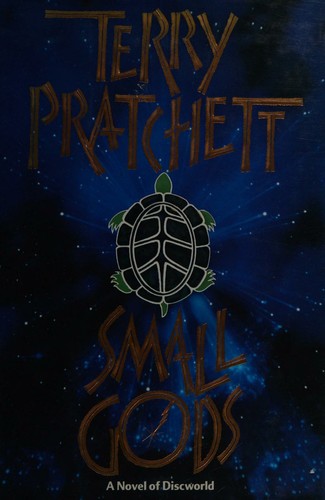
Small Gods
by Terry Pratchett
★ Top 10 book of 1992 · #7 on Best Books of 1992
Brutha, a humble novice, discovers he is the Chosen One, though all he really hopes for is peace, justice and kindness. The Inquisition's habit of tormenting him is a rather unwelcome complication.
Best for: Readers who like comic fantasy with a satirical edge on religion
Small Gods is #7 on BookWard's Best Books of 1992, out of 43 1992 books that cleared our data bar.
What Small Gods is about
Brutha is a novice in the church of Omnia, a young man with a perfect memory who can't read and has never needed to think for himself. Then the great god Om speaks to him, and only him. Om, who meant to appear in glory, has landed in the body of a tortoise, with little left of his power beyond the ability to singe an eyebrow with a tiny thunderbolt.
When the church's feared inquisitor, Vorbis, takes Brutha along on a diplomatic mission to Ephebe, the novice meets philosophers who ask questions he has never been allowed to ask. Om, meanwhile, discovers that Brutha may be his only true believer. Pratchett's thirteenth Discworld novel looks at faith, dogma, and the use of religion as a tool of power, with plenty of wit and a good deal of warmth for the people caught in the middle.
Small Gods on the Best Books of 1992
Small Gods came out in 1992. Of the 43 books first published in 1992 that met BookWard's data bar, it ranks #7 on our Best Books of 1992 list.
Why it made the list: 326 readers have shelved it on Open Library; readers rate it 4.3 out of 5 (75 ratings). The list ranks each year’s books on how many readers have picked them up, how highly readers rate them, and how many are reading them right now.
It earns Reader favorite.
Nearby on the 1992 list
- The Shadow Rising Robert Jordan, #5
- The Artist's Way Julia Cameron, #6
- Your Money or Your Life Vicki Robin, #8
- Gerald's Game Stephen King, #9
See all Best Books of 1992 Best books by year
More years: Best Books of 1991 Best Books of 1993.
The numbers behind it
- Readers: 197 want to read it, 7 are reading it now and 122 have read it, according to Open Library.
- Ratings: 4.3 out of 5 from 75 Open Library ratings.
| Signal | This book (0 to 100) | Weight |
|---|---|---|
| Reach | 81 | 55% |
| Reader love | 95 | 25% |
| Being read right now | 30 | 20% |
Questions about Small Gods
When was Small Gods published?
Small Gods by Terry Pratchett was first published in 1992.
Was Small Gods one of the best books of 1992?
Small Gods is #7 on BookWard's Best Books of 1992, out of 43 1992 books that cleared our data bar. 326 readers have shelved it on Open Library; readers rate it 4.3 out of 5 (75 ratings).
Why is Small Gods on the Best Books of 1992 list?
326 readers have shelved it on Open Library; readers rate it 4.3 out of 5 (75 ratings).
More of the best books of 1992
- Welcome to Dead House Robert Lawrence Stine, #1
- The Secret History Donna Tartt, #2
- Snow Crash Neal Stephenson, #3
- The Indispensable Calvin and Hobbes Bill Watterson, #4
- The Shadow Rising Robert Jordan, #5
- The Artist's Way Julia Cameron, #6
See the full Best Books of 1992, the Top 100, or new books on Rising.
How we know
This page uses public data: Open Library reader counts and ratings, and Wikipedia page views for recent years. The description is paraphrased from real source text. Rankings reflect reading interest, not quality or sales, and can be affected by data gaps. Lists update monthly.
Suits adult and older teen readers who enjoy satire and fantasy.
Depends on the edition you pick.
A tortoise god, one true believer, and a very funny argument about faith. 69% taste match
 BookWard’s take
A tortoise god, one true believer, and a very funny argument about faith
Small Gods puts a fallen god inside a tortoise's body, beside the only man who actually believes in him, and lets the comedy do serious work. The satire of religious institutions feels fresh because it is built from the inside, with real affection for the believer. The internal logic is tight, too: the rules of belief and divine power are followed rigorously even at their silliest. The hook is immediate, with the tortoise problem arriving almost at once. It is more driven by its central idea than most novels, and the exposition sometimes explains outright where I would rather it showed. Still, the voice is unmistakable, and the tone stays funny while the subject stays heavy.
A mid-sized novel that moves briskly for its ambitions; shorter than BookWard's ideal, but it rarely feels padded.
Scenes move quickly and the satire keeps momentum, though it pauses for philosophy more than BookWard's fastest reads.
A comic fantasy about gods who depend on belief to survive is a distinctive angle, well matched to BookWard's appetite for the new.
Clean, witty, and unshowy; the style serves the joke rather than ornament, a touch plainer than BookWard's middle.
Brutha's inner change drives much of the book, balanced against a plot of war and conspiracy.
Despite cruelty and dogma, it ends on faith in people and in thinking for yourself, matching BookWard's hopeful lean.
A conventional linear quest told straight, more traditional than BookWard's slight appetite for formal play.
Dense with jokes, puns and absurd situations, funnier than BookWard's already comedy-friendly baseline.
Torture, war and dogma give it real shadows, balanced by comedy so it never turns grim.
Brutha's loyalty and Om's change carry real feeling under the comedy, about as intense as BookWard expects.
See all 50 dialsEvery position, side by side with this book
Where it lines up
- OriginalityBookWard 9 · book 9
- EndingBookWard 8 · book 8
- OpeningBookWard 10 · book 9
Where it pulls apart
- LengthBookWard 1 · book 4
- Story or ideasBookWard 3 · book 7
- ExpositionBookWard 2 · book 6
A mid-sized novel that moves briskly for its ambitions; shorter than BookWard's ideal, but it rarely feels padded.
A god stuck in a tortoise's body, talking to the one boy who can hear him, grabs attention immediately, as BookWard likes.
It plays with religious and fantasy conventions to subvert them, avoiding the usual tropes in a way BookWard rewards.
The rules of belief and divine power are applied consistently, even in jokes, which suits BookWard's taste for airtight worlds.
Scenes move quickly and the satire keeps momentum, though it pauses for philosophy more than BookWard's fastest reads.
A comic fantasy about gods who depend on belief to survive is a distinctive angle, well matched to BookWard's appetite for the new.
Brutha's slow awakening is convincingly drawn, though some supporting figures serve the satire more than they deepen.
The central arc resolves with real closure, in line with BookWard's preference for endings that land.
Warmth sits beside the jokes without tipping into syrup; slightly more tender than BookWard's restrained ideal.
The darker moments, including the Quisition's cruelty, serve the argument rather than exist for effect.
Pratchett's dry, digressive, footnoted narration is instantly recognizable and a major draw for BookWard.
It is a story-driven novel carrying a strong argument about faith, leaning further toward ideas than BookWard usually does.
Philosophical points are sometimes stated outright by characters, somewhat more explained than BookWard's show-it-in-scene preference.
The journey keeps its energy through varied episodes, holding up better than most comic fantasy of this length.
Clean, witty, and unshowy; the style serves the joke rather than ornament, a touch plainer than BookWard's middle.
Brutha's inner change drives much of the book, balanced against a plot of war and conspiracy.
Despite cruelty and dogma, it ends on faith in people and in thinking for yourself, matching BookWard's hopeful lean.
A conventional linear quest told straight, more traditional than BookWard's slight appetite for formal play.
Dense with jokes, puns and absurd situations, funnier than BookWard's already comedy-friendly baseline.
Easy to read on the surface, with some philosophical ideas that reward attention; lighter than BookWard's middle.
It moves between Brutha, Om, Vorbis and others, giving a moderate spread of perspectives close to BookWard's taste.
Events unfold in order without flashback tricks, sitting at the linear end where BookWard is slightly more flexible.
A flat world carried by a turtle, living gods and talking tortoises put it firmly in fantasy, above BookWard's balance.
A good number of named characters across Omnia and Ephebe, comfortably above a small cast, near BookWard's range.
The stakes cover religion, war and belief across nations, though the focus stays on a few people.
Brutha's doubts and Om's confusion share space with marches, escapes and political maneuvering.
Much of the wit lives in exchanges, especially between Om and Brutha, making it dialogue-forward like BookWard's lean.
Romance plays no role; the relationships that matter are faith, friendship and conflict.
Discworld is invented, but its recognizable human institutions make it approachable, slightly unfamiliar in the right way.
Set in an invented, vaguely ancient world, far from the present day despite its modern concerns.
Its themes of faith, power and doubt feel as current now as in 1992, matching BookWard's liking for lasting books.
A clear, authoritative narrator guides us honestly through events, leaving trust in the telling intact.
Right and wrong are drawn fairly clearly around cruelty and dogma, with more nuance in the treatment of belief itself.
Setting is sketched efficiently with jokes rather than long passages, leaner than BookWard's middle.
Part of Discworld but readable on its own, so it sits toward standalone while belonging to a larger run.
The plot has reversals and revelations without being built around shocks; roughly on par with BookWard's taste.
It challenges ideas about faith and authority while remaining enjoyable, leaning a little challenging overall.
Torture, war and dogma give it real shadows, balanced by comedy so it never turns grim.
Brutha's loyalty and Om's change carry real feeling under the comedy, about as intense as BookWard expects.
The humor is mostly dry, wry and understated, tilting toward BookWard's drier preference.
Executions and war appear in the story, but are handled with restraint and rarely lingered over.
Sexual content is essentially absent; the focus is on ideas and relationships of faith.
Religion, institutional power and war are central to the plot, placing politics in the foreground.
The language is plain with a few invented terms and mock-ancient names, easier than BookWard's middle.
The narrator clearly holds views on dogma and belief and delivers them with wit and force.
It looks at how old ideas shape the present while hoping for change ahead, close to BookWard's middle.
A faith in individual conscience and honest thinking runs through it, a little more idealistic than cynical.
Review written by BookWard, dial version 1, November 2026.
Who is Small Gods right for?
Suits adult and older teen readers who enjoy satire and fantasy. It includes torture, war and religious criticism, which some readers may find sensitive.
Easy to read on the surface, with some philosophical ideas that reward attention; lighter than BookWard's middle.
Torture, war and dogma give it real shadows, balanced by comedy so it never turns grim.
Brutha's loyalty and Om's change carry real feeling under the comedy, about as intense as BookWard expects.
Executions and war appear in the story, but are handled with restraint and rarely lingered over.
Book CompanionSmall Gods: ideas, characters, themes
A god reduced to a tortoise must rely on the one man who truly believes in him, and learns that belief shapes both gods and people.
- A god in disguise. Om manifests as a tortoise with almost no power, a setup that drives both the comedy and the story.
- The only true believer. Brutha is the one person who genuinely believes in Om, while most others follow out of fear or habit.
- Vorbis and the Quisition. The Quisition, led by Vorbis, uses fear and cruelty to enforce the church's version of belief.
- Ephebe and philosophy. In Ephebe, Brutha meets philosophers and the unfamiliar idea of entertaining ideas you are not certain of.
- A dispute about the world's shape. Didactylos writes a work that contradicts Omnian dogma about the shape of the Discworld, bringing him into conflict with the church.
Characters
Om
The god stuck in a tortoise
A once-mighty deity reduced to a tortoise with almost no power, forced to reckon with what belief really means.
Brutha
The novice and prophet
A gentle, illiterate novice with an eidetic memory and one genuine belief; his thinking begins to grow beyond what he was taught.
Vorbis
Head of the Quisition
A feared leader of the church's enforcers who brings Brutha along as his secretary on a diplomatic mission.
Didactylos
Ephebian philosopher
A philosopher whose book on the turtle's movement challenges Omnian doctrine.
Urn
Didactylos's nephew
A young Ephebian who works alongside his uncle among the philosophers.
Themes
How a god's strength depends on the people who truly believe in him.
How institutions can drift from the faith they claim to serve.
The value of questioning ideas rather than accepting them out of habit or fear.
The difference between obedience driven by threat and genuine conviction.
How questions and uncertainty can be a strength rather than a weakness.
Discussion questions
- Why does Om's power depend on belief, and what does that say about how gods and ideas survive?
- Is Brutha's simplicity a weakness, a strength, or both?
- How does the book separate faith from the institution that claims to speak for it?
- What does Ephebe's culture of argument offer that Omnia's doesn't?
- Does the humor make the book's criticism of religion easier or harder to take seriously?
Personalize your Book Companion
This is the general edition. In BookWard, the Companion is written for you: your reading profile, your notes, and spoiler-safe to the page you are on.
Buy, listen or borrow Small Gods
Each link opens a search for this book on that store, in a new tab.
Read on a device
Borrow
Reviews and community
If you liked Small Gods
Death plays Father Christmas, and belief itself is at stake
Wyrd SistersTerry PratchettPratchett's Macbeth-flavored Discworld comedy, sharp and quick, with three unforgettable witches
Feet of ClayTerry PratchettPratchett's Watch novel pairs a golem murder with a poisoned Patrician
Witches AbroadTerry PratchettThree witches, one wand, and a fairy tale with teeth
Find your own best books
Add what you have read, rate it, and BookWard will recommend what to read next.
Free to start. No credit card needed.