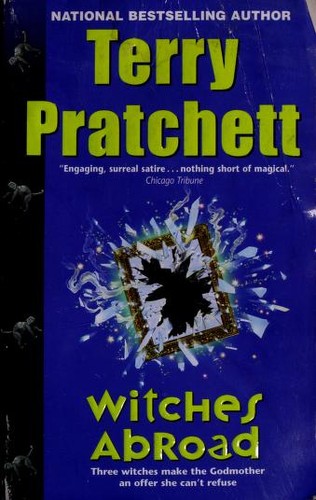
Witches Abroad
by Terry Pratchett
★ Top 10 book of 1991 · #8 on Best Books of 1991
When a well-meaning but disorganised fairy godmother dies, three witches travel by broomstick to Genua to stop a servant girl from marrying a prince. They face assorted monsters en route, then must outsmart a rival godmother obsessed with a perfect ending.
Best for: Readers who enjoy comic fantasy that playfully twists classic fairy tales
Witches Abroad is #8 on BookWard's Best Books of 1991, out of 23 1991 books that cleared our data bar.
What Witches Abroad is about
When the witch Desiderata Hollow dies, her magic wand passes to Magrat Garlick, who also inherits a job as fairy godmother to a young woman named Emberella. Desiderata left no instructions, and almost everything Magrat points the wand at turns into a pumpkin. Magrat, Granny Weatherwax, and Nanny Ogg set off for the city of Genua to stop Emberella from marrying the Duc, who is secretly a frog changed by magic.
Standing in their way is Emberella's other fairy godmother, Lady Lilith de Tempscire, who wants a happy ending and uses the Discworld's story-driven nature to push events toward a Cinderella tale. The road brings a village troubled by a vampire, a charging-bulls festival, and a falling house, before the witches reach Genua and meet the voodoo witch Erzulie Gogol. The twelfth Discworld novel is a comic, witty send-up of fairy tales, with sharp things to say about who gets to decide how a story ends.
Witches Abroad on the Best Books of 1991
Witches Abroad came out in 1991. Of the 23 books first published in 1991 that met BookWard's data bar, it ranks #8 on our Best Books of 1991 list.
Why it made the list: 206 readers have shelved it on Open Library; readers rate it 4.1 out of 5 (54 ratings). The list ranks each year’s books on how many readers have picked them up, how highly readers rate them, and how many are reading them right now.
Nearby on the 1991 list
- Reaper Man Terry Pratchett, #6
- Chrysanthemum Kevin Henkes, #7
- Xenocide Orson Scott Card, #9
- On Directing Film David Mamet, #10
See all Best Books of 1991 Best books by year
More years: Best Books of 1990 Best Books of 1992.
The numbers behind it
- Readers: 104 want to read it, 3 are reading it now and 99 have read it, according to Open Library.
- Ratings: 4.1 out of 5 from 54 Open Library ratings.
| Signal | This book (0 to 100) | Weight |
|---|---|---|
| Reach | 52 | 55% |
| Reader love | 74 | 25% |
| Being read right now | 22 | 20% |
Questions about Witches Abroad
When was Witches Abroad published?
Witches Abroad by Terry Pratchett was first published in 1991.
Was Witches Abroad one of the best books of 1991?
Witches Abroad is #8 on BookWard's Best Books of 1991, out of 23 1991 books that cleared our data bar. 206 readers have shelved it on Open Library; readers rate it 4.1 out of 5 (54 ratings).
Why is Witches Abroad on the Best Books of 1991 list?
206 readers have shelved it on Open Library; readers rate it 4.1 out of 5 (54 ratings).
More of the best books of 1991
- Outlander Diana Gabaldon, #1
- Needful Things Stephen King, #2
- American Psycho Bret Easton Ellis, #3
- Shiloh Phyllis Reynolds Naylor, #4
- The Firm John Grisham, #5
- Reaper Man Terry Pratchett, #6
See the full Best Books of 1991, the Top 100, or new books on Rising.
How we know
This page uses public data: Open Library reader counts and ratings, and Wikipedia page views for recent years. The description is paraphrased from real source text. Rankings reflect reading interest, not quality or sales, and can be affected by data gaps. Lists update monthly.
It suits teens and adults who enjoy comic fantasy and parody.
Depends on the edition you pick.
Three witches, one wand, and a fairy tale with teeth. 63% taste match
 BookWard’s take
Three witches, one wand, and a fairy tale with teeth
Pratchett takes Cinderella and asks what happens when a story forces itself on a kingdom. Magrat inherits a fairy godmother's wand she cannot use, and the trio set out for Genua to stop a 'happy ending' that nobody has agreed to. The originality is high here, because the book turns the logic of stories into its engine. The voice is just as strong: it is unmistakably Pratchett, dry and quick, with a joke in nearly every paragraph. The comedy never lets up or loses a point, and the fairy-tale conventions are played with rather than leaned on, which is where much of the pleasure lies. It runs on dialogue and on how its three leads rub against each other. It is a middle Discworld book, and a fine place to meet the witches.
A standard-length comic fantasy that keeps moving, so it sits well below sprawling, though not as lean as BookWard prefers.
The journey to Genua is episodic and brisk, with a mishap always close, near BookWard's quick preference.
Treating narrative itself as the villain is a fresh angle on Cinderella, in line with BookWard's taste for the original.
The prose is witty and playful rather than ornate, a touch more stylish than BookWard's plain-leaning taste.
The mission drives events, but the witches' personalities and rivalries carry the fun, so it leans toward character.
Cheerful and decent at heart, it believes people can outwit a bad story, hopeful in line with BookWard.
A linear quest with fairy-tale scaffolding, more conventional than BookWard's mild appetite for structure play.
Comic in nearly every scene, well above BookWard's already humor-friendly position.
Mostly light, with a sinister thread in the forced-marriage plot and a few menacing scenes.
Feeling is present but kept under the jokes, a middling intensity.
See all 50 dialsEvery position, side by side with this book
Where it lines up
- Character depthBookWard 8 · book 8
- EndingBookWard 8 · book 8
- PaceBookWard 8 · book 7
Where it pulls apart
- LengthBookWard 1 · book 4
- OpeningBookWard 10 · book 7
- Internal logicBookWard 10 · book 7
A standard-length comic fantasy that keeps moving, so it sits well below sprawling, though not as lean as BookWard prefers.
The setup of an unused wand and a fairy tale to stop arrives quickly, a little softer than BookWard's instant grab.
It uses fairy-tale tropes on purpose, then bends them, which is the kind of familiar-but-subverted play BookWard enjoys.
The Discworld idea that stories shape reality drives the plot consistently, close to the airtight rules BookWard wants.
The journey to Genua is episodic and brisk, with a mishap always close, near BookWard's quick preference.
Treating narrative itself as the villain is a fresh angle on Cinderella, in line with BookWard's taste for the original.
Granny, Nanny and Magrat are sharply drawn and distinct, giving depth beyond the usual comic types BookWard dislikes.
The central problem is resolved cleanly and satisfyingly, matching BookWard's liking for a closed ending.
It is warm but undercuts easy sweetness with wit, a little more indulgent than BookWard's restraint.
Its darker turns, including a forced marriage, serve the story rather than shock for effect, which suits BookWard.
This is fiction, so the nonfiction rigor dial does not apply.
Pratchett's comic voice is instantly recognizable, matching BookWard's strong appetite for a distinctive author.
It is story-led, but the idea of narrative as a force gives it unusual weight, higher than BookWard's story-first lean.
Explanation comes mostly through scenes and wry narration, though the narrator does comment, slightly above BookWard's showing.
The travel structure keeps incidents coming, though a journey book can drift a little between set pieces.
The prose is witty and playful rather than ornate, a touch more stylish than BookWard's plain-leaning taste.
The mission drives events, but the witches' personalities and rivalries carry the fun, so it leans toward character.
Cheerful and decent at heart, it believes people can outwit a bad story, hopeful in line with BookWard.
A linear quest with fairy-tale scaffolding, more conventional than BookWard's mild appetite for structure play.
Comic in nearly every scene, well above BookWard's already humor-friendly position.
It reads easily and quickly, lighter than BookWard's comfortable range.
The narration moves among the witches and the Genua cast, a moderate spread of viewpoints.
Events unfold in a straightforward line, simpler than BookWard's occasional taste for shifts.
Witches, vampires, zombies and a living fairy tale make this deeply fantastical, above BookWard's balance.
Three leads plus the Genua figures make a mid-sized cast, a bit larger than BookWard's small-cast lean.
A kingdom's fate is at stake, but the telling stays close to the witches, so scale is middling.
It balances the witches' thoughts and quarrels with outward mishaps and travel.
Banter among the witches is central to the fun, so dialogue is heavy, in line with BookWard.
Romance is the fairy-tale target the plot resists, not a driving thread.
The Discworld and Genua are richly unfamiliar settings, matching BookWard's liking for new places.
A fantasy world with no tie to our present, so it sits well toward the past.
Built on fairy-tale patterns and human nature, it should hold up well over time.
A reliable, openly wry narrator guides the story, far from unreliable.
Right and wrong are clear: forcing a happy ending is wrong, so it is less ambiguous than BookWard's taste.
Description is present and colorful but secondary to jokes and dialogue.
This is fiction, so the nonfiction style dial does not apply.
This is fiction, so the nonfiction perspective dial does not apply.
It is the twelfth Discworld novel, though it reads well as a witches-focused entry.
Reversals of fairy-tale expectations come regularly, a moderate amount of surprise.
A comforting, fun read that asks little of the reader, easier than BookWard's challenge-leaning taste.
Mostly light, with a sinister thread in the forced-marriage plot and a few menacing scenes.
Feeling is present but kept under the jokes, a middling intensity.
The humor is dry and observational with some broader gags, leaning toward the dry side.
Peril and a few creature scenes are played lightly, with little graphic violence.
Very little sexual content appears beyond innuendo.
Questions of power and control over a people run through the plot but stay in the background.
The language is plain and accessible, with some comic regional speech.
The narrator freely editorializes, giving the book a strongly opinionated voice.
It reworks old stories, so it looks back more than forward.
It trusts in sense and decency over fate, a mildly idealistic stance with a sharp edge.
Review written by BookWard, dial version 1, November 2026.
Who is Witches Abroad right for?
It suits teens and adults who enjoy comic fantasy and parody. The forced-marriage plot and some peril are handled lightly but are present.
It reads easily and quickly, lighter than BookWard's comfortable range.
Mostly light, with a sinister thread in the forced-marriage plot and a few menacing scenes.
Feeling is present but kept under the jokes, a middling intensity.
Peril and a few creature scenes are played lightly, with little graphic violence.
Book CompanionWitches Abroad: ideas, characters, themes
Three witches travel to a distant city to stop a godmother from forcing a fairy-tale ending on a kingdom.
- The inherited wand. Magrat receives a fairy godmother's wand with no instructions, and most of what she points it at turns into a pumpkin.
- A Cinderella with a twist. The servant girl Emberella has been promised she will not be made to marry the Duc, who is secretly a frog.
- A rival godmother. Lady Lilith de Tempscire wants a 'happy ending' at any cost, using the way stories shape the Disc.
- The road to Genua. The journey brings mishaps along the way, from a vampire-troubled village to a house falling on Nanny Ogg.
- Voodoo in the city. In Genua the older witches meet Erzulie Gogol and her zombie servant, Baron Saturday.
Characters
Magrat Garlick
The new fairy godmother
She inherits Desiderata's wand and must learn to use it, with limited success at first.
Granny Weatherwax
Senior witch on the trip
A formidable and proud witch who travels to Genua to stop the forced ending.
Nanny Ogg
Companion witch
A cheerful witch, travelling with her cat Greebo, who survives a falling house thanks to her hat.
Lady Lilith de Tempscire
Rival fairy godmother
Emberella's other godmother, determined to produce a fairy-tale ending by force.
Emberella
The servant girl
A young woman in Genua whom the witches are trying to protect from an unwanted marriage.
Themes
Narratives can shape and trap the people living inside them.
A happy ending is worthless if it is forced on someone.
Familiar story patterns are reworked rather than repeated.
The witches' bickering coexists with real loyalty.
Seeing other places exposes both the strange and the familiar.
Discussion questions
- Why does Pratchett make the rival godmother's good intentions so dangerous?
- How does the book use fairy-tale expectations to create comedy?
- What separates the three witches, and why does that make them effective together?
- Is a forced happy ending ever a happy ending?
- What does the trip to Genua add that a stay at home could not?
Personalize your Book Companion
This is the general edition. In BookWard, the Companion is written for you: your reading profile, your notes, and spoiler-safe to the page you are on.
Buy, listen or borrow Witches Abroad
Each link opens a search for this book on that store, in a new tab.
Read on a device
Borrow
Reviews and community
If you liked Witches Abroad
Pratchett's Macbeth-flavored Discworld comedy, sharp and quick, with three unforgettable witches
Feet of ClayTerry PratchettPratchett's Watch novel pairs a golem murder with a poisoned Patrician
Guards! Guards!Terry PratchettA dragon, a doomed Watch, and Pratchett's sharpest early satire
WintersmithTerry PratchettWinter falls for the wrong girl, and Discworld bends
Find your own best books
Add what you have read, rate it, and BookWard will recommend what to read next.
Free to start. No credit card needed.