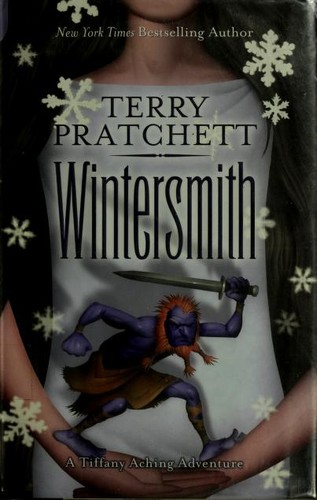
Wintersmith
by Terry Pratchett
★ Top 25 book of 2006 · #23 on Best Books of 2006
In Terry Pratchett's 2006 novel, Tiffany Aching begins turning into a personification of Summer because she cannot resist dancing, while the Wintersmith hunts for his destined bride. It is the third entry in a lively, funny series.
Best for: Readers who have enjoyed The Wee Free Men and Hat Full of Sky
Wintersmith is #23 on BookWard's Best Books of 2006, out of 47 2006 books that cleared our data bar.
What Wintersmith is about
Tiffany Aching is thirteen, a witch in training on the Discworld, and she is learning her craft from the formidable Miss Treason. Warned not to join the dark morris dance, she joins it anyway, and the consequences are bigger than she bargained for. The Wintersmith, winter himself, mistakes her for the Summer Lady and becomes enchanted by her. He builds himself a human body to pursue her, though he has no idea what being human involves.
Meanwhile Tiffany finds she carries a little of the Summer Lady's power, and plants begin to grow wherever she walks barefoot. As the Wintersmith's long, bitter season buries houses, closes roads, and threatens the sheep of the Chalk, Granny Weatherwax sends the Nac Mac Feegles in search of a hero. It is the third Tiffany Aching story, funny and warm, and a good fit for younger readers or anyone who likes their fantasy witty and kind-hearted.
Wintersmith on the Best Books of 2006
Wintersmith came out in 2006. Of the 47 books first published in 2006 that met BookWard's data bar, it ranks #23 on our Best Books of 2006 list.
Why it made the list: 246 readers have shelved it on Open Library; readers rate it 4.1 out of 5 (31 ratings). The list ranks each year’s books on how many readers have picked them up, how highly readers rate them, and how many are reading them right now.
Nearby on the 2006 list
- The Audacity of Hope Barack Obama, #21
- The Innocent Man John Grisham, #22
- American Born Chinese Gene Luen Yang, #24
- The Husband Dean Koontz, #25
See all Best Books of 2006 Best books by year
More years: Best Books of 2005 Best Books of 2007.
The numbers behind it
- Readers: 178 want to read it, 5 are reading it now and 63 have read it, according to Open Library.
- Ratings: 4.1 out of 5 from 31 Open Library ratings.
| Signal | This book (0 to 100) | Weight |
|---|---|---|
| Reach | 57 | 55% |
| Reader love | 57 | 25% |
| Being read right now | 13 | 20% |
Questions about Wintersmith
When was Wintersmith published?
Wintersmith by Terry Pratchett was first published in 2006.
Was Wintersmith one of the best books of 2006?
Wintersmith is #23 on BookWard's Best Books of 2006, out of 47 2006 books that cleared our data bar. 246 readers have shelved it on Open Library; readers rate it 4.1 out of 5 (31 ratings).
Why is Wintersmith on the Best Books of 2006 list?
246 readers have shelved it on Open Library; readers rate it 4.1 out of 5 (31 ratings).
More of the best books of 2006
- The Sea of Monsters Rick Riordan, #1
- The Book Thief Markus Zusak, #2
- Half of a Yellow Sun Chimamanda Ngozi Adichie, #3
- The Boy in the Striped Pyjamas John Boyne, #4
- The Secret Rhonda Byrne, #5
- Mindset Carol S. Dweck, #6
See the full Best Books of 2006, the Top 100, or new books on Rising.
How we know
This page uses public data: Open Library reader counts and ratings, and Wikipedia page views for recent years. The description is paraphrased from real source text. Rankings reflect reading interest, not quality or sales, and can be affected by data gaps. Lists update monthly.
Written with younger readers in mind and a good fit for roughly ten and up, as well as adults who enjoy Discworld.
Depends on the edition you pick.
Winter falls for the wrong girl, and Discworld bends. 67% taste match
 BookWard’s take
Winter falls for the wrong girl, and Discworld bends
Tiffany Aching, thirteen and apprenticed to a witch, joins a dance she was told to stay out of, and the personification of winter takes her for someone else. That opening hooks at once, and the book keeps its energy from there. Pratchett's Discworld is comic fantasy that doesn't read like anyone else's, and the narration has opinions it isn't shy about sharing. It is very funny, but the comedy carries real feeling about growing up and responsibility. The characters have real depth, and Tiffany is drawn with care. The weaker side is exposition: Pratchett will happily stop and explain a joke or an idea, which can slow things down. This is also the third Tiffany Aching story, though it stands up well enough on its own.
A mid-length young adult novel rather than a doorstop, though not as lean as BookWard's taste.
Events keep arriving, with the Wintersmith's pursuit and Tiffany's odd new powers, if a touch more leisurely than BookWard likes.
A girl mistaken for Summer by the spirit of Winter is an inventive premise, in line with BookWard's taste.
The prose is witty and playful with some flourish, a little more decorated than BookWard's leaning.
Tiffany's growth drives the book more than any chase, though the Wintersmith's pursuit keeps things moving.
The tone leans optimistic and kind, fitting BookWard's slightly hopeful outlook.
A conventional forward-moving structure, similar to BookWard's mild taste.
Comic invention is constant, pushing this well past BookWard's already humor-friendly position.
Winter and death appear, but the tone stays warm and gentle for young readers.
Feelings run real and moving, softened by humor.
See all 50 dialsEvery position, side by side with this book
Where it lines up
- OriginalityBookWard 9 · book 9
- Character depthBookWard 8 · book 8
- EndingBookWard 8 · book 8
Where it pulls apart
- LengthBookWard 1 · book 4
- Internal logicBookWard 10 · book 7
- ExpositionBookWard 2 · book 6
A mid-length young adult novel rather than a doorstop, though not as lean as BookWard's taste.
A forbidden dance and an unexpected meeting with winter itself start the story moving quickly, which BookWard rewards.
It plays with fantasy conventions and personifications in fresh ways, close to BookWard's preference for avoiding tropes.
Discworld rules are consistent and the magic follows its own comic logic, a little looser than BookWard's airtight ideal.
Events keep arriving, with the Wintersmith's pursuit and Tiffany's odd new powers, if a touch more leisurely than BookWard likes.
A girl mistaken for Summer by the spirit of Winter is an inventive premise, in line with BookWard's taste.
Tiffany is a thoughtful, well-observed protagonist, and the witches around her are sharply drawn.
The central problem is brought to a satisfying close, in line with BookWard's liking for resolution.
Warmth is present but tempered by wit, so it is less restrained than BookWard prefers.
Its darker moments serve the story and the stakes rather than existing for effect.
Not applicable to a work of fiction.
Pratchett's narration is unmistakable, full of asides and wry observation, matching BookWard's love of distinctive voice.
Ideas about seasons and growing up matter, but this is first and foremost a story-led adventure.
Pratchett often pauses to explain ideas and jokes directly, which is further from BookWard's scene-first preference.
The energy mostly holds, with enough incident and invention to carry the middle.
The prose is witty and playful with some flourish, a little more decorated than BookWard's leaning.
Tiffany's growth drives the book more than any chase, though the Wintersmith's pursuit keeps things moving.
The tone leans optimistic and kind, fitting BookWard's slightly hopeful outlook.
A conventional forward-moving structure, similar to BookWard's mild taste.
Comic invention is constant, pushing this well past BookWard's already humor-friendly position.
Written for younger readers, it reads easily without losing depth.
It centers on Tiffany but also follows the Wintersmith and other witches along the way.
The story moves forward in a straight line through the changing season.
Personified seasons, witches and a Cornucopia that spills out animals make this fully fantastical.
Several witches, the Wintersmith and the Baron's son give it a good-sized, memorable cast.
The stakes are real, but the story stays focused on one girl and her small corner of the Discworld.
It balances Tiffany's inner struggles with a steady run of events around her.
Conversation among the witches and others carries a lot of the humor and plot.
A strange courtship by the Wintersmith and a nod to the Baron's son are present but not the heart of the book.
Discworld is an invented place, though returning readers will find it comfortably familiar.
Set in a fantasy world with an old-fashioned rural feel, far from present day.
Its themes of growing up and responsibility feel durable, and it has stayed well regarded since 2006.
The narration is trustworthy and guides the reader openly.
Right and wrong are fairly clear, with nuance mostly in how people handle power and duty.
Seasonal imagery and the Discworld's folk customs get colorful, imaginative treatment.
Not applicable to a work of fiction.
Not applicable to a work of fiction.
It is the third Tiffany Aching novel and part of the wider Discworld, though accessible on its own.
Tiffany's emerging powers and the Wintersmith's schemes bring a few turns, not a flood of them.
A friendly, accessible read that comforts more than it challenges.
Winter and death appear, but the tone stays warm and gentle for young readers.
Feelings run real and moving, softened by humor.
Wit mixes dry asides with some broader comic business.
Little violence, since it is aimed at younger readers.
No sexual content, apart from a mild courtship thread.
Power and duty are themes, but politics stays in the background.
Plain English with some comic regional speech, nothing hard to follow.
The narration freely offers opinions and wry commentary.
It looks neither strongly back nor forward, focused on the present season and Tiffany's growth.
The book believes in decency, responsibility and the good that ordinary people can do.
Review written by BookWard, dial version 1, November 2026.
Who is Wintersmith right for?
Written with younger readers in mind and a good fit for roughly ten and up, as well as adults who enjoy Discworld. It touches on death, but gently and without graphic content.
Written for younger readers, it reads easily without losing depth.
Winter and death appear, but the tone stays warm and gentle for young readers.
Feelings run real and moving, softened by humor.
Little violence, since it is aimed at younger readers.
Book CompanionWintersmith: ideas, characters, themes
A young witch's slip at the wrong dance draws the spirit of winter to her, and she must handle the consequences while growing into her own power.
- A forbidden dance. Tiffany joins the dark morris despite Miss Treason's warning, and the Wintersmith mistakes her for the Summer Lady.
- The silver horse pendant. A gift from Roland, the Baron's son, which Tiffany drops and the Wintersmith uses to find her.
- Borrowed powers. Tiffany discovers she has some of the Summer Lady's abilities, and plants grow where she walks barefoot.
- The elder witches step in. Granny Weatherwax and Nanny Ogg learn the Wintersmith is tracking Tiffany and advise how to deal with it.
- The Wintersmith wants to be human. Believing his non-human nature is the obstacle, he sets out to build himself a body.
Characters
Tiffany Aching
Protagonist
A thirteen-year-old witch in training, practical and thoughtful, caught up in something far larger than she expected.
The Wintersmith
The personification of winter
Enchanted by Tiffany and convinced she is the Summer Lady, he pursues her with gifts.
Miss Treason
Tiffany's teacher
The witch Tiffany is apprenticed to, who warns her not to join the dance.
Granny Weatherwax
Senior witch
An elder witch who steps in when she learns the Wintersmith has been tracking Tiffany.
Nanny Ogg
Senior witch
A fellow elder witch, and the one Tiffany goes to live with.
Themes
Tiffany takes on adult responsibilities and learns the weight of her own choices.
Winter and summer are treated as living forces with their own roles and appetites.
Witchcraft here is about looking after others, not just wielding power.
The Wintersmith's attempt to become human asks what makes a person.
Dances, rhymes and old customs carry real force in the story.
Discussion questions
- Why does the Wintersmith mistake Tiffany for the Summer Lady, and what does that say about how he sees the world?
- What does Miss Treason's warning about the dance suggest about the cost of curiosity?
- How does Pratchett use humor to carry serious ideas about duty and growing up?
- Is the Wintersmith a villain, a victim of his own nature, or something in between?
- What does it mean for Tiffany to have powers she did not ask for, and how does she handle them?
Personalize your Book Companion
This is the general edition. In BookWard, the Companion is written for you: your reading profile, your notes, and spoiler-safe to the page you are on.
Buy, listen or borrow Wintersmith
Each link opens a search for this book on that store, in a new tab.
Read on a device
Borrow
Reviews and community
If you liked Wintersmith
Death takes early retirement and Discworld gets funnier and wiser
Witches AbroadTerry PratchettThree witches, one wand, and a fairy tale with teeth
Wyrd SistersTerry PratchettPratchett's Macbeth-flavored Discworld comedy, sharp and quick, with three unforgettable witches
MaskeradeTerry PratchettDiscworld's witches crash the opera in a witty Phantom spoof
Find your own best books
Add what you have read, rate it, and BookWard will recommend what to read next.
Free to start. No credit card needed.