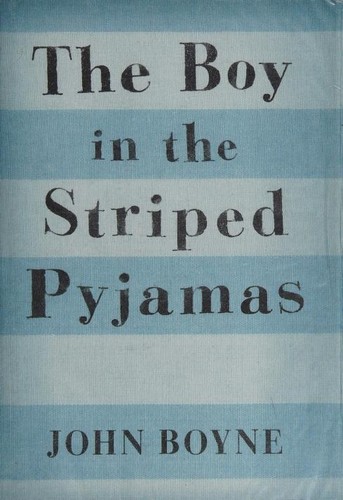
The Boy in the Striped Pyjamas
by John Boyne
★ Top 5 book of 2006 · #4 on Best Books of 2006
This Holocaust novel comes from Irish writer John Boyne and was published in 2006. It is a work of fiction set against the history of the Holocaust.
Best for: Readers drawn to Holocaust-themed fiction by an Irish novelist
The Boy in the Striped Pyjamas is #4 on BookWard's Best Books of 2006, out of 47 2006 books that cleared our data bar.
What The Boy in the Striped Pyjamas is about
Bruno is nine years old. When a visit from Hitler leads to a promotion, the family leaves their Berlin home for a new house beside a place Bruno can only call "Out-With". From the house he can see people in what look like striped pyjamas, and he is lonely enough to wonder what lies beyond the fence.
There he meets Shmuel, a boy who shares his age and his birthday. Bruno brings him food, and a friendship grows that neither boy is equipped to understand fully. It has sold more than 11 million copies worldwide, though Holocaust scholars, historians and memorial organizations have criticised its historical inaccuracies.
The Boy in the Striped Pyjamas on the Best Books of 2006
The Boy in the Striped Pyjamas came out in 2006. Of the 47 books first published in 2006 that met BookWard's data bar, it ranks #4 on our Best Books of 2006 list.
Why it made the list: 1,607 readers have shelved it on Open Library; readers rate it 3.9 out of 5 (76 ratings); 114 are reading it right now. The list ranks each year’s books on how many readers have picked them up, how highly readers rate them, and how many are reading them right now.
It earns Being read right now.
Nearby on the 2006 list
- The Book Thief Markus Zusak, #2
- Half of a Yellow Sun Chimamanda Ngozi Adichie, #3
- The Secret Rhonda Byrne, #5
- Mindset Carol S. Dweck, #6
See all Best Books of 2006 Best books by year
More years: Best Books of 2005 Best Books of 2007.
The numbers behind it
- Readers: 1,338 want to read it, 114 are reading it now and 155 have read it, according to Open Library.
- Ratings: 3.9 out of 5 from 76 Open Library ratings.
| Signal | This book (0 to 100) | Weight |
|---|---|---|
| Reach | 91 | 55% |
| Reader love | 45 | 25% |
| Being read right now | 91 | 20% |
Questions about The Boy in the Striped Pyjamas
When was The Boy in the Striped Pyjamas published?
The Boy in the Striped Pyjamas by John Boyne was first published in 2006.
Was The Boy in the Striped Pyjamas one of the best books of 2006?
The Boy in the Striped Pyjamas is #4 on BookWard's Best Books of 2006, out of 47 2006 books that cleared our data bar. 1,607 readers have shelved it on Open Library; readers rate it 3.9 out of 5 (76 ratings); 114 are reading it right now.
Why is The Boy in the Striped Pyjamas on the Best Books of 2006 list?
1,607 readers have shelved it on Open Library; readers rate it 3.9 out of 5 (76 ratings); 114 are reading it right now.
More of the best books of 2006
- The Sea of Monsters Rick Riordan, #1
- The Book Thief Markus Zusak, #2
- Half of a Yellow Sun Chimamanda Ngozi Adichie, #3
- The Secret Rhonda Byrne, #5
- Mindset Carol S. Dweck, #6
- New Moon Stephenie Meyer, #7
See the full Best Books of 2006, the Top 100, or new books on Rising.
How we know
This page uses public data: Open Library reader counts and ratings, and Wikipedia page views for recent years. The description is paraphrased from real source text. Rankings reflect reading interest, not quality or sales, and can be affected by data gaps. Lists update monthly.
Often read by young teens, it suits readers who can handle a tragic ending and a Holocaust setting.
Depends on the edition you pick.
A child's-eye Holocaust fable that divides readers and historians. 41% taste match
 BookWard’s take
A child's-eye Holocaust fable that divides readers and historians
John Boyne's 2006 novel follows Bruno, a nine-year-old whose father becomes commandant of Auschwitz, and his friendship with a Jewish boy on the other side of the fence. The hook is immediate: the move, the strange view from the window, the pyjamas that aren't pyjamas. It reads fast and plain, the opening pulls you in, and the whole design rests on one simple, controlled idea. The cost is that it leans on familiar tropes and its internal logic is shaky. Historians and memorial organizations have criticised its inaccuracies, and the premise strains under scrutiny. It is a fable, a morality tale told through naive eyes, and it asks for a different kind of trust than a realist account of the period. It has sold more than 11 million copies, so plenty of readers meet this history here first.
A short, quick novel built around one idea; that economy matches BookWard's taste for tight books.
Short chapters and a simple line of events keep it moving quickly, close to BookWard's quick pace.
A child's-eye view of Auschwitz was a fresh angle, though the fable form is familiar.
Simple, clear sentences suited to a young point of view, well short of ornate.
Events and the friendship share the load, with the situation steering most of what happens.
The tone and ending are tragic, with only the friendship offering warmth.
Told in a straightforward, conventional sequence with no formal experiments.
The subject is grave, and the little humour comes from Bruno's mispronunciations.
Its setting is a death camp, and it builds to a devastating conclusion.
Pitched to move the reader strongly, especially toward the end.
See all 50 dialsEvery position, side by side with this book
Where it lines up
- EndingBookWard 8 · book 8
- LengthBookWard 1 · book 2
- PaceBookWard 8 · book 7
Where it pulls apart
- Internal logicBookWard 10 · book 3
- Familiar tropesBookWard 10 · book 4
- Rigor (nonfiction)BookWard 9 · book 2
A short, quick novel built around one idea; that economy matches BookWard's taste for tight books.
The move to a new house and the odd view of the camp pull the reader in right away, as BookWard likes.
The innocent-child-witness device is well worn, so it leans on a familiar approach, short of what BookWard prizes.
The premise relies on a child never grasping what is plainly in front of him, which strains belief against BookWard's love of airtight setups.
Short chapters and a simple line of events keep it moving quickly, close to BookWard's quick pace.
A child's-eye view of Auschwitz was a fresh angle, though the fable form is familiar.
Bruno is drawn through his naivety, but the wider cast works more as symbols than as fully formed people.
The ending resolves its central story completely and decisively, in line with BookWard's preference.
It aims squarely at the heart and invites tears, more sentimental than BookWard prefers.
The darkness serves the moral point, though the closing beat is designed for maximum impact.
It is a fable, not a historical account, and historians have criticised its inaccuracies.
The plain, childlike narration is consistent and recognisable, though not especially singular.
The story carries the book, but it exists to deliver a moral idea about innocence and complicity.
Bruno's misunderstandings are often corrected by the narration, so meaning is explained rather than left to scenes.
Brief and focused, with little time for the middle to slacken.
Simple, clear sentences suited to a young point of view, well short of ornate.
Events and the friendship share the load, with the situation steering most of what happens.
The tone and ending are tragic, with only the friendship offering warmth.
Told in a straightforward, conventional sequence with no formal experiments.
The subject is grave, and the little humour comes from Bruno's mispronunciations.
Easy to read in language and form, though the subject matter is heavy.
The story stays close to Bruno almost throughout.
Events unfold in order across Bruno's time at the new house.
Set in a real historical place, with a fable-like premise that bends plausibility.
A small circle of family, household staff and one fenced-off friend.
An intimate story seen from one house and one fence, set against vast events.
Balances Bruno's thoughts and misreadings with the outward events around him.
Conversations between the boys and within the family carry a good share of the story.
There is no romance; the central bond is a friendship.
Auschwitz and a commandant's household are unfamiliar territory for most readers, shown through a child's eyes.
Set in World War II, firmly in the past.
Its huge sales and adaptations show lasting reach, even as its accuracy is disputed.
The narration is plain and trustworthy, though it keeps Bruno's innocence close.
The book frames right and wrong in clear, unambiguous terms as a morality tale.
Spare and economical, giving only what the child's view needs.
A standalone novel, though a later sequel, All the Broken Places, exists.
The path is fairly signposted, with few real surprises until the end.
Emotionally hard, but written to be accessible and consoling in its moral clarity.
Its setting is a death camp, and it builds to a devastating conclusion.
Pitched to move the reader strongly, especially toward the end.
Most of the horror is implied and kept offstage, seen through a child's partial understanding.
No sexual content.
Nazi ideology and the Holocaust frame everything, though the story stays human-scaled.
Plain, accessible language throughout.
The narration is mostly neutral, with its moral stance carried by the story.
It looks back at a historical catastrophe.
Rooted in tragedy, it still affirms friendship and innocence as values.
Review written by BookWard, dial version 1, November 2026.
Who is The Boy in the Striped Pyjamas right for?
Often read by young teens, it suits readers who can handle a tragic ending and a Holocaust setting. The death camp and the fates of children are central, so it can help to read alongside factual history.
Easy to read in language and form, though the subject matter is heavy.
Its setting is a death camp, and it builds to a devastating conclusion.
Pitched to move the reader strongly, especially toward the end.
Most of the horror is implied and kept offstage, seen through a child's partial understanding.
Book CompanionThe Boy in the Striped Pyjamas: ideas, characters, themes
A sheltered boy's friendship with a prisoner across a fence exposes how innocence and ignorance collide with atrocity.
- A child's-eye frame. Bruno, aged nine, sees the camp through misunderstanding, mishearing names and seeing the prisoners' uniforms as striped pyjamas.
- The move. Bruno's father is promoted to Commandant of Auschwitz, uprooting the family from Berlin and from Bruno's three best friends.
- The fence. Bruno's exploring leads him to Shmuel, a Jewish boy of the same age who shares his birthday.
- A daily friendship. The boys talk near the fence and Bruno brings food, while Shmuel grows visibly thinner.
- Disputed accuracy. Holocaust scholars, historians and memorial organizations have criticised the book's historical inaccuracies as potentially damaging to education.
Characters
Bruno
Protagonist
A nine-year-old boy who moves to Auschwitz with his family and misreads much of what he sees.
Shmuel
Bruno's friend
A Jewish boy held in the camp who shares Bruno's age and birthday.
Ralf
Bruno's father
The newly promoted Commandant of Auschwitz.
Gretel
Bruno's sister
His 12-year-old sister, whom he nicknames 'A Hopeless Case'.
Pavel
Household chef
A Jewish chef who works in the family's home.
Themes
How a child's limited understanding shapes what he sees and fails to see.
How ordinary households and everyday routines sit alongside atrocity.
Whether personal connection can reach past imposed divisions.
What adults and children choose, or are allowed, not to understand.
The ethics and risks of turning historical atrocity into fable.
Discussion questions
- Does Bruno's naivety feel believable, or does it strain the story?
- What does a fable gain and lose when its subject is a real atrocity?
- How should readers weigh the novel's reach against historians' criticisms of its accuracy?
- What does the friendship across the fence say about innocence and responsibility?
- How might this book prompt a young reader to learn more about the real history?
Personalize your Book Companion
This is the general edition. In BookWard, the Companion is written for you: your reading profile, your notes, and spoiler-safe to the page you are on.
Buy, listen or borrow The Boy in the Striped Pyjamas
Each link opens a search for this book on that store, in a new tab.
Read on a device
Borrow
Reviews and community
If you liked The Boy in the Striped Pyjamas
A fake diary that has outlived its own claim to be real
Where the Red Fern GrowsWilson RawlsA boy, two hounds, and the Ozarks: a classic that earns its tears
JawsPeter BenchleyA shark thriller with a town's rot running alongside it
The GiverLois LowryA short, quiet dystopia that still lands decades on
Find your own best books
Add what you have read, rate it, and BookWard will recommend what to read next.
Free to start. No credit card needed.