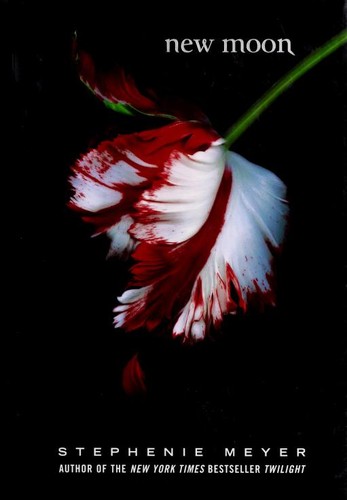
New Moon
by Stephenie Meyer
★ Top 10 book of 2006 · #7 on Best Books of 2006
Bella Swan's love for vampire Edward Cullen proves more dangerous than she imagined, and their relationship threatens everything they hold dear. This sequel to Twilight mixes romance and suspense with a supernatural twist.
Best for: Twilight fans craving more vampire romance, suspense and star-crossed love
New Moon is #7 on BookWard's Best Books of 2006, out of 47 2006 books that cleared our data bar.
What New Moon is about
Bella Swan's eighteenth birthday party at the Cullens' house ends badly when a paper cut sends Edward's brother Jasper after her. Soon the Cullens leave Forks altogether, and Edward tells her he no longer loves her, hoping she will move on. She does not. Bella sinks into months of deep depression, and the only thing that seems to lift her is risk, since reckless thrills bring Edward's voice back to her.
Her closest comfort becomes Jacob Black, whose own life is changing in startling ways and who hopes for more than friendship. Meanwhile, old dangers circle, and a far darker threat waits in Italy. This second Twilight novel leans into heartbreak and longing, and its mood is brooding and melancholic. It suits readers who followed Bella and Edward from the first book and want to see their bond tested.
New Moon on the Best Books of 2006
New Moon came out in 2006. Of the 47 books first published in 2006 that met BookWard's data bar, it ranks #7 on our Best Books of 2006 list.
Why it made the list: 1,240 readers have shelved it on Open Library; readers rate it 4 out of 5 (85 ratings); 80 are reading it right now. The list ranks each year’s books on how many readers have picked them up, how highly readers rate them, and how many are reading them right now.
Nearby on the 2006 list
- The Secret Rhonda Byrne, #5
- Mindset Carol S. Dweck, #6
- The Case of the Missing Marquess (Enola Holmes, #1) Nancy Springer, #8
- Pretty Little Liars Sara Shepard, #9
See all Best Books of 2006 Best books by year
More years: Best Books of 2005 Best Books of 2007.
The numbers behind it
- Readers: 945 want to read it, 80 are reading it now and 215 have read it, according to Open Library.
- Ratings: 4 out of 5 from 85 Open Library ratings.
| Signal | This book (0 to 100) | Weight |
|---|---|---|
| Reach | 89 | 55% |
| Reader love | 49 | 25% |
| Being read right now | 89 | 20% |
Questions about New Moon
When was New Moon published?
New Moon by Stephenie Meyer was first published in 2006.
Was New Moon one of the best books of 2006?
New Moon is #7 on BookWard's Best Books of 2006, out of 47 2006 books that cleared our data bar. 1,240 readers have shelved it on Open Library; readers rate it 4 out of 5 (85 ratings); 80 are reading it right now.
Why is New Moon on the Best Books of 2006 list?
1,240 readers have shelved it on Open Library; readers rate it 4 out of 5 (85 ratings); 80 are reading it right now.
More of the best books of 2006
- The Sea of Monsters Rick Riordan, #1
- The Book Thief Markus Zusak, #2
- Half of a Yellow Sun Chimamanda Ngozi Adichie, #3
- The Boy in the Striped Pyjamas John Boyne, #4
- The Secret Rhonda Byrne, #5
- Mindset Carol S. Dweck, #6
See the full Best Books of 2006, the Top 100, or new books on Rising.
How we know
This page uses public data: Open Library reader counts and ratings, and Wikipedia page views for recent years. The description is paraphrased from real source text. Rankings reflect reading interest, not quality or sales, and can be affected by data gaps. Lists update monthly.
Suits teens and up, especially readers who like romance with a supernatural edge.
Depends on the edition you pick.
A heartbreak-heavy sequel that trades vampire romance for grief and wolves. 40% taste match
 BookWard’s take
A heartbreak-heavy sequel that trades vampire romance for grief and wolves
New Moon opens with a paper cut and a party, then strips away the thing Bella most wants. The hook is immediate and the cause and effect hold together, so a reader who likes an opening that grabs and a world with firm rules is well served. The middle is where it falters. Bella's months of depression give the book real emotional weight, but the pace drops hard and the stretch sags for it. Familiar tropes are everywhere, from the brooding immortal to the best friend who becomes a rival, and the book leans on them more than most. Sentiment runs high, and the characters have more depth than the series' reputation suggests. It is also a sequel, through and through, and it only fully pays off for readers already invested in the series.
A full-size novel with a long stretch of waiting and recovery; BookWard prefers tighter books, so this runs longer than its taste.
A sharp opening gives way to months of grief that move slowly, short of the quick tempo BookWard favors.
The vampire-and-werewolf romance framework is familiar, with little that reinvents it, so BookWard would want more.
Plain, conversational sentences carry the book, matching BookWard's slight preference for unadorned writing.
Bella's emotional state drives nearly every choice, so this is firmly character-led, as BookWard likes.
Long stretches of loss and depression dominate before any light appears, so it leans bleak, below BookWard's mild hopefulness.
A straightforward chronological telling with no formal games, more conventional than BookWard's mild appetite.
Jacob brings warmth and occasional lightness, but the book is mostly earnest rather than funny.
Grief, depression and mortal danger give it some weight, though it stays within teen-fiction limits.
Heartbreak and longing are rendered intensely, above BookWard's balanced level.
See all 50 dialsEvery position, side by side with this book
Where it lines up
- OpeningBookWard 10 · book 9
- Story or ideasBookWard 3 · book 2
- Character depthBookWard 8 · book 6
Where it pulls apart
- Familiar tropesBookWard 10 · book 2
- LengthBookWard 1 · book 6
- Internal logicBookWard 10 · book 6
A full-size novel with a long stretch of waiting and recovery; BookWard prefers tighter books, so this runs longer than its taste.
The birthday party and the paper cut put the central crisis on the page almost at once, which BookWard rewards.
The brooding immortal, the rival friend and the love triangle are well-worn paths, well short of BookWard's appetite for avoiding tropes.
Its supernatural rules mostly hold, though the plot leans on convenient timing and Bella's choices stretch it, below BookWard's airtight standard.
A sharp opening gives way to months of grief that move slowly, short of the quick tempo BookWard favors.
The vampire-and-werewolf romance framework is familiar, with little that reinvents it, so BookWard would want more.
Bella's grief and her friendship with Jacob are drawn with real feeling, though the supporting figures lean toward types.
The climactic confrontation resolves its immediate crisis, while the series keeps larger threats alive, which suits BookWard reasonably well.
Romantic longing and heartbreak are played openly and at full volume, quite far from BookWard's restraint.
The danger and the separation are driven by the story's emotional logic, and the darkest moments are mostly earned rather than gratuitous.
This dial does not apply to a novel.
Bella's first-person narration is unmistakable and consistent, though more recognizable than truly distinctive.
This is entirely a story-led book, driven by relationships and peril rather than argument or concept, which matches BookWard's lean.
Much is conveyed through Bella's inner commentary and explanation, a bit more telling than BookWard would like.
The long stretch after Edward leaves repeats its grief beats, and critics flagged that middle, so it sags against BookWard's sustained ideal.
Plain, conversational sentences carry the book, matching BookWard's slight preference for unadorned writing.
Bella's emotional state drives nearly every choice, so this is firmly character-led, as BookWard likes.
Long stretches of loss and depression dominate before any light appears, so it leans bleak, below BookWard's mild hopefulness.
A straightforward chronological telling with no formal games, more conventional than BookWard's mild appetite.
Jacob brings warmth and occasional lightness, but the book is mostly earnest rather than funny.
Simple prose and a clear storyline make it easy to read, less demanding than BookWard's middle ground.
Everything is filtered through Bella alone, which is far narrower than BookWard's taste for multiple viewpoints.
Events move forward in order through the months after the birthday, so it is more linear than BookWard's mix.
Vampires and werewolves are central, so this sits well into fantasy territory, above BookWard's balance.
The focus stays on Bella, the Cullens and the Quileute circle, so the cast stays modest.
Even with international travel late on, the stakes stay personal, centered on one relationship and family loyalty.
Bella's feelings and reflections take up most of the page space, leaning heavily inward.
Conversations between Bella and Jacob and with her father carry a good share of the story.
The love story drives everything, from the separation to the climax, putting it at the top of the dial.
A rainy small town and a tribal reservation feel recognizable, while the Italian trip adds a touch of the unfamiliar.
A contemporary American high-school setting makes this feel firmly present-day.
Closely tied to the mid-2000s teen craze, though its themes of heartbreak travel further.
Bella tells it straight and plainly, with few signs she is misleading anyone.
The book draws fairly clear lines between protectors and threats, short of BookWard's taste for ambiguity.
Moody weather and the Pacific Northwest setting get some attention, though description is not the main draw.
This dial does not apply to a novel.
This dial does not apply to a novel.
It is the second book in the Twilight series and depends on the first.
Jacob's transformation and the late trip to Italy supply real surprises, above BookWard's moderate appetite.
A comforting, romantic read that rarely pushes the reader to rethink anything.
Grief, depression and mortal danger give it some weight, though it stays within teen-fiction limits.
Heartbreak and longing are rendered intensely, above BookWard's balanced level.
Jacob's easy teasing is warm rather than broad, keeping the humor mild.
Peril and fights appear, but largely without graphic detail, so the violence is modest.
Romance is present but kept chaste and restrained, with little sexual content.
Politics barely registers beyond the vampire world's own rulers, which stay in the background.
The language is plain and contemporary throughout, with nothing dense about it.
Bella's narration is full of her own feelings and judgments, so it reads as opinionated.
The story is anchored in what has been lost and the pull toward the past, leaning backward.
Devotion and loyalty are treated as nearly absolute virtues, giving it an idealistic tilt.
Review written by BookWard, dial version 1, November 2026.
Who is New Moon right for?
Suits teens and up, especially readers who like romance with a supernatural edge. Sensitive moments include depression, reckless risk-taking and some menace from vampires.
Simple prose and a clear storyline make it easy to read, less demanding than BookWard's middle ground.
Grief, depression and mortal danger give it some weight, though it stays within teen-fiction limits.
Heartbreak and longing are rendered intensely, above BookWard's balanced level.
Peril and fights appear, but largely without graphic detail, so the violence is modest.
Book CompanionNew Moon: ideas, characters, themes
After the person she loves leaves to keep her safe, Bella has to find a way to live, and finds an unexpected bond in a friend whose own secret is about to surface.
- A party that goes wrong. Bella's eighteenth birthday ends in danger when a small cut puts her in peril among the Cullens.
- Edward's departure. To protect Bella, Edward and his family leave Forks, and he tells her he no longer loves her.
- Grief takes over. Bella sinks into months of depression and memory loss while the world moves on around her.
- Risk as a link. She discovers that thrill-seeking lets her hear Edward's voice in her mind, and she keeps chasing it.
- Jacob's secret. Her growing friendship with Jacob Black is complicated when he changes and a hidden truth about his tribe is revealed.
Characters
Bella Swan
Narrator and protagonist
A senior in high school whose life is upended by the loss of Edward.
Edward Cullen
Vampire and Bella's love
He leaves Forks believing it is the only way to keep Bella safe.
Jacob Black
Bella's friend
A cheerful companion who eases her pain and undergoes a drastic change.
Alice Cullen
Edward's sister
She makes a surprise return that sets the final stretch in motion.
Jasper Cullen
Edward's adopted brother
His reaction to Bella's blood on her birthday sets the story in motion.
Themes
How loss can swallow a person and what slowly pulls them back out.
Whether leaving someone to keep them safe is care or a betrayal.
The pull between a comforting friend and a love that cannot be replaced.
Chasing danger as a way to feel connected to what is gone.
Who gets to belong to a community, and what it costs to be part of one.
Discussion questions
- Was Edward right to leave, or did he take away Bella's choice?
- How does Bella's grief feel true to you, and where does it feel stretched?
- Is Jacob a good friend to Bella, or does he want more than she can give?
- Why does Bella hear Edward's voice only when she takes risks?
- Does the long middle section deepen the story or slow it down?
Personalize your Book Companion
This is the general edition. In BookWard, the Companion is written for you: your reading profile, your notes, and spoiler-safe to the page you are on.
Buy, listen or borrow New Moon
Each link opens a search for this book on that store, in a new tab.
Read on a device
Borrow
Reviews and community
If you liked New Moon
Third Twilight book: love triangle meets a vampire army
Fallen (Fallen #1)Lauren KateA brooding boarding-school romance that leans hard on familiar YA tropes
Midnight SunStephenie MeyerTwilight again, told from inside Edward Cullen's head
CraveTracy WolffA vampire academy romance that runs on tropes and momentum
Find your own best books
Add what you have read, rate it, and BookWard will recommend what to read next.
Free to start. No credit card needed.