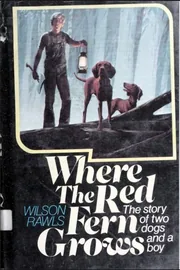
Where the Red Fern Grows
by Wilson Rawls · 1961
It suits readers around 9 to 12 and older readers who enjoy classic dog stories.
249 pages, about 4 to 6 hours.
A boy, two hounds, and the Ozarks: a classic that earns its tears. 48% taste match
About the book
Wilson Rawls first published Where the Red Fern Grows in 1961. It is a children's novel in the classic tradition, aimed at readers around ages 9 to 12, and it belongs to the shelf of dog stories and boyhood adventures. Rawls drew on his own childhood for the book, and it counts as autobiographical fiction.
The story follows Billy Colman, a boy who buys two Redbone Coonhounds and trains them for hunting. The hounds are named Old Dan and Little Ann, and much of the book centers on the bond between the boy and his dogs. Billy's family appears throughout, including Mama, Papa, and Grandpa, along with neighbors such as Old Man Pritchard and Mrs. Pritchard. The setting is the Ozark Mountains of Oklahoma, with the Illinois River and the town of Tahlequah among its places, and the period is the twentieth century. Friendship, adolescence, and life with animals run through the narrative. The book runs about 249 pages in its median edition, and it has appeared in 57 editions.
As the story opens, a man sees some dogs fighting in an alley.
Characters
Billy ColmanLittle AnnOld Man PritchardMrs. PritchardGrandpaMama
Setting
Ozark MountainsGlendale College LibraryUnited StatesIllinois RiverTahlequah
Period
20th Century
Themes
Social Issues - FriendshipSocial Situations - AdolescenceSocial Issues - AdolescenceClassicsAction & Adventure - GeneralAnimals - Dogschildren's classicsdogs
- Want to read 863
- Reading now 87
- Read 138
Most people shelving it are saving it for later.
Of 1088 readers who put it on a shelf, 79% want to read it, 8% are reading it now, 13% have finished it and 0% stopped before the end.
By the numbers
- The median edition runs 249 pages. Counting about 275 words a page and an adult reading pace of 250 words a minute, that is about 4.6 hours of reading.
- Open Library tracks 57 editions from 35 publishers, the earliest dated 1961 and the latest 2018, across 3 languages.
- On reader demand it ranks in the top 1% of the classic books in our catalog (8,749 of them).
- Libraries shelve it under Dewey 813.54 and Library of Congress class PS-3568.00000000.A884 W53 1961.
 BookWard’s take
A boy, two hounds, and the Ozarks: a classic that earns its tears
Billy Colman buys two Redbone Coonhounds, Old Dan and Little Ann, and trains them to hunt in the Ozarks of Oklahoma. Rawls drew on his own childhood, and the story runs on that bond between boy and dogs. The opening is slow, easing into hunting life before it finds its footing, so it asks for some patience early. The book is openly tender and leans toward the sentimental, where I tend to prefer more restraint. It does not lean on shock for effect, though. Its darkness comes out of the story and the landscape, and its ending is fully resolved. At 249 pages it stays short and sustained, with Mama, Papa, Grandpa and the Pritchards giving Billy a believable world around him. Plain prose, a direct emotional line, and a clear moral center make it a durable children's classic.
At 249 pages it is short and focused, which matches BookWard's love of tight books.
The pace moves steadily with hunts and chores, brisker than slow but gentler than BookWard's preference.
The Ozark setting and Rawls's own boyhood give it texture, though the dog-story frame is classic.
The prose is plain and clear, close to BookWard's slightly plain leaning.
The bond between Billy and his dogs drives the book more than any plot machinery.
Warmth and loyalty run through it, balanced by loss, so it sits near the middle on outlook.
It tells its story in a conventional straight line, a little more traditional than BookWard.
It is mostly earnest, with light moments rather than comedy.
It is gentle at heart but not shy about loss, landing mid-scale.
It is built to be moving and delivers strong, heartfelt feeling.
See all 50 dialsEvery position, side by side with this book
Where it lines up
- EndingBookWard 8 · book 9
- Story or ideasBookWard 3 · book 2
- LengthBookWard 1 · book 3
Where it pulls apart
- Familiar tropesBookWard 10 · book 4
- OpeningBookWard 10 · book 6
- SentimentBookWard 8 · book 2
At 249 pages it is short and focused, which matches BookWard's love of tight books.
It opens with a boy's longing for hunting dogs and settles in gradually, a softer start than BookWard likes.
A boy and his dogs is familiar ground, so it rests on well-worn shapes more than BookWard prefers.
Events follow cleanly from Billy's choices and the hunting life around him, which BookWard values.
The pace moves steadily with hunts and chores, brisker than slow but gentler than BookWard's preference.
The Ozark setting and Rawls's own boyhood give it texture, though the dog-story frame is classic.
Billy and his two hounds are drawn with warmth and distinct personalities, a good fit for BookWard.
It is openly tender and built to move readers, the opposite of the restraint BookWard favors.
Its hard moments grow out of the story and the setting, which BookWard respects.
Rawls writes in a plain, warm, storytelling voice shaped by the Ozarks, distinctive and welcome.
This is a story-led book, firmly where BookWard sits.
Most of what matters is shown in hunts and family scenes rather than explained outright.
The hunting episodes keep up momentum, so the middle holds without much slack.
The prose is plain and clear, close to BookWard's slightly plain leaning.
The bond between Billy and his dogs drives the book more than any plot machinery.
Warmth and loyalty run through it, balanced by loss, so it sits near the middle on outlook.
It tells its story in a conventional straight line, a little more traditional than BookWard.
It is mostly earnest, with light moments rather than comedy.
It is an easy read aimed at ages 9 to 12, lighter than BookWard's usual taste.
The story is told from Billy's single viewpoint.
It is a grounded story of hunting and family life in the Ozarks.
A small circle of family, neighbors and two hounds keeps the cast compact.
This is an intimate story of one boy, his family and his dogs.
Hunts, chores and outdoor work give it a lean toward action over reflection.
Dialogue appears alongside narration and action, moderate rather than heavy.
Romance is not part of this story, which centers on friendship with animals.
The Ozark hill country is a fresh setting for many readers, which BookWard enjoys.
It looks back to a bygone rural world, far from the present day.
Published in 1961 and still a children's classic, it holds up across generations.
Billy tells his story straightforwardly with no sense of a trick or a slant.
The book's loyalties and values are clear rather than ambiguous.
Rawls gives the Ozark landscape and the hounds vivid, loving detail.
It is deeply personal, rooted in the author's own childhood.
It stands on its own as a single novel.
The story follows a natural course with few abrupt surprises.
It leans comforting in tone, even as it asks hard emotional things of the reader.
It is gentle at heart but not shy about loss, landing mid-scale.
It is built to be moving and delivers strong, heartfelt feeling.
Humor is warm and homespun when it appears.
Hunting and its consequences appear on the page, at a level suited to young readers.
There is no sexual content in this children's novel.
Politics are absent from this story of a boy and his dogs.
Rural speech colors the voices but the language stays easy to follow.
Billy's narration carries strong feeling and personal judgment.
Loyalty, hard work and devotion drive it, giving it an idealistic streak.
Review written by BookWard, dial version 1, November 2026.
Who is Where the Red Fern Grows right for?
It suits readers around 9 to 12 and older readers who enjoy classic dog stories. It deals openly with loss and hunting, so younger or sensitive readers may want a grown-up nearby.
It is an easy read aimed at ages 9 to 12, lighter than BookWard's usual taste.
It is gentle at heart but not shy about loss, landing mid-scale.
It is built to be moving and delivers strong, heartfelt feeling.
Hunting and its consequences appear on the page, at a level suited to young readers.
Book CompanionWhere the Red Fern Grows: ideas, characters, themes
A boy in the Ozarks buys and trains two hunting hounds, and their bond shapes his boyhood.
- The purchase. Billy Colman buys two Redbone Coonhounds, setting the story in motion.
- Old Dan and Little Ann. The two hounds are the heart of the book, each with her or his own character.
- Life in the Ozarks. Hunts, chores and family life root the story in Oklahoma hill country.
- Family and neighbors. Mama, Papa, Grandpa and the Pritchards give Billy a community around him.
- Autobiographical roots. Rawls drew on his own boyhood, which gives the book its warmth and authority.
Characters
Billy Colman
The boy at the center
He buys and trains the two hounds and tells the story.
Old Dan
One of Billy's hounds
A Redbone Coonhound and Billy's hunting partner.
Little Ann
Billy's other hound
The second Redbone Coonhound, bonded with Old Dan and Billy.
Old Man Pritchard
A neighbor
A figure in Billy's community in the Ozarks.
Grandpa
Family
A member of Billy's family who appears throughout.
Themes
The loyal bond between a boy and his dogs.
Billy grows through responsibility and loss.
Mama, Papa and Grandpa support Billy's dreams.
The Ozark landscape shapes the life and hunts.
Devotion between people and animals drives the story.
Discussion questions
- Why do you think Billy's bond with Old Dan and Little Ann matters so much to him?
- How does the Ozark setting shape the way the story feels?
- What role do Billy's family and neighbors play in his growing up?
- The book is openly emotional; does that make it stronger or heavier for you?
- How might the story change if told by someone other than Billy?
Personalize your Book Companion
This is the general edition. In BookWard, the Companion is written for you: your reading profile, your notes, and spoiler-safe to the page you are on.
Buy, listen or borrow Where the Red Fern Grows
Each link opens a search for this book on that store, in a new tab.
Read on a device
Borrow
Reviews and community
If you liked Where the Red Fern Grows
A kind girl keeps her dignity when fortune turns against her
The Incredible JourneySheila BurnfordThree pets, 300 miles of Canadian wilderness, and no way but forward
The Happiest Man on EarthEddie JakuA survivor's short, warm memoir built on gratitude and kindness
Captains CourageousRudyard KiplingA spoiled boy, a cold ocean, and honest work at sea
Sources: Open Library.
Track Where the Red Fern Grows and find your next favorite
Add it to your shelf, rate what you have read, and BookWard will recommend what fits you.
Free to start. No credit card needed.