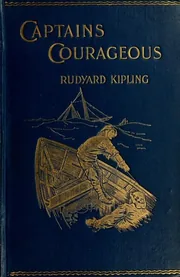
Captains Courageous
by Rudyard Kipling · 1896
It suits teen and adult readers who enjoy classic adventure, and its short length makes it approachable.
150 pages, about 2.5 to 3.5 hours.
A spoiled boy, a cold ocean, and honest work at sea. 56% taste match
The story
Captains Courageous is a sea story by Rudyard Kipling, first published in 1896 and often shelved with young adult fiction and classic literature. Its subtitle, A Story of the Grand Banks, points to the cold North Atlantic waters off Newfoundland, where much of the action takes place among working fishermen and the schooners they sail from New England.
The central figure is Harvey Cheyne Jr., a fifteen-year-old and the spoiled son of a railroad tycoon. He goes overboard from an ocean liner and is pulled from the water by a Portuguese fisherman who takes him aboard a fishing schooner. Once there, he is made to earn his keep as a ship's boy for the length of a fishing season. The book follows a rich teenager adjusting to the crew, the labor of the fishing trade, and the relationships he forms on board, touching on how he comes to see himself. It belongs to the tradition of seafaring tales and is read in school settings as well as for pleasure. Editions run to roughly 150 pages, and the novel has appeared in nearly a thousand editions.
THE weather door of the smoking-room had been left open to the North Atlantic fog, as the big liner rolled and lifted, whistling to warm the fishing-fleet.
Setting
Grand Banks of NewfoundlandNew England
Themes
Teenage boysFishersInterpersonal relationsReadingLiteratureFisher (Mammal)Self-perceptionChildren of the rich
- Want to read 82
- Reading now 7
- Read 17
Most people shelving it are saving it for later.
Of 106 readers who put it on a shelf, 77% want to read it, 7% are reading it now, 16% have finished it and 0% stopped before the end.
By the numbers
- The median edition runs 150 pages. Counting about 275 words a page and an adult reading pace of 250 words a minute, that is about 2.8 hours of reading.
- Open Library tracks 991 editions from 219 publishers, the earliest dated 1896 and the latest 2023, across 9 languages.
- On reader demand it ranks in the top 13% of the classic books in our catalog (8,749 of them).
- Libraries shelve it under Dewey 823 and Library of Congress class PR-4854.00000000.C2 C30.
 BookWard’s take
A spoiled boy, a cold ocean, and honest work at sea
Kipling opens with the fog and the whistling liner, then drops a rich boy into the North Atlantic and hauls him onto a working schooner. The hook is quick and the premise is clean, and it makes for a strong start. The pace holds because the book stays on the crew and the labor of the season. Character depth comes from watching Harvey Cheyne Jr. measured against men who owe him nothing. The ending is a different matter: it's a tidy, comfortable arc, and it leans on the familiar pattern of the pampered youth reformed by hard work. The sea detail is rich and the voice is unmistakably Kipling's, which is where the book earns its place. Short, brisk, and best taken as a classic adventure rather than a surprise.
At roughly 150 pages it is compact, which fits BookWard's love of tight books.
It moves steadily through the fishing season without rushing, a bit calmer than BookWard prefers.
The Grand Banks setting is distinctive, but the reform story itself is well worn.
The prose is textured with sea terms and period rhythm, a touch richer than BookWard's middle ground.
Events drive the book as much as Harvey's change does, so it balances both.
Harvey's growth and the crew's decency give it a clearly hopeful outlook.
It is a plainly told, conventional narrative with no formal experiment.
There is gentle humor in the crew's ribbing, but the tone stays mostly earnest.
The sea carries danger, but the book stays gentle overall.
Feeling builds through friendship and respect without becoming overwrought.
See all 50 dialsEvery position, side by side with this book
Where it lines up
- EndingBookWard 8 · book 8
- Authorial voiceBookWard 9 · book 9
- Story or ideasBookWard 3 · book 3
Where it pulls apart
- Familiar tropesBookWard 10 · book 4
- Internal logicBookWard 10 · book 7
- OriginalityBookWard 9 · book 5
At roughly 150 pages it is compact, which fits BookWard's love of tight books.
A fog-bound liner and a boy going overboard puts the reader in the story almost immediately, which BookWard rewards.
The spoiled rich boy reformed by honest work is a familiar arc, so it sits below BookWard's appetite for fresh ground.
The chain of events from the fall to the season at sea follows plainly and credibly.
It moves steadily through the fishing season without rushing, a bit calmer than BookWard prefers.
The Grand Banks setting is distinctive, but the reform story itself is well worn.
Harvey and the crew are drawn with care, though some of the fishermen read as types.
The book resolves its central arc cleanly, which matches BookWard's liking for closure.
It carries real warmth toward its characters and their bonds, without tipping into syrup.
Hardship comes from the work and the sea, not from darkness used for effect.
Kipling's voice is confident, vivid and unmistakable, exactly the distinctiveness BookWard values.
This is a story-led adventure first, with its ideas carried by incident rather than argument.
Kipling mixes scene with some explaining of ships and trade, so it sits a little above BookWard's show-first preference.
The season at sea keeps finding new work and new faces, so the middle holds up well.
The prose is textured with sea terms and period rhythm, a touch richer than BookWard's middle ground.
Events drive the book as much as Harvey's change does, so it balances both.
Harvey's growth and the crew's decency give it a clearly hopeful outlook.
It is a plainly told, conventional narrative with no formal experiment.
There is gentle humor in the crew's ribbing, but the tone stays mostly earnest.
The nautical vocabulary asks some effort, though the story itself is easy to follow.
The story stays close to Harvey rather than moving among many minds.
Events run in order across a single fishing season.
This is a realistic sea story with no fantastical element.
A schooner crew keeps the cast small and easy to hold in mind.
The stakes are one boy's season, though the ocean setting gives it some breadth.
It follows the work, weather and action on deck more than private reflection.
Crew talk, banter and dialect carry a large share of the telling.
Romance plays no part in this seafaring tale.
Life aboard a Grand Banks schooner is unfamiliar territory for most readers today.
It was published in 1896 and belongs firmly to its period.
The coming-of-age core still works, though the setting is tied to a vanished trade.
The narration is straightforward and trustworthy, with no games played.
The book is clear about the value of honest work and decent character.
Kipling renders the fog, the fleet and the labor of fishing in rich detail.
It is a self-contained standalone novel.
The path is fairly predictable, with few real surprises.
It is largely comforting, a reassuring tale of growth and belonging.
The sea carries danger, but the book stays gentle overall.
Feeling builds through friendship and respect without becoming overwrought.
The humor is mixed, with some broad crew banter alongside drier moments.
There is danger and hardship at sea but little graphic violence.
There is no sexual content.
Class difference is present but never the focus of the story.
Period dialect and fishing terminology make some passages dense going.
Kipling's narration has clear views and a strong storytelling personality.
The book looks back at a way of working and living more than forward.
It believes in work, loyalty and the chance for a person to change.
Review written by BookWard, dial version 1, November 2026.
Who is Captains Courageous right for?
It suits teen and adult readers who enjoy classic adventure, and its short length makes it approachable. The sea dangers and period dialect are the main things to be aware of.
The nautical vocabulary asks some effort, though the story itself is easy to follow.
The sea carries danger, but the book stays gentle overall.
Feeling builds through friendship and respect without becoming overwrought.
There is danger and hardship at sea but little graphic violence.
Book CompanionCaptains Courageous: ideas, characters, themes
A pampered boy is thrown into the hard, honest life of a fishing crew and learns who he is by working alongside them.
- The fall from privilege. Harvey goes overboard from an ocean liner, losing his comfortable world in a moment.
- Rescue at sea. A Portuguese fisherman pulls him from the water and takes him aboard a schooner.
- Earning his keep. He is made to work as a ship's boy for the length of a fishing season.
- Life on the Grand Banks. The book shows the labor and routines of fishermen working the cold North Atlantic.
- Seeing himself anew. Through the crew and the work, Harvey comes to understand himself differently.
Characters
Harvey Cheyne Jr.
Protagonist
A fifteen-year-old, the spoiled son of a railroad tycoon, who must learn to work as a ship's boy.
The Portuguese fisherman
Rescuer
The man who pulls Harvey from the water and brings him aboard the schooner.
Themes
How wealth shapes a boy's view of the world until it is stripped away.
The value of honest labor and skill, learned by doing.
A young person growing into a clearer sense of who he is.
How a crew's shared dependence builds trust and belonging.
How changing circumstances change the way Harvey sees himself.
Discussion questions
- Why does Kipling begin with the fog and the liner before moving to the schooner?
- How does the work itself change Harvey, beyond being told what to do?
- Does the story treat wealth fairly, or does it simplify the rich and the poor?
- What does the crew teach Harvey that his old life could not?
- Does the ending feel earned, and what would a less tidy ending have said?
Personalize your Book Companion
This is the general edition. In BookWard, the Companion is written for you: your reading profile, your notes, and spoiler-safe to the page you are on.
Buy, listen or borrow Captains Courageous
Each link opens a search for this book on that store, in a new tab.
Read on a device
Borrow
Reviews and community
If you liked Captains Courageous
Twain's classic swap story: a prince and a pauper trade places
A Little PrincessFrances Hodgson BurnettA kind girl keeps her dignity when fortune turns against her
The Quiet GentlemanGeorgette HeyerA Regency homecoming where the charming surface hides a murder plot
Where the Red Fern GrowsWilson RawlsA boy, two hounds, and the Ozarks: a classic that earns its tears
Sources: Open Library.
Track Captains Courageous and find your next favorite
Add it to your shelf, rate what you have read, and BookWard will recommend what fits you.
Free to start. No credit card needed.