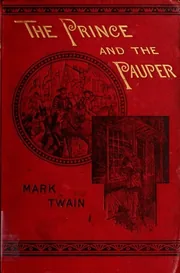
The Prince and the Pauper
by Mark Twain · 1881
It suits younger readers and adults alike, and the graphic edition makes it especially accessible.
256 pages, about 4 to 6 hours.
Twain's classic swap story: a prince and a pauper trade places. 56% taste match
The story
The Prince and the Pauper is a work of historical fiction by American author Mark Twain, first published in 1881. It was his first attempt at the genre, and it belongs to the tradition of classic adventure stories about mistaken identity and lookalikes.
The setting is London and the wider kingdom of England in the years of Edward VI's reign, 1547 to 1553. Edward is a nine-year-old boy who comes to the throne in 1547. Tom Canty is a poor London child who happens to look just like him and who lives with a father who drinks and treats him cruelly. When the two boys trade places, each comes to see how differently the other has lived, one among the poor and the other among kings and rulers. The book follows the ordeals of both boys as each is taken for the other. Many editions of about 256 pages have been printed over the years, and it is often read by younger readers as well as adults.
Setting
London (England)Great BritainEnglandMistaken identity
Period
Edward VI, 1547-1553
Themes
ReadersPoorKings and rulersImpostors and imposturePoor childrenBoysClassic LiteraturePrinces
- Want to read 318
- Reading now 24
- Read 66
- Stopped 1
Most people shelving it are saving it for later.
Of 409 readers who put it on a shelf, 78% want to read it, 6% are reading it now, 16% have finished it and 0% stopped before the end.
By the numbers
- The median edition runs 256 pages. Counting about 275 words a page and an adult reading pace of 250 words a minute, that is about 4.7 hours of reading.
- Open Library tracks 755 editions from 250 publishers, the earliest dated 1881 and the latest 2022, across 17 languages.
- On reader demand it ranks in the top 3% of the classic books in our catalog (8,749 of them).
- Libraries shelve it under Dewey [Fic] and Library of Congress class PZ-0003.00000000.C59 Pr40.
 BookWard’s take
Twain's classic swap story: a prince and a pauper trade places
Twain's first try at historical fiction builds a whole book on one clean premise: two boys who look alike, a London pauper and the nine-year-old heir to England's throne, switch lives. The hook is immediate, and the idea holds together airtight within its own rules. Where it feels less fresh is the familiar ground it covers. Mistaken identity and lookalikes are well-worn territory now, even if Twain helped wear them in. The characters are lighter than I'd like, since both boys mostly exist to serve the lesson about rich and poor. The tone runs warm and sentimental, and the ending resolves everything fully. It is a brisk, readable, humane adventure, and this graphic edition suits readers who want the story without the length.
At 256 pages, and lighter still as a graphic edition, it is compact, which BookWard values.
It moves steadily through the boys' separate ordeals, close to BookWard's preference for brisk reading.
A classic that shaped later swap stories, but its central idea now reads as familiar, short of BookWard's bar.
Twain writes in accessible, clear language, and the graphic format keeps it plainer still.
Events of the swap drive it more than inner change, leaning plot-led against BookWard's character lean.
Its core is a hopeful belief in kindness and fairness, a little warmer than BookWard's already hopeful lean.
A straightforward adventure arc with two linked strands, more conventional than experimental.
Twain's wit lightens an otherwise serious tale about class and cruelty.
It touches on poverty and an abusive, drunken father, but stays largely mild.
Both boys' ordeals carry real feeling without tipping into extremes.
See all 50 dialsEvery position, side by side with this book
Where it lines up
- PaceBookWard 8 · book 7
- EndingBookWard 8 · book 9
- Shock for effectBookWard 9 · book 8
Where it pulls apart
- Familiar tropesBookWard 10 · book 3
- OriginalityBookWard 9 · book 4
- SentimentBookWard 8 · book 4
At 256 pages, and lighter still as a graphic edition, it is compact, which BookWard values.
The look-alike boys and the swap set the story moving early, matching BookWard's wish for an immediate pull.
Mistaken-identity and lookalike plots are familiar territory, so it leans on tropes more than BookWard prefers.
The swap premise holds together on its own terms, and each boy's trouble follows from it, which suits BookWard.
It moves steadily through the boys' separate ordeals, close to BookWard's preference for brisk reading.
A classic that shaped later swap stories, but its central idea now reads as familiar, short of BookWard's bar.
Tom and Edward are clear and sympathetic but built to carry a lesson, so they are less layered than BookWard likes.
Classic adventure stories like this one tie off their threads, which fits BookWard's taste for resolution.
Its warmth and moral purpose are open and heartfelt, more sentimental than BookWard's restrained taste.
Hardships such as Tom's cruel father serve the story's point, though the book stays gentle overall.
Twain's humor and moral stance give it a recognizable personality, though less strongly stamped than his best-known work.
The story leads, driven by the swap, though the rich-and-poor idea runs underneath.
Twain shows much in action but also lays out the moral point plainly at times.
The two parallel ordeals give it forward motion, and the short length keeps it from drifting.
Twain writes in accessible, clear language, and the graphic format keeps it plainer still.
Events of the swap drive it more than inner change, leaning plot-led against BookWard's character lean.
Its core is a hopeful belief in kindness and fairness, a little warmer than BookWard's already hopeful lean.
A straightforward adventure arc with two linked strands, more conventional than experimental.
Twain's wit lightens an otherwise serious tale about class and cruelty.
Easy to follow and welcoming to younger readers, with the graphic format easing it further.
It follows both boys through their separate lives, giving it a dual rather than many-voiced view.
The story proceeds in order through the reign of Edward VI without time shifts.
It is a grounded historical tale with no supernatural element.
The two boys dominate, with a modest supporting group around them, so the cast is moderate.
It moves between a London slum and the royal court, mixing the personal with the national.
Action and circumstance carry the story more than inner reflection does.
Exchanges between the boys and those who mistake them carry a good share of the story.
This is an adventure about class and identity, with no romantic thread.
Tudor London is distant from most readers' experience, so the setting feels unfamiliar.
Set in 1547 to 1553 and written in 1881, it looks firmly to the past.
Over a century on, its swap premise and themes of class and fairness still land, and it is still widely read.
The story is told straightforwardly, with no sense of a narrator hiding anything.
The book plainly sets out compassion and fairness as right and cruelty as wrong.
It gives enough of London and the court to ground the swap without lingering over detail.
It is a self-contained story.
Close escapes and discoveries come regularly, though the swap premise makes much of it foreseeable.
A gentle, accessible read with a moral at its center rather than a hard test of the reader.
It touches on poverty and an abusive, drunken father, but stays largely mild.
Both boys' ordeals carry real feeling without tipping into extremes.
Twain's humor is open and good-natured, leaning broader than dry.
Hardship and some rough treatment appear, but the book keeps it moderate.
There is no sexual content to speak of.
Class, monarchy and justice sit at the heart of the premise, giving it a clear social edge.
The language is straightforward, and the graphic edition makes it plainer still.
Twain's own views on class and kindness show through the telling.
It looks back to the Tudor era, though its concern with fairness reaches forward.
It holds out a belief that empathy across class lines is possible and worth pursuing.
Review written by BookWard, dial version 1, November 2026.
Who is The Prince and the Pauper right for?
It suits younger readers and adults alike, and the graphic edition makes it especially accessible. Sensitive points include a cruel, drinking father and scenes of poverty and rough treatment.
Easy to follow and welcoming to younger readers, with the graphic format easing it further.
It touches on poverty and an abusive, drunken father, but stays largely mild.
Both boys' ordeals carry real feeling without tipping into extremes.
Hardship and some rough treatment appear, but the book keeps it moderate.
Book CompanionThe Prince and the Pauper: ideas, characters, themes
Two look-alike boys, one a prince and one a pauper, swap lives and each learns what the other's world is really like.
- The swap. A poor London boy and the young heir to England's throne trade places, setting up the book's central premise.
- Two worlds. Each boy lives among the other's people, one among the poor and one among kings and rulers.
- Taken for each other. Because they look so alike, each is treated as the other and faces ordeals he did not choose.
- Tudor setting. The story is set in London and England during Edward VI's reign, from 1547 to 1553.
- Twain's first historical novel. Published in 1881, it was Mark Twain's first attempt at historical fiction.
Characters
Edward
The young prince
A nine-year-old who comes to the throne of England in 1547 and takes the pauper's place.
Tom Canty
The London pauper
A poor boy who looks just like Edward and lives with an abusive, drinking father.
Themes
How wealth and birth shape what a person's life is like.
Whether who you are comes from your clothes and position or from within.
Understanding others by living their circumstances.
Whether society treats rich and poor fairly.
How people use or withhold power over those weaker than themselves.
Discussion questions
- What does each boy learn that he could not have learned in his own life?
- Why might Twain have chosen two boys who look alike to explore class?
- How does Tom's home life shape the way he sees the court?
- Does a swap story like this still feel fresh, or is it familiar by now?
- What does the book suggest about whether people are defined by their station?
Personalize your Book Companion
This is the general edition. In BookWard, the Companion is written for you: your reading profile, your notes, and spoiler-safe to the page you are on.
Buy, listen or borrow The Prince and the Pauper
Each link opens a search for this book on that store, in a new tab.
Read on a device
Borrow
Reviews and community
If you liked The Prince and the Pauper
Three Mississippi women, 1962, and one risky project
The RainmakerJohn GrishamA young lawyer, a crooked insurer, and a case worth winning
Strangers in TimeDavid BaldacciTwo wartime orphans, a bookshop, and a widower with secrets
Captains CourageousRudyard KiplingA spoiled boy, a cold ocean, and honest work at sea
Sources: Open Library.
Track The Prince and the Pauper and find your next favorite
Add it to your shelf, rate what you have read, and BookWard will recommend what fits you.
Free to start. No credit card needed.