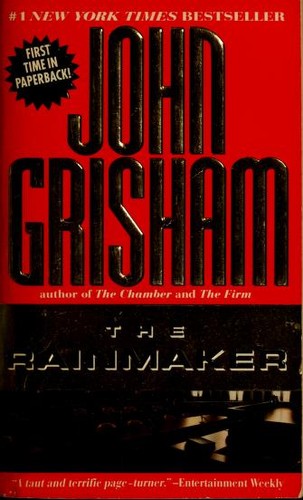
The Rainmaker
by John Grisham
★ Top 10 book of 1995 · #8 on Best Books of 1995
Rudy Baylor, a law student in his last semester, ends up facing a powerful and ruthless company. His fight leads him to expose a vast, multibillion-dollar insurance scam.
Best for: Readers who like legal thrillers about underdogs taking on corrupt corporations
The Rainmaker is #8 on BookWard's Best Books of 1995, out of 28 1995 books that cleared our data bar.
What The Rainmaker is about
Rudy Baylor is close to finishing law school in Memphis and has big hopes of becoming the sort of attorney who wins enormous verdicts, the kind people call a rainmaker. Then his job offer disappears when the firm that planned to hire him is swallowed up by a powerful rival. Short on money and options, he takes work with a shady ambulance chaser and gets guidance from an older former insurance assessor who failed the bar exam six times.
A grieving family and an elderly woman bring him cases against a major insurance company that has refused to pay for treatment. Rudy and his partner open their own small practice and take on the company. Along the way he meets a young woman trapped in a violent marriage, and his sense of what the law is for begins to change. It is a story about ambition meeting conscience, written in a clear, brisk style that suits readers who like courtroom fights with a strong moral center.
The Rainmaker on the Best Books of 1995
The Rainmaker came out in 1995. Of the 28 books first published in 1995 that met BookWard's data bar, it ranks #8 on our Best Books of 1995 list.
Why it made the list: 466 readers have shelved it on Open Library; readers rate it 3.9 out of 5 (34 ratings); 34 are reading it right now. The list ranks each year’s books on how many readers have picked them up, how highly readers rate them, and how many are reading them right now.
Nearby on the 1995 list
- Wicked Gregory Maguire, #6
- The Demon-Haunted World Carl Sagan, #7
- The Diamond Age Neal Stephenson, #9
- Kiss the Girls James Patterson, #10
See all Best Books of 1995 Best books by year
More years: Best Books of 1994 Best Books of 1996.
The numbers behind it
- Readers: 359 want to read it, 34 are reading it now and 73 have read it, according to Open Library.
- Ratings: 3.9 out of 5 from 34 Open Library ratings.
| Signal | This book (0 to 100) | Weight |
|---|---|---|
| Reach | 75 | 55% |
| Reader love | 39 | 25% |
| Being read right now | 89 | 20% |
Questions about The Rainmaker
When was The Rainmaker published?
The Rainmaker by John Grisham was first published in 1995.
Was The Rainmaker one of the best books of 1995?
The Rainmaker is #8 on BookWard's Best Books of 1995, out of 28 1995 books that cleared our data bar. 466 readers have shelved it on Open Library; readers rate it 3.9 out of 5 (34 ratings); 34 are reading it right now.
Why is The Rainmaker on the Best Books of 1995 list?
466 readers have shelved it on Open Library; readers rate it 3.9 out of 5 (34 ratings); 34 are reading it right now.
More of the best books of 1995
- The Lost World Michael Crichton, #1
- Emotional Intelligence Daniel Goleman, #2
- Northern Lights Philip Pullman, #3
- Rose Madder Stephen King, #4
- Mindhunter John E. Douglas, #5
- Wicked Gregory Maguire, #6
See the full Best Books of 1995, the Top 100, or new books on Rising.
How we know
This page uses public data: Open Library reader counts and ratings, and Wikipedia page views for recent years. The description is paraphrased from real source text. Rankings reflect reading interest, not quality or sales, and can be affected by data gaps. Lists update monthly.
Suits adult and older teen readers who enjoy courtroom drama.
Depends on the edition you pick.
A young lawyer, a crooked insurer, and a case worth winning. 55% taste match
 BookWard’s take
A young lawyer, a crooked insurer, and a case worth winning
The Rainmaker follows Rudy Baylor, a law student who loses his job offer just before graduation and ends up taking on an insurance giant on behalf of a family denied a bone marrow transplant. It hooks at once, because the injustice is clear and the clock is ticking. The internal logic is tight: legal maneuvers follow from one another and nothing feels arbitrary. The pace stays brisk and the middle never sags. This is a story-driven book, written in plain prose and built on a conventional courtroom structure. Where it gets less original is in its legal-thriller machinery, and the sentiment runs warmer than I tend to like. Still, it earns its stakes and delivers a satisfying resolution.
A full-sized legal thriller, longer than BookWard's tight preference, though the story justifies most of it.
Events keep moving through hospitals, offices and courtrooms, close to the brisk pace BookWard likes.
The insurance-denial case gives it a grounded edge, but the legal-thriller frame is well worn, short of BookWard's high bar.
The prose is plain and functional, a little plainer than BookWard's middle ground.
Plot mechanics drive most of it, though Rudy's growth matters, a touch more plot-led than BookWard's taste.
Underdog determination gives it an upbeat undertow even amid bleak circumstances, in line with BookWard.
Told in a conventional, chronological sequence, plainer than BookWard's slightly adventurous middle.
Mostly serious, with occasional wry notes around the ambulance-chasing world, below BookWard's lean toward humor.
Illness, abuse and corporate cruelty give it real weight, near BookWard's middle.
The family's plight and the abuse subplot generate real feeling, close to BookWard's level.
See all 50 dialsEvery position, side by side with this book
Where it lines up
- EndingBookWard 8 · book 8
- Story or ideasBookWard 3 · book 3
- Sagging middleBookWard 8 · book 8
Where it pulls apart
- Familiar tropesBookWard 10 · book 4
- LengthBookWard 1 · book 6
- OriginalityBookWard 9 · book 5
A full-sized legal thriller, longer than BookWard's tight preference, though the story justifies most of it.
A sick young man denied a transplant and a protagonist suddenly out of work pull you in from the start, just as BookWard wants.
Underdog lawyer versus corrupt corporation is a familiar setup, which sits below BookWard's strong preference for avoiding tropes.
Legal and insurance maneuvers follow cause and effect cleanly, matching BookWard's taste for airtight plotting.
Events keep moving through hospitals, offices and courtrooms, close to the brisk pace BookWard likes.
The insurance-denial case gives it a grounded edge, but the legal-thriller frame is well worn, short of BookWard's high bar.
Rudy and the people around him are drawn with enough texture to matter, though some supporting figures lean toward types.
The central case reaches a clear conclusion, which fits BookWard's preference for resolution.
The Black family's plight is played for real feeling, warmer than the restraint BookWard favors.
Its darker turns grow out of the abuse and denial of care at the story's core, which BookWard credits as earned.
Grisham's plainspoken courtroom style is recognizable, though not as singular as BookWard's top picks.
This is a story-led book; the insurance scandal serves the plot, which suits BookWard's story preference.
Legal procedure is often explained to the reader directly, more than the show-in-scene BookWard prefers.
The case keeps escalating, so the middle holds up, as BookWard likes.
The prose is plain and functional, a little plainer than BookWard's middle ground.
Plot mechanics drive most of it, though Rudy's growth matters, a touch more plot-led than BookWard's taste.
Underdog determination gives it an upbeat undertow even amid bleak circumstances, in line with BookWard.
Told in a conventional, chronological sequence, plainer than BookWard's slightly adventurous middle.
Mostly serious, with occasional wry notes around the ambulance-chasing world, below BookWard's lean toward humor.
An easy, fast read with no barriers, a little easier than BookWard's taste.
The story stays with one protagonist, short of the multiple viewpoints BookWard enjoys.
Events unfold in order, more linear than BookWard's mild appetite for time-shifting.
Entirely realistic, grounded in law, medicine and business, more so than BookWard's middle position.
A sizable supporting cast of clients, partners and opponents sits a bit above BookWard's small-cast comfort.
One young lawyer's cases anchor the book, though the corporate stakes widen it slightly; roughly BookWard's middle.
Action in offices, hospitals and courtrooms dominates over reflection, more outward than BookWard's mix.
Meetings, depositions and courtroom exchanges carry much of the book, matching BookWard's liking for dialogue.
Rudy's bond with Kelly is a real thread but not the engine of the story, near BookWard's middle.
Memphis law offices and hospitals are mostly familiar ground, less unfamiliar than BookWard likes.
Set in its mid-1990s moment, a little further from the present than BookWard's leaning.
The insurance-denial theme still resonates, though the book is clearly rooted in its period.
Rudy tells it straightforwardly, a reliable guide, unlike BookWard's taste for unreliability.
Right and wrong are drawn clearly, with a sympathetic family against a ruthless insurer, clearer than BookWard prefers.
Settings are sketched efficiently rather than lushly, around BookWard's middle.
A standalone novel, matching BookWard's middle position.
Legal reversals and surprises arrive regularly, a bit fewer than BookWard enjoys.
A satisfying page-turner with a righteous streak, more comforting than challenging.
Illness, abuse and corporate cruelty give it real weight, near BookWard's middle.
The family's plight and the abuse subplot generate real feeling, close to BookWard's level.
Humor is mostly dry and situational, slightly drier than BookWard's middle.
Domestic abuse and its aftermath are present but not lingered over, near BookWard's comfort.
Romantic and sexual content is present but modest, below BookWard's middle.
Corporate greed and the health insurance system are central themes, near BookWard's middle.
Language is plain with some legal jargon, easier than BookWard's middle.
The narration takes a clear side against the insurer, a touch more opinionated than neutral.
It looks at present-day wrongs more than the future, a bit more backward-facing than BookWard's tilt.
It believes a determined lawyer can make a difference, close to BookWard's idealistic lean.
Review written by BookWard, dial version 1, November 2026.
Who is The Rainmaker right for?
Suits adult and older teen readers who enjoy courtroom drama. It deals with serious illness and domestic abuse, which some readers may find upsetting.
An easy, fast read with no barriers, a little easier than BookWard's taste.
Illness, abuse and corporate cruelty give it real weight, near BookWard's middle.
The family's plight and the abuse subplot generate real feeling, close to BookWard's level.
Domestic abuse and its aftermath are present but not lingered over, near BookWard's comfort.
Book CompanionThe Rainmaker: ideas, characters, themes
A newly minted lawyer takes on a powerful insurer that refused to cover a dying young man's treatment.
- The title's meaning. A rainmaker is a lawyer who wins spectacular cases and earns huge damages, which Rudy dreams of becoming.
- Rudy's setback. His job vanishes when his employer is bought out by a firm that represents the insurer.
- The ambulance-chasing world. Rudy joins a ruthless personal injury operation and learns its shady methods from a mentor.
- The Black family case. A denied bone marrow transplant for leukemia-stricken Donny Ray becomes the case that matters most.
- Kelly's situation. Rudy meets a young woman recovering from injuries inflicted by her husband, and a bond forms.
Characters
Rudy Baylor
Protagonist
A third-year law student at Memphis State chasing a big break.
Dot and Buddy Black
Clients
A poor family whose son Donny Ray needs a transplant their insurer denied.
J. Lyman "Bruiser" Stone
Employer
A ruthless, successful ambulance chaser with corrupt business dealings.
Deck Shifflet
Mentor
A former insurance assessor with a law degree who failed the bar exam six times.
Kelly Riker
Love interest
A teenage patient recovering from injuries inflicted by her husband.
Themes
Whether an individual can hold a huge corporation to account.
How far lawyers bend the rules to win clients and cases.
The human cost when coverage is denied.
Rudy's dream of becoming a rainmaker and what it costs.
The fear that keeps a victim from leaving.
Discussion questions
- Why does Rudy's dream of being a rainmaker come true differently than he expected?
- How do Bruiser Stone's methods compare with what Rudy believes a lawyer should be?
- What makes the Black family's case so compelling as the center of the story?
- How does Rudy's relationship with Kelly shape his choices?
- Does the book make the insurance fight feel realistic or simplified?
Personalize your Book Companion
This is the general edition. In BookWard, the Companion is written for you: your reading profile, your notes, and spoiler-safe to the page you are on.
Buy, listen or borrow The Rainmaker
Each link opens a search for this book on that store, in a new tab.
Read on a device
Borrow
Reviews and community
If you liked The Rainmaker
A big-firm lawyer walks out and takes a secret file with him
The ClientJohn GrishamA boy, a dead body, and a lawyer worth rooting for
The FirmJohn GrishamA fast, polished legal thriller that made Grisham a household name
The Eyes of DarknessDean KoontzA grieving mother, a chalkboard message, and a race north
Find your own best books
Add what you have read, rate it, and BookWard will recommend what to read next.
Free to start. No credit card needed.