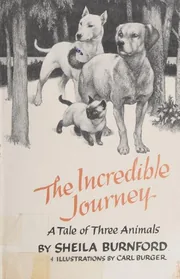
The Incredible Journey
by Sheila Burnford · 1960
This suits young readers who enjoy animal adventure and survival stories, and it reads well aloud or alone.
145 pages, about 2.5 to 3.5 hours.
Three pets, 300 miles of Canadian wilderness, and no way but forward. 55% taste match
About the book
Sheila Burnford's The Incredible Journey is a children's adventure novel about animals, first published in 1960. It follows three household pets: Luath, Bodger and Tao, a Siamese cat. Separated from the people who keep them, the trio sets out across roughly 300 miles of Canadian wilderness, heading toward home. Along the way the story shows the hardship and strain of such a trek, and keeps its attention on the devotion and nerve of the animals as they press on together.
The action unfolds in the northwestern corner of Ontario, a region of lakes, rivers and small farms and towns spread far apart. John Longridge and Mrs. Oakes are among the people who appear in the book. Because the story centers on survival in the wild and on the bond between pets and their owners, it sits comfortably alongside other juvenile fiction about dogs, cats and animals in general. The book runs to about 145 pages in its typical edition, and it has appeared in dozens of editions since it was first released.
This journey took place in a part of Canada which lies in the northwestern part of the great sprawling province of Ontario.
Characters
LuathBodgerTaoJohn LongridgeMrs. Oakes
Setting
CanadaOntario
Themes
Adventure and adventurersdogspetssiamese catsWilderness survivalAnimalsChildren's storiesChildren's literature
- Want to read 152
- Reading now 13
- Read 37
Most people shelving it are saving it for later.
Of 202 readers who put it on a shelf, 75% want to read it, 6% are reading it now, 18% have finished it and 0% stopped before the end.
By the numbers
- The median edition runs 145 pages. Counting about 275 words a page and an adult reading pace of 250 words a minute, that is about 2.7 hours of reading.
- Open Library tracks 95 editions from 51 publishers, the earliest dated 1960 and the latest 2013, across 4 languages.
- On reader demand it ranks in the top 6% of the classic books in our catalog (8,749 of them).
- Libraries shelve it under Dewey 813.54 and Library of Congress class PZ-0010.30000000.B935 In 1996.
 BookWard’s take
Three pets, 300 miles of Canadian wilderness, and no way but forward
A short, lean adventure that wastes no time. Luath, Bodger and Tao set out across northwestern Ontario toward home, and the book keeps its eye on the road. At 145 pages it is tight in the best way, and the pace is brisk throughout. It draws on the old tropes of animal survival tales, so it is not original, yet it is plainly told and holds together. The journey itself supplies the structure, which keeps the story steady from start to finish. Sentiment is where I part company with it: loyalty and courage are the whole point, and the book is warmer than I would like. Still, it is a clean, sustained trek with no sagging middle, and it earns its place as a children's classic.
At 145 pages it is as tight as a full novel gets, which matches BookWard's love of short books.
The trek keeps moving with little padding, a little brisker than slow but short of breakneck, close to BookWard's pace.
Animals crossing wilderness toward home is a familiar premise, so it rates lower than BookWard likes.
The writing is direct and readable for young readers, close to BookWard's plainer-leaning taste.
The route and its obstacles drive the book more than inner change, so it sits more plot-led than BookWard.
Loyalty and the pull toward home give the book an encouraging outlook, in step with BookWard.
It follows a straight line from setting out to arriving, more conventional than BookWard's middle position.
The tone is earnest survival adventure with little comedy, more serious than BookWard's lightly funny taste.
Hardship and strain are part of the trek, but the tone stays suited to young readers, a little gentler than BookWard.
Devotion and the strain of the road give the book real feeling, near BookWard's middle.
See all 50 dialsEvery position, side by side with this book
Where it lines up
- LengthBookWard 1 · book 1
- EndingBookWard 8 · book 8
- Sagging middleBookWard 8 · book 8
Where it pulls apart
- Familiar tropesBookWard 10 · book 4
- OriginalityBookWard 9 · book 4
- OpeningBookWard 10 · book 7
At 145 pages it is as tight as a full novel gets, which matches BookWard's love of short books.
It sets the three animals on their way early, which suits BookWard, though the opening is more steady than gripping.
The faithful-animals-heading-home setup is a well-worn shape, so BookWard would want more freshness here.
The journey gives the story a clear spine, and events follow from the terrain and the animals' needs, as BookWard prefers.
The trek keeps moving with little padding, a little brisker than slow but short of breakneck, close to BookWard's pace.
Animals crossing wilderness toward home is a familiar premise, so it rates lower than BookWard likes.
Luath, Bodger and Tao are drawn with distinct natures, though animal characters stay simpler than BookWard's ideal.
A journey toward home points to a clear resolution, which fits BookWard's liking for closure.
Devotion and loyalty are central, so the book leans warmer and more affecting than BookWard's restrained taste.
The hardship is part of the survival story and serves it, rather than being used for cheap effect, which BookWard respects.
The telling is clear and confident but plain, a little less distinctive than BookWard favors.
This is story all the way, a journey told as a journey, which matches BookWard's story-led lean.
The trek is shown through events and the animals' choices more than explained, in line with BookWard.
A single road gives the book forward motion from start to finish, which BookWard rewards.
The writing is direct and readable for young readers, close to BookWard's plainer-leaning taste.
The route and its obstacles drive the book more than inner change, so it sits more plot-led than BookWard.
Loyalty and the pull toward home give the book an encouraging outlook, in step with BookWard.
It follows a straight line from setting out to arriving, more conventional than BookWard's middle position.
The tone is earnest survival adventure with little comedy, more serious than BookWard's lightly funny taste.
It is written for young readers and reads easily, lighter going than BookWard's moderate preference.
The story follows three animals, giving more than one angle, a bit short of BookWard's many-viewpoint taste.
The journey runs forward in order without jumps, more linear than BookWard's middle setting.
It is a grounded survival story about real animals, more realistic than BookWard's middle setting.
Three animals carry the book, with a few people at the edges, a smaller cast than BookWard's middle.
The trek is 300 miles across wilderness, though the focus stays on three companions, so it lands mid-scale.
The story is about travel and survival, so action outweighs inner thought, more outward than BookWard's balance.
Animals do not speak, so the book has little dialogue, lighter than BookWard's taste.
Romance does not figure in a story about pets and their owners, a little lighter than BookWard's middle.
The northwestern Ontario backcountry of lakes and rivers is an unfamiliar setting for most readers, as BookWard likes.
First published in 1960, it reads as a mid-century book, older than BookWard's present-day lean.
Its themes of loyalty and courage have kept it in print across many editions, matching BookWard's liking for lasting books.
The narration is a straightforward guide to the journey, more reliable than BookWard's unreliable preference.
Loyalty and courage are plainly good here, so the moral picture is clearer than BookWard's ambiguity.
Lakes, rivers and wilderness give the book a vivid sense of place, a bit richer than BookWard's middle.
It stands alone as a single story, in line with BookWard's standalone lean.
A journey story offers setbacks more than twists, so it surprises less than BookWard prefers.
It is an accessible, comforting-leaning read for children, gentler than BookWard's taste for challenge.
Hardship and strain are part of the trek, but the tone stays suited to young readers, a little gentler than BookWard.
Devotion and the strain of the road give the book real feeling, near BookWard's middle.
Humor is a minor note in a serious adventure, so it leans dry and light, a touch under BookWard's middle.
Danger and hardship appear, but the book is aimed at children and keeps it measured, a bit below BookWard's middle.
There is no sexual content in a children's animal adventure, below BookWard's middle.
The story is about survival and loyalty, with politics absent, below BookWard's middle.
The language is plain and meant for young readers, below BookWard's middle.
The narration stays with the animals and events rather than pushing opinions, a bit under BookWard's middle.
It looks back to a mid-century world and a simple journey, more backward-facing than BookWard.
Loyalty and courage are treated as worth admiring, so the outlook is idealistic, close to BookWard's lean.
Review written by BookWard, dial version 1, November 2026.
Who is The Incredible Journey right for?
This suits young readers who enjoy animal adventure and survival stories, and it reads well aloud or alone. The trek involves hardship and danger for the animals, which sensitive readers may find upsetting at times.
It is written for young readers and reads easily, lighter going than BookWard's moderate preference.
Hardship and strain are part of the trek, but the tone stays suited to young readers, a little gentler than BookWard.
Devotion and the strain of the road give the book real feeling, near BookWard's middle.
Danger and hardship appear, but the book is aimed at children and keeps it measured, a bit below BookWard's middle.
Book CompanionThe Incredible Journey: ideas, characters, themes
Three pets cross roughly 300 miles of Canadian wilderness toward the people they belong to, held together by loyalty and courage.
- Three companions. The story follows Luath, Bodger and Tao, a Siamese cat, as they travel together across the wilderness.
- A long way home. They head about 300 miles through northwestern Ontario in search of their owners.
- Hardship on the road. The book shows the suffering and strain of the trek, not just the adventure of it.
- Loyalty and courage. The animals' devotion and nerve carry the story from start to finish.
- A place of lakes and rivers. The setting is a region of lakes, rivers and small, widely spaced farms and towns.
Characters
Luath
One of the three traveling pets
One of the animals making the long journey home across the wilderness.
Bodger
One of the three traveling pets
A fellow traveler whose bond with the others helps carry the trio forward.
Tao
The Siamese cat
The cat who completes the trio on the journey toward home.
John Longridge
A person in the story
One of the people who appear in the book.
Mrs. Oakes
A person in the story
Another of the people who appear in the book.
Themes
The animals' devotion to each other and to the people they are trying to reach.
Pressing on through danger and exhaustion when turning back is not an option.
The practical struggle to stay alive in the wild.
The pull of the place and people that give the journey its purpose.
How three very different animals depend on one another.
Discussion questions
- Why do you think the story keeps its attention on the animals rather than on the people they are looking for?
- How does the setting of lakes, rivers and distant farms shape the dangers the animals face?
- What do Luath, Bodger and Tao each bring to the group, and how do they depend on one another?
- Is the book more about reaching home or about the journey itself?
- How does the book balance hardship with hope, and where do you feel that balance most?
Personalize your Book Companion
This is the general edition. In BookWard, the Companion is written for you: your reading profile, your notes, and spoiler-safe to the page you are on.
Buy, listen or borrow The Incredible Journey
Each link opens a search for this book on that store, in a new tab.
Read on a device
Borrow
Reviews and community
If you liked The Incredible Journey
Two wartime orphans, a bookshop, and a widower with secrets
EnduranceAlfred LansingA true survival story that reads like a tightly built thriller
The RiverGary PaulsenA short, tense survival sequel that stays on the water
The Eyes of DarknessDean KoontzA grieving mother, a chalkboard message, and a race north
Sources: Open Library.
Track The Incredible Journey and find your next favorite
Add it to your shelf, rate what you have read, and BookWard will recommend what fits you.
Free to start. No credit card needed.