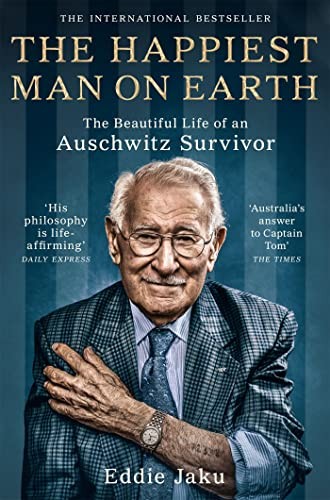
The Happiest Man on Earth
by Eddie Jaku
★ Top 25 book of 2020 · #14 on Best Books of 2020
Eddie Jaku, a Jewish man born in Leipzig, recounts surviving seven years in Nazi camps and the death march that ended them. At 100, he shares what gratitude, kindness and tolerance have taught him about living well.
Best for: Readers seeking an uplifting Holocaust memoir about gratitude and resilience
The Happiest Man on Earth is #14 on BookWard's Best Books of 2020, out of 65 2020 books that cleared our data bar.
What The Happiest Man on Earth is about
Eddie Jaku was a young man in Leipzig when Kristallnacht arrived in November 1938. He was beaten, arrested and taken to a concentration camp, and the years that followed carried him through Buchenwald, Auschwitz and a forced death march. His family, his friends and his homeland were all taken from him, yet he came out of it with a resolve he has kept ever since: to smile each day, as thanks for being alive and as a way of remembering the six million Jews who were murdered.
Written when he was 100, this memoir shows how a person can look back on unimaginable cruelty and still speak of gratitude. It is described as an uplifting memoir in the vein of The Last Lecture and Man's Search for Meaning.
The Happiest Man on Earth on the Best Books of 2020
The Happiest Man on Earth came out in 2020. Of the 65 books first published in 2020 that met BookWard's data bar, it ranks #14 on our Best Books of 2020 list.
Why it made the list: 282 readers have shelved it on Open Library; readers rate it 4.8 out of 5 (16 ratings). The list ranks each year’s books on how many readers have picked them up, how highly readers rate them, and how many are reading them right now.
Nearby on the 2020 list
- Guest List Lucy Foley, #12
- From Blood and Ash Jennifer L. Armentrout, #13
- Cat Kid Comic Club Dav Pilkey, #15
- Heart Bones Colleen Hoover, #16
See all Best Books of 2020 Best books by year
More years: Best Books of 2019 Best Books of 2021.
The numbers behind it
- Readers: 249 want to read it, 15 are reading it now and 18 have read it, according to Open Library.
- Ratings: 4.8 out of 5 from 16 Open Library ratings.
| Signal | This book (0 to 100) | Weight |
|---|---|---|
| Reach | 49 | 55% |
| Reader love | 97 | 25% |
| Being read right now | 74 | 20% |
Questions about The Happiest Man on Earth
When was The Happiest Man on Earth published?
The Happiest Man on Earth by Eddie Jaku was first published in 2020.
Was The Happiest Man on Earth one of the best books of 2020?
The Happiest Man on Earth is #14 on BookWard's Best Books of 2020, out of 65 2020 books that cleared our data bar. 282 readers have shelved it on Open Library; readers rate it 4.8 out of 5 (16 ratings).
Why is The Happiest Man on Earth on the Best Books of 2020 list?
282 readers have shelved it on Open Library; readers rate it 4.8 out of 5 (16 ratings).
More of the best books of 2020
- Good Girl, Bad Blood Holly Jackson, #1
- The Inheritance Games Jennifer Lynn Barnes, #2
- The Psychology of Money Morgan Housel, #3
- The Ballad of Songbirds and Snakes Suzanne Collins, #4
- Heartstopper, Volume 3 Alice Oseman, #5
- The Midnight Library Matt Haig, #6
See the full Best Books of 2020, the Top 100, or new books on Rising.
How we know
This page uses public data: Open Library reader counts and ratings, and Wikipedia page views for recent years. The description is paraphrased from real source text. Rankings reflect reading interest, not quality or sales, and can be affected by data gaps. Lists update monthly.
Suited to mature teens and adults, and widely read in schools and families.
Depends on the edition you pick.
A survivor's short, warm memoir built on gratitude and kindness. 53% taste match
 BookWard’s take
A survivor's short, warm memoir built on gratitude and kindness
Eddie Jaku tells his own story, from Leipzig and Kristallnacht through Buchenwald and Auschwitz to a forced death march, then turns to what he learned from it. The book is personal and plainly told, with an outlook that is hopeful where the events themselves are not. That hopefulness is where it parts company most gladly from the restrained memoirs I usually favor: it runs warmer and more sentimental than they do. The real strength is the voice, since a storyteller's own warmth carries the pages. It is lean, the man himself is drawn with real specificity, and it asks little of the reader. It earns its darkness by being true, and it never leans on shock.
A brisk memoir that keeps its telling concise, which suits BookWard's preference for tight books.
Years of events move quickly through short, direct passages rather than lingering.
The history is well known, though his claim to happiness gives it a distinct angle.
Plain, conversational language with little ornament, which fits the spoken feel.
Driven by one man's experience and inner response more than by plot machinery.
Its whole purpose is to show that a good life is possible after devastation.
Serious in subject, with only light touches of warmth rather than humor.
Concentration camps and persecution make the content heavy, though handled without relish.
Loss and gratitude are felt strongly throughout.
See all 50 dialsEvery position, side by side with this book
Where it lines up
- EndingBookWard 8 · book 8
- Shock for effectBookWard 9 · book 9
- LengthBookWard 1 · book 2
Where it pulls apart
- Familiar tropesBookWard 10 · book 5
- OriginalityBookWard 9 · book 4
- SentimentBookWard 8 · book 3
A brisk memoir that keeps its telling concise, which suits BookWard's preference for tight books.
Survivor memoirs and gratitude messages follow familiar shapes, so it sits in the middle on freshness.
A life told in clear sequence, with each stage following from the last.
Years of events move quickly through short, direct passages rather than lingering.
The history is well known, though his claim to happiness gives it a distinct angle.
His life and his conclusions about gratitude are brought to a clear close.
It is openly warm and affirming, which is less restrained than BookWard usually prefers.
The horrors are real and recounted because they happened, not to jolt the reader.
It rests on one person's memory and reflection rather than documented, cross-checked research.
A storyteller's warm, personal manner comes through and gives the book its identity.
Story carries the book, but its central pull is the philosophy of gratitude drawn from it.
Short and focused, it holds its energy without a baggy stretch.
Plain, conversational language with little ornament, which fits the spoken feel.
Driven by one man's experience and inner response more than by plot machinery.
Its whole purpose is to show that a good life is possible after devastation.
Serious in subject, with only light touches of warmth rather than humor.
Accessible and clearly written, easy to read in a few sittings despite heavy material.
Told entirely from the author's own point of view.
A true account, firmly grounded in documented history.
The focus stays on the author and a small circle of people around him.
One life, though set against vast historical events.
It balances what happened to him with how he came to understand it.
Not a romance; relationships appear only as part of his wider story.
The camps and wartime Germany are unfamiliar territory for most readers.
Set largely in the 1930s and 1940s, with reflection from the present.
Its themes of kindness and gratitude are not tied to a single moment.
A plainspoken first-person account with no sign of trickery.
It speaks with clear conviction about tolerance, kindness and gratitude.
Detail serves the events rather than lingering on scenery.
It reads as a told life story, not an analytical argument.
Entirely first-person, grounded in his own experience and feelings.
A single standalone memoir.
A life story with few narrative surprises beyond the events themselves.
The history is hard, but the book's message leans toward comfort and uplift.
Concentration camps and persecution make the content heavy, though handled without relish.
Loss and gratitude are felt strongly throughout.
Essentially absent.
The Nazi regime is central, though the book's focus is human rather than partisan.
Clear, plain English throughout.
He states his views on life and kindness openly and often.
Mostly a look back, though its lessons are aimed at the reader's future.
It argues firmly that kindness and gratitude can make life beautiful.
Review written by BookWard, dial version 1, November 2026.
Who is The Happiest Man on Earth right for?
Suited to mature teens and adults, and widely read in schools and families. It covers persecution, camps and mass murder, though told with restraint and an uplifting aim.
Accessible and clearly written, easy to read in a few sittings despite heavy material.
Concentration camps and persecution make the content heavy, though handled without relish.
Loss and gratitude are felt strongly throughout.
Book CompanionThe Happiest Man on Earth: ideas, characters, themes
A Holocaust survivor argues that gratitude, kindness and choosing to smile can make a good life possible even after unimaginable loss.
- Before the war. Eddie Jaku is born in Leipzig into a Jewish family, and his teenage world is overturned.
- Kristallnacht. On November 9, 1938, he is beaten by SS men, arrested and sent to a concentration camp.
- Years in the camps. He endures Buchenwald and Auschwitz and a forced death march near the end of the war.
- A promise. Grateful to have survived, he vows to smile every day and honor the six million Jews murdered.
- A life of gratitude. At 100 he reflects on tolerance, kindness and living his best possible life.
Characters
Eddie Jaku
Author and narrator
A Leipzig-born survivor who recounts his ordeal and the outlook he built afterward.
Themes
Valuing the gift of survival and of each ordinary day.
Choosing compassion toward others as a way of living.
Rejecting hatred and accepting people across differences.
Honoring those who were lost by telling their story.
Keeping one's spirit intact against overwhelming odds.
Discussion questions
- What does it mean for Jaku to call himself the happiest man on earth?
- How does gratitude function as a choice rather than a feeling in this book?
- Why might a survivor emphasize kindness over bitterness?
- How does the memoir balance horror with hope?
- What would it take to apply his advice in your own life?
Personalize your Book Companion
This is the general edition. In BookWard, the Companion is written for you: your reading profile, your notes, and spoiler-safe to the page you are on.
Buy, listen or borrow The Happiest Man on Earth
Each link opens a search for this book on that store, in a new tab.
Read on a device
Borrow
Reviews and community
If you liked The Happiest Man on Earth
A neurosurgeon's rise from a Detroit failing student to Johns Hopkins
Let Me Hear Your VoiceCatherine MauriceA mother's urgent, unsparing account of fighting her daughter's autism
The Boy Who Harnessed the WindWilliam KamkwambaA Malawian teenager builds a windmill from scrap and stubbornness
Where the Red Fern GrowsWilson RawlsA boy, two hounds, and the Ozarks: a classic that earns its tears
Find your own best books
Add what you have read, rate it, and BookWard will recommend what to read next.
Free to start. No credit card needed.