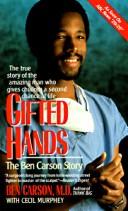
Gifted Hands
by Ben Carson
★ Top 25 book of 1990 · #11 on Best Books of 1990
Ben Carson rose from inner-city Detroit, poor grades and a fierce temper to become head of pediatric neurosurgery at Johns Hopkins at 33. His story covers landmark operations, including separating conjoined twins, and the role of his mother's faith in him.
Best for: Readers who enjoy inspiring true stories of overcoming poverty and doubt through determination.
Gifted Hands is #11 on BookWard's Best Books of 1990, out of 39 1990 books that cleared our data bar.
What Gifted Hands is about
Ben Carson tells his own story here, with writing help from Cecil Murphey. He begins in a poor Detroit neighborhood, where his mother Sonya raises him and his brother Curtis on her own after their father leaves. Money is tight, and she faces mental health troubles of her own. Young Ben does badly at school and has a temper that gets him into trouble. The turn comes when he commits to his studies, earns top marks and wins a place in Yale's premed program.
The account follows him on through college, where he meets his future wife, Candy Rustin, and into medical school and a neurosurgery residency at Johns Hopkins. It covers his rise to the post of youngest director of pediatric neurosurgery there, a landmark 1987 operation to separate conjoined twins, and his work on hemispherectomy. It is an earnest, faith-centered story in which Ben, raised by his mother Sonya in inner-city Detroit, goes from failing grades to a career as a pediatric neurosurgeon, relying on trust in God. A 2009 film adaptation followed.
Gifted Hands on the Best Books of 1990
Gifted Hands came out in 1990. Of the 39 books first published in 1990 that met BookWard's data bar, it ranks #11 on our Best Books of 1990 list.
Why it made the list: 286 readers have shelved it on Open Library; readers rate it 4.4 out of 5 (16 ratings); 30 are reading it right now. The list ranks each year’s books on how many readers have picked them up, how highly readers rate them, and how many are reading them right now.
Nearby on the 1990 list
- Maniac Magee Jerry Spinelli, #9
- Four Past Midnight Stephen King, #10
- Oh, the Places You'll Go! Dr. Seuss, #12
- The Beauty Myth Naomi Wolf, #13
See all Best Books of 1990 Best books by year
More years: Best Books of 1991.
The numbers behind it
- Readers: 238 want to read it, 30 are reading it now and 18 have read it, according to Open Library.
- Ratings: 4.4 out of 5 from 16 Open Library ratings.
| Signal | This book (0 to 100) | Weight |
|---|---|---|
| Reach | 64 | 55% |
| Reader love | 82 | 25% |
| Being read right now | 85 | 20% |
Questions about Gifted Hands
When was Gifted Hands published?
Gifted Hands by Ben Carson was first published in 1990.
Was Gifted Hands one of the best books of 1990?
Gifted Hands is #11 on BookWard's Best Books of 1990, out of 39 1990 books that cleared our data bar. 286 readers have shelved it on Open Library; readers rate it 4.4 out of 5 (16 ratings); 30 are reading it right now.
Why is Gifted Hands on the Best Books of 1990 list?
286 readers have shelved it on Open Library; readers rate it 4.4 out of 5 (16 ratings); 30 are reading it right now.
More of the best books of 1990
- Good Omens Terry Pratchett, #1
- Jurassic Park Michael Crichton, #2
- The Eye of the World Robert Jordan, #3
- The Witching Hour Anne Rice, #4
- Flow Mihaly Csikszentmihalyi, #5
- The Things They Carried Tim O'Brien, #6
See the full Best Books of 1990, the Top 100, or new books on Rising.
How we know
This page uses public data: Open Library reader counts and ratings, and Wikipedia page views for recent years. The description is paraphrased from real source text. Rankings reflect reading interest, not quality or sales, and can be affected by data gaps. Lists update monthly.
Suits teens and adults, and is often read as an inspirational story about overcoming hardship.
Depends on the edition you pick.
A neurosurgeon's rise from a Detroit failing student to Johns Hopkins. 46% taste match
 BookWard’s take
A neurosurgeon's rise from a Detroit failing student to Johns Hopkins
Gifted Hands is Ben Carson's first-person account of going from a struggling kid in inner-city Detroit to directing pediatric neurosurgery at Johns Hopkins at 33. It opens with his father leaving when he is eight, so the stakes arrive early. The structure is conventional and the arc is clean: hardship, effort, mastery, with Sonya Carson at the center of the early chapters. Carson comes across as clear and driven, though a self-portrait naturally leans admiring. The tone is warm, and the faith that shapes his story is stated outright rather than hinted at. The prose is direct, with Carson explaining what he learned as he goes. The outlook is firmly hopeful and the story is fully resolved. Read it for the surgical chapters and the family story underneath them.
A standard-length memoir that covers childhood through a surgical career without sprawling, which sits mid-scale against BookWard's love of tight books.
Moves briskly through childhood, college, and training, then slows for the surgical set pieces.
The material is distinctive, but the inspirational-memoir form it sits in is well worn.
Straightforward, accessible writing with little ornament, a bit plainer than BookWard's middle ground.
Driven by one person's growth and choices, with achievements as milestones along the way.
Its whole message is that effort and belief can beat bad odds, as hopeful as books get.
A chronological life story told in order, with no formal experiments.
A serious, earnest tone with little comic relief.
Deals with abandonment, poverty, anger and his mother's mental health, handled gently.
Moving in places, such as family hardship and high-stakes surgery, without turning wrenching.
See all 50 dialsEvery position, side by side with this book
Where it lines up
- EndingBookWard 8 · book 8
- Story or ideasBookWard 3 · book 3
- Shock for effectBookWard 9 · book 8
Where it pulls apart
- Familiar tropesBookWard 10 · book 3
- LengthBookWard 1 · book 5
- OriginalityBookWard 9 · book 4
A standard-length memoir that covers childhood through a surgical career without sprawling, which sits mid-scale against BookWard's love of tight books.
It opens with his father leaving when Ben is eight, which gives the story an immediate emotional footing, though it is not a cold-open grabber.
The underdog-to-triumph arc is a familiar shape for a success memoir, which is a mark against it for BookWard.
A life story told in order, with cause and effect easy to follow from poor grades to Yale to Hopkins.
Moves briskly through childhood, college, and training, then slows for the surgical set pieces.
The material is distinctive, but the inspirational-memoir form it sits in is well worn.
Carson, his mother Sonya and his wife Candy come through clearly, though mostly as Carson sees them.
Warm and openly inspirational, with a clear wish to uplift, which is more sentimental than BookWard prefers.
The drama comes from real events such as the twin separation, not from shock added for effect.
A personal account built on memory and testimony, not a documented or analytical study.
A plain, earnest first-person voice with a clear personality, shaped with co-writer Cecil Murphey.
Story-led: it follows one life, with lessons drawn from events rather than argued as ideas.
Carson explains his lessons, medical points and faith directly instead of leaving them in scene.
The early years and the surgical chapters carry energy, with some drift through the training years.
Straightforward, accessible writing with little ornament, a bit plainer than BookWard's middle ground.
Driven by one person's growth and choices, with achievements as milestones along the way.
Its whole message is that effort and belief can beat bad odds, as hopeful as books get.
A chronological life story told in order, with no formal experiments.
A serious, earnest tone with little comic relief.
Easy to read, with medical details explained for general readers.
One narrator, Carson, throughout.
Follows his life in order from childhood forward.
A true story set firmly in the real world.
A few central figures, chiefly Ben, his mother Sonya, his brother Curtis and his wife Candy.
Personal and intimate in scope, even as the surgeries gained worldwide attention.
Balances his inner struggles with temper and school against external achievements.
Mostly narration with moderate use of recalled conversation.
His meeting and marriage to Candy is a thread, not a driver.
Inner-city Detroit, Yale and the operating room will be unfamiliar territory for many readers.
Set from his childhood through the late 1980s, so it reads as a past-era memoir.
The perseverance theme travels well, though the book is anchored in its late-80s milestones.
A straightforward self-account with no sign of an unreliable teller.
The lessons about effort, faith and character are stated plainly, not left open.
Focused on events and lessons, with description serving the story and not decoration.
Told as a story, not as analysis.
First-person and intimate from the first page, about as personal as nonfiction gets.
A standalone memoir.
Events unfold as life events, not engineered surprises.
An encouraging read that comforts more than it unsettles.
Deals with abandonment, poverty, anger and his mother's mental health, handled gently.
Moving in places, such as family hardship and high-stakes surgery, without turning wrenching.
Humor is minimal and gentle.
His temper brings some conflict, but the book is mostly free of violence.
None to speak of.
Mostly about personal advancement, with social conditions in the background.
Plain, accessible language throughout.
Carson plainly shares his convictions and faith and draws clear conclusions.
Mostly looks back over his life, with an eye toward what comes next.
Strongly believes that determination and faith can change a life.
Review written by BookWard, dial version 1, November 2026.
Who is Gifted Hands right for?
Suits teens and adults, and is often read as an inspirational story about overcoming hardship. It touches on family abandonment, poverty, anger and a parent's mental health, and the Christian faith that runs through it is stated openly.
Easy to read, with medical details explained for general readers.
Deals with abandonment, poverty, anger and his mother's mental health, handled gently.
Moving in places, such as family hardship and high-stakes surgery, without turning wrenching.
His temper brings some conflict, but the book is mostly free of violence.
Book CompanionGifted Hands: ideas, characters, themes
A boy with poor grades and a volatile temper turns his life around through his mother's insistence, hard work and faith, and becomes a pioneering pediatric neurosurgeon.
- An early loss. Ben's father leaves when he is eight, and his mother Sonya raises two sons alone through money troubles and her own mental health struggles.
- From failing to top of the class. Carson describes how poor school performance and a hot temper gave way to excellent grades and a place at Yale.
- College and a partner. At Yale he faces financial pressure and academic surprises, and meets Candy Rustin, with whom he shares music and a commitment to the Seventh-day Adventist Church.
- The path to Hopkins. He returns to Michigan for medical school, then goes to Johns Hopkins for his residency and becomes its youngest director of pediatric neurosurgery.
- The twin separation. The book builds toward the first known separation of craniopagus twins joined at the back of the head, with both surviving.
Characters
Ben Carson
Narrator and subject
A Detroit boy who struggles at school and with his temper before becoming a leading pediatric neurosurgeon.
Sonya Carson
His mother
Raises Ben and Curtis alone after their father leaves and pushes her son to believe he can do more.
Curtis Carson
His older brother
Grows up alongside Ben through the family's difficult years.
Candy Rustin
His future wife
Meets Ben at Yale, shares his love of music and his faith, and later marries him.
Themes
Sustained effort can overcome poor circumstances and early failure.
Trust in God shapes Carson's choices and his view of his surgical work.
Sonya's belief in her son sets the course of his life.
Learning to manage anger is part of becoming who he is.
The book follows a path from inner-city hardship to elite institutions.
Discussion questions
- How much does Sonya Carson's insistence shape Ben's turnaround, compared with his own choices?
- What role does faith play in how Carson describes his work and decisions?
- How does knowing this is a self-told account change the way you read its triumphs?
- What does the book suggest about the link between temper and ambition?
- Which moment in the book would you most like to hear more about, and why?
Personalize your Book Companion
This is the general edition. In BookWard, the Companion is written for you: your reading profile, your notes, and spoiler-safe to the page you are on.
Buy, listen or borrow Gifted Hands
Each link opens a search for this book on that store, in a new tab.
Read on a device
Borrow
Reviews and community
If you liked Gifted Hands
A survivor's short, warm memoir built on gratitude and kindness
The Art of Racing in the RainGarth SteinA philosophizing dog narrates a family's hardest years, tenderly and plainly
The Boy Who Harnessed the WindWilliam KamkwambaA Malawian teenager builds a windmill from scrap and stubbornness
Let Me Hear Your VoiceCatherine MauriceA mother's urgent, unsparing account of fighting her daughter's autism
Find your own best books
Add what you have read, rate it, and BookWard will recommend what to read next.
Free to start. No credit card needed.