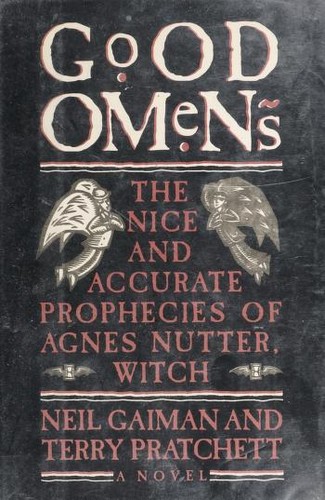
Good Omens
by Terry Pratchett
★ Most-read book of 1990 · #1 on Best Books of 1990
An angel and a demon who have grown comfortable on Earth would rather the apocalypse not arrive on schedule. With a witch's prophecy pointing to next Saturday and the Antichrist gone missing, they must scramble to stop the end.
Best for: Readers who enjoy comic fantasy about the end of the world
Good Omens is #1 on BookWard's Best Books of 1990, out of 39 1990 books that cleared our data bar.
What Good Omens is about
Aziraphale is an angel who once guarded the Eastern Gate of Eden. Crowley is a demon, and the serpent who tempted Eve. Both have lived on Earth since the beginning, and they have grown rather fond of humanity and their comfortable life in England. So when the end of the world is scheduled, neither is keen on seeing it through.
Then a mix-up at a small country hospital sends the Antichrist to the wrong family. Adam Young grows up in Lower Tadfield with three friends, Pepper, Wensleydale and Brian, and without knowing who he is, he bends reality in odd ways, from raising Atlantis to summoning UFOs. Meanwhile the Four Horsemen gather in modern guises, Anathema Device studies the cryptic but perfectly accurate prophecies of her ancestor Agnes Nutter, and Newton Pulsifer joins Sergeant Shadwell's tiny Witchfinder Army.
Pratchett and Gaiman's 1990 comic novel pokes fun at prophecy and the apocalypse, while asking whether upbringing or destiny shapes a person. It is witty, satirical and warm toward its mismatched heroes.
Good Omens on the Best Books of 1990
Good Omens came out in 1990. Of the 39 books first published in 1990 that met BookWard's data bar, it ranks #1 on our Best Books of 1990 list.
Why it made the list: 1,323 readers have shelved it on Open Library; readers rate it 4.4 out of 5 (90 ratings); 75 are reading it right now. The list ranks each year’s books on how many readers have picked them up, how highly readers rate them, and how many are reading them right now.
It earns Most-read of 1990 and reader favorite and being read right now.
Nearby on the 1990 list
- Jurassic Park Michael Crichton, #2
- The Eye of the World Robert Jordan, #3
See all Best Books of 1990 Best books by year
More years: Best Books of 1991.
The numbers behind it
- Readers: 1,072 want to read it, 75 are reading it now and 176 have read it, according to Open Library.
- Ratings: 4.4 out of 5 from 90 Open Library ratings.
| Signal | This book (0 to 100) | Weight |
|---|---|---|
| Reach | 95 | 55% |
| Reader love | 100 | 25% |
| Being read right now | 95 | 20% |
Questions about Good Omens
When was Good Omens published?
Good Omens by Terry Pratchett was first published in 1990.
Was Good Omens one of the best books of 1990?
Good Omens is #1 on BookWard's Best Books of 1990, out of 39 1990 books that cleared our data bar. 1,323 readers have shelved it on Open Library; readers rate it 4.4 out of 5 (90 ratings); 75 are reading it right now.
Why is Good Omens on the Best Books of 1990 list?
1,323 readers have shelved it on Open Library; readers rate it 4.4 out of 5 (90 ratings); 75 are reading it right now.
More of the best books of 1990
- Jurassic Park Michael Crichton, #2
- The Eye of the World Robert Jordan, #3
- The Witching Hour Anne Rice, #4
- Flow Mihaly Csikszentmihalyi, #5
- The Things They Carried Tim O'Brien, #6
- Little Girl Lost Drew Barrymore, #7
See the full Best Books of 1990, the Top 100, or new books on Rising.
How we know
This page uses public data: Open Library reader counts and ratings, and Wikipedia page views for recent years. The description is paraphrased from real source text. Rankings reflect reading interest, not quality or sales, and can be affected by data gaps. Lists update monthly.
Suits most teens and adults who enjoy comic fantasy.
Depends on the edition you pick.
An angel and a demon try to stop the apocalypse, politely. 64% taste match
 BookWard’s take
An angel and a demon try to stop the apocalypse, politely
Good Omens takes the Antichrist story and turns it into a comedy of manners. Aziraphale and Crowley have grown fond of Earth and would rather the world not end on schedule, and then the Antichrist goes missing. The opening hooks almost at once, with a prophecy, a nanny and a swapped baby, and the pace stays brisk across a wide cast. Originality is the draw: the book plays with a famous horror premise rather than leaning on it, and the authorial voice is distinctive from page one. It is story-led rather than idea-led, though the jokes carry real ideas about good, evil and ordinary people. The ending is resolved, and the tone stays warm and funny throughout.
A mid-length comic novel that stays lively rather than sprawling, which suits BookWard's preference for tight books reasonably well.
Short scenes and rotating storylines keep it moving, close to the fast pace BookWard likes.
A comic take on the Antichrist story with an unlikely angel and demon friendship feels fresh, in line with BookWard's taste.
Clean, witty and conversational rather than ornate, with the jokes in the phrasing.
A countdown plot and a character-led friendship share the load about evenly.
The book loves ordinary people and trusts they can choose well, so it lands hopeful.
A conventional converging-storylines structure, dressed up with comic interludes.
Comedy is the whole engine, from the premise to the narration, at the top of the dial.
The apocalypse is played for laughs, so the content stays gentle.
There is warmth and affection, but the book keeps its emotions light.
See all 50 dialsEvery position, side by side with this book
Where it lines up
- PaceBookWard 8 · book 8
- EndingBookWard 8 · book 8
- Shock for effectBookWard 9 · book 9
Where it pulls apart
- LengthBookWard 1 · book 5
- Internal logicBookWard 10 · book 6
- Familiar tropesBookWard 10 · book 7
A mid-length comic novel that stays lively rather than sprawling, which suits BookWard's preference for tight books reasonably well.
It opens on a prophecy and a baby delivered to a demon, which grabs at once and matches BookWard's taste.
It borrows the evil-child premise but deliberately subverts it, so it is playful with tropes more than reliant on them.
Its rules are comic and bend for a joke, though events follow from the misunderstandings that drive them.
Short scenes and rotating storylines keep it moving, close to the fast pace BookWard likes.
A comic take on the Antichrist story with an unlikely angel and demon friendship feels fresh, in line with BookWard's taste.
Aziraphale and Crowley are drawn with warmth and history, though much of the wider cast is sketched for comedy.
The apocalypse plot comes to a clear conclusion, which BookWard values.
Affection for humanity runs through it, but jokes keep the warmth from turning syrupy.
Its apocalyptic events are played for comedy, with nothing shock-driven or gratuitous, which BookWard approves of.
The comic voice is unmistakable, with footnote-style asides and dry narration, well above BookWard's bar.
Story comes first, with ideas about good and evil carried inside the jokes, which fits BookWard's lean toward story.
Narrator asides explain a fair amount, though the plot mostly plays out in scene.
Several strands keep the middle moving as they converge on the countdown to the end.
Clean, witty and conversational rather than ornate, with the jokes in the phrasing.
A countdown plot and a character-led friendship share the load about evenly.
The book loves ordinary people and trusts they can choose well, so it lands hopeful.
A conventional converging-storylines structure, dressed up with comic interludes.
Comedy is the whole engine, from the premise to the narration, at the top of the dial.
Easy and fast to read, with no heavy lifting required.
The narrative moves among angels, demons, a witch, children, the Horsemen and more.
It runs in a mostly linear countdown, with occasional glances into the past.
Angels, demons, witches and the Four Horsemen make it fully fantastical.
Many characters across heaven, hell and an English village, which is more than BookWard usually prefers.
The fate of the whole world is at stake, though much of it plays out in a small village.
Events and schemes lead, but the characters' thoughts and asides get real room.
Banter between Crowley and Aziraphale and among the children carries a lot of the book.
A recognisably English setting with a supernatural layer on top.
Set in a contemporary world of its time, with a modern feel that has aged gracefully.
Its jokes and ideas about good, evil and humanity have kept their charm.
The narrator is a witty, trustworthy guide, so reliability is high.
The good-versus-evil framing is deliberately blurred, but the book still clearly favours kindness.
Description is functional and funny rather than lush.
A standalone novel, with no series commitment.
Misunderstandings and reversals keep surprises coming through the countdown.
A comforting, easy-going read despite the end-of-the-world subject.
The apocalypse is played for laughs, so the content stays gentle.
There is warmth and affection, but the book keeps its emotions light.
The humor is wry and clever with some broad comic set pieces.
Violence is mostly cartoonish and kept offstage or played for laughs.
Sexual content is essentially absent.
Satirical swipes touch institutions and modern life but never take over.
The language is plain and conversational throughout.
The narrator editorialises constantly with amused asides.
It riffs on the past and the present while the plot looks ahead to the end of the world.
It believes in basic human decency winning out over fate.
Review written by BookWard, dial version 1, November 2026.
Who is Good Omens right for?
Suits most teens and adults who enjoy comic fantasy. It deals with demons, the apocalypse and some irreverent treatment of religion, which some readers may want to know about.
Easy and fast to read, with no heavy lifting required.
The apocalypse is played for laughs, so the content stays gentle.
There is warmth and affection, but the book keeps its emotions light.
Violence is mostly cartoonish and kept offstage or played for laughs.
Book CompanionGood Omens: ideas, characters, themes
Good Omens is a comic apocalypse story in which an angel and a demon, fond of Earth, team up to stop the end of the world.
- A friendship across the divide. Aziraphale and Crowley have lived on Earth since its creation and become unlikely allies, which sets up most of the humor and heart.
- The wrong child. A hospital mix-up means the Antichrist, Adam Young, grows up in a quiet village with the wrong family.
- Prophecy as a plot device. The prophecies of Agnes Nutter, a witch from 1655, set the countdown and guide those trying to stop the end.
- The Four Horsemen. The Horsemen assemble in modern guises, including a war correspondent and a biker, which gives the book a satirical edge.
- Reality-bending boyhood. Adam, unaware of his nature, begins reshaping the world to fit his ideas, with funny and strange results.
Characters
Aziraphale
An angel who guarded the Eastern Gate of Eden
Fussy and fond of comfort, he has grown attached to life on Earth and wants to prevent the Apocalypse.
Crowley
A demon who was once the serpent in Eden
Easygoing and long settled on Earth, he works with Aziraphale to stop the end of the world.
Adam Young
The Antichrist, raised in Lower Tadfield
An ordinary boy with reality-warping powers he does not know he has.
Anathema Device
A witch and descendant of Agnes Nutter
She is trying to prevent the Apocalypse foretold by her ancestor.
Themes
The book questions whether people are born one or the other or made by upbringing and choice.
Prophecy says the end is coming, but the characters push back against a predetermined future.
Even an angel and a demon come to prefer ordinary human life over the grand cosmic plan.
Adam's childhood in a village shapes who he becomes more than his origin does.
The Horsemen's modern forms poke fun at war, food, pollution and technology.
Discussion questions
- Why do Aziraphale and Crowley prefer Earth to their own sides?
- Does the book suggest people are shaped more by nature or upbringing?
- How does the humor change the way the apocalypse feels?
- What is the role of prophecy, and does it ever actually decide anything?
- Which Horseman's modern version works best as satire, and why?
Personalize your Book Companion
This is the general edition. In BookWard, the Companion is written for you: your reading profile, your notes, and spoiler-safe to the page you are on.
Buy, listen or borrow Good Omens
Each link opens a search for this book on that store, in a new tab.
Read on a device
Borrow
Reviews and community
If you liked Good Omens
A comic fantasy of two brothers and one trickster father
MaskeradeTerry PratchettDiscworld's witches crash the opera in a witty Phantom spoof
Reaper ManTerry PratchettDeath takes early retirement and Discworld gets funnier and wiser
HogfatherTerry PratchettDeath plays Father Christmas, and belief itself is at stake
Find your own best books
Add what you have read, rate it, and BookWard will recommend what to read next.
Free to start. No credit card needed.