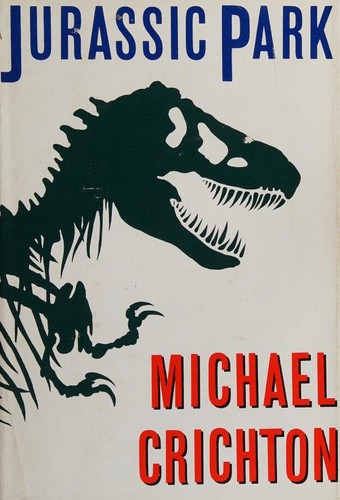
Jurassic Park
by Michael Crichton
★ Top 5 book of 1990 · #2 on Best Books of 1990
A theme park filled with genetically re-created dinosaurs falls apart, serving as a warning about genetic engineering. The collapse also illustrates chaos theory and what it means in the real world.
Best for: Readers who like science fiction cautionary tales about genetic engineering
Jurassic Park is #2 on BookWard's Best Books of 1990, out of 39 1990 books that cleared our data bar.
What Jurassic Park is about
Billionaire John Hammond has done what no one thought possible: he has brought dinosaurs back to life on a remote island, using ancient DNA drawn from insects preserved in amber. The animals are all bred as females and engineered so they cannot survive outside the park. He invites a small group to tour it, among them a paleontologist, a paleobotanist, a mathematician and a lawyer, along with his own two grandchildren.
Michael Crichton uses the setup to ask what happens when people believe they can fully control nature. The mathematician's talk of chaos theory runs through the story, and so does the question of what greed does to careful science. Part cautionary tale, part tense adventure, it suits readers who like their science fiction grounded in plausible-sounding detail.
Jurassic Park on the Best Books of 1990
Jurassic Park came out in 1990. Of the 39 books first published in 1990 that met BookWard's data bar, it ranks #2 on our Best Books of 1990 list.
Why it made the list: 1,734 readers have shelved it on Open Library; readers rate it 4.2 out of 5 (203 ratings); 92 are reading it right now. The list ranks each year’s books on how many readers have picked them up, how highly readers rate them, and how many are reading them right now.
It earns Being read right now.
Nearby on the 1990 list
- Good Omens Terry Pratchett, #1
- The Eye of the World Robert Jordan, #3
- The Witching Hour Anne Rice, #4
See all Best Books of 1990 Best books by year
More years: Best Books of 1991.
The numbers behind it
- Readers: 1,347 want to read it, 92 are reading it now and 295 have read it, according to Open Library.
- Ratings: 4.2 out of 5 from 203 Open Library ratings.
| Signal | This book (0 to 100) | Weight |
|---|---|---|
| Reach | 97 | 55% |
| Reader love | 87 | 25% |
| Being read right now | 97 | 20% |
Questions about Jurassic Park
When was Jurassic Park published?
Jurassic Park by Michael Crichton was first published in 1990.
Was Jurassic Park one of the best books of 1990?
Jurassic Park is #2 on BookWard's Best Books of 1990, out of 39 1990 books that cleared our data bar. 1,734 readers have shelved it on Open Library; readers rate it 4.2 out of 5 (203 ratings); 92 are reading it right now.
Why is Jurassic Park on the Best Books of 1990 list?
1,734 readers have shelved it on Open Library; readers rate it 4.2 out of 5 (203 ratings); 92 are reading it right now.
More of the best books of 1990
- Good Omens Terry Pratchett, #1
- The Eye of the World Robert Jordan, #3
- The Witching Hour Anne Rice, #4
- Flow Mihaly Csikszentmihalyi, #5
- The Things They Carried Tim O'Brien, #6
- Little Girl Lost Drew Barrymore, #7
See the full Best Books of 1990, the Top 100, or new books on Rising.
How we know
This page uses public data: Open Library reader counts and ratings, and Wikipedia page views for recent years. The description is paraphrased from real source text. Rankings reflect reading interest, not quality or sales, and can be affected by data gaps. Lists update monthly.
Suits teens and adults who enjoy suspense and science-flavored adventure.
Depends on the edition you pick.
A cautionary techno-thriller that runs on ideas and teeth. 54% taste match
 BookWard’s take
A cautionary techno-thriller that runs on ideas and teeth
Jurassic Park opens with strange animal attacks in Costa Rica and never really lets go. The hook is about as strong as they come, and the pace follows: this is a book built to be turned quickly. What sets it apart is that it is driven by ideas. Chaos theory and genetic engineering are not decoration, they bring about the collapse of the park, which gives the internal logic a tight, cause-and-effect feel. Exposition is where it parts company with my own taste, since Crichton often stops to explain the science outright rather than dramatize it. Character depth is thinner too, with the cast serving the argument more than the other way round. If you want a fast, clever, standalone-feeling thriller with a real thesis underneath, it delivers.
Short chapters and rising danger keep it moving fast, in step with BookWard's preference.
The amber-DNA premise felt fresh and shaped a whole genre, though it sits just under BookWard's high bar.
Plain, functional sentences serve the thriller, close to BookWard's slightly plain lean.
Events and the unraveling of the park drive everything, tilting well toward plot over character.
This is a warning about hubris, and the mood leans pessimistic about human control over nature.
A fairly conventional thriller structure, with the park's collapse unfolding in order.
It is serious in tone, with only occasional dry asides.
Predators and death are central, but the tone stays adventurous rather than grim.
Fear and suspense run high, while deeper feeling stays muted.
See all 50 dialsEvery position, side by side with this book
Where it lines up
- SentimentBookWard 8 · book 8
- OpeningBookWard 10 · book 9
- PaceBookWard 8 · book 9
Where it pulls apart
- Familiar tropesBookWard 10 · book 6
- ExpositionBookWard 2 · book 8
- Story or ideasBookWard 3 · book 8
It starts with mysterious attacks and escalating menace, which suits BookWard's love of an opening that grabs at once.
The monster-on-the-loose frame is familiar, though the scientific premise is handled with more care than genre habit.
The disaster follows a clear chain of cause and effect tied to the chaos theory premise, which BookWard rewards.
Short chapters and rising danger keep it moving fast, in step with BookWard's preference.
The amber-DNA premise felt fresh and shaped a whole genre, though it sits just under BookWard's high bar.
Characters mostly serve the ideas and the action, which falls short of the deeply drawn people BookWard prefers.
The central crisis is brought to a clear close, with some threads left to a sequel.
Crichton keeps it cool and clinical rather than tender, which fits BookWard's taste for restraint.
The violence is part of the cautionary argument, mostly earned rather than gratuitous, though it is vivid.
Crichton builds the science with notable seriousness, though it remains a novel and not an argument.
The tone is confident and brisk but more efficient than singular, a touch under BookWard's love of distinct voices.
The book exists to dramatize chaos theory and genetic overreach, so ideas lead even more than BookWard usually likes.
Characters regularly explain the science outright, which runs against BookWard's preference for showing in scene.
Tension is sustained through the tour and the breakdown, with only minor pauses for explanation.
Plain, functional sentences serve the thriller, close to BookWard's slightly plain lean.
Events and the unraveling of the park drive everything, tilting well toward plot over character.
This is a warning about hubris, and the mood leans pessimistic about human control over nature.
A fairly conventional thriller structure, with the park's collapse unfolding in order.
It is serious in tone, with only occasional dry asides.
Accessible and quick to read, with technical ideas explained along the way.
The story moves between scientists, staff and the children, giving a wide spread of perspectives.
The events unfold in a straightforward forward sequence.
The dinosaurs are fantastical, but the book works hard to ground them in plausible science.
A moderate ensemble of scientists, investors, staff and two children is manageable to follow.
Contained on a single island, though the stakes feel large.
Action, survival and explanation dominate over interior reflection.
Conversations carry much of the science and argument, making dialogue a significant engine.
Romance is barely a presence, since survival and ideas take the space.
A remote island park of living dinosaurs is an unfamiliar setting, handled in concrete detail.
Set in its own late-1980s present, it reads as slightly dated but not remote.
Its warning about technology outrunning control has aged well and kept the book widely read.
An external narrator reports events straightforwardly, with no trick of unreliability.
The book clearly sides against reckless engineering, leaving little ambiguity about its message.
Practical, scene-setting description serves the action more than it indulges.
It has a direct sequel, The Lost World, and the story has grown into a franchise.
Reversals come as systems fail, though the overall shape of the disaster is predictable.
It leaves readers with real questions about science and control, more than a comforting adventure would.
Predators and death are central, but the tone stays adventurous rather than grim.
Fear and suspense run high, while deeper feeling stays muted.
Humor is sparse and understated.
Dinosaur attacks and deaths are a regular feature, rendered plainly but vividly.
Sexual content is essentially absent.
Corporate greed and scientific ethics matter, but it is not a political book.
Language is plain, with technical terms explained as they come up.
The narration stays fairly neutral, letting events and characters carry the argument.
Though set in the present, it dwells on what past science and ambition have unleashed.
Wonder at nature gives way to a pointedly skeptical view of human ambition.
Review written by BookWard, dial version 1, November 2026.
Who is Jurassic Park right for?
Suits teens and adults who enjoy suspense and science-flavored adventure. It contains frequent, graphic animal attacks and character deaths, along with some intense scenes of peril involving children.
Accessible and quick to read, with technical ideas explained along the way.
Predators and death are central, but the tone stays adventurous rather than grim.
Fear and suspense run high, while deeper feeling stays muted.
Dinosaur attacks and deaths are a regular feature, rendered plainly but vividly.
Book CompanionJurassic Park: ideas, characters, themes
When people build systems they cannot fully predict or control, even careful safeguards fail, and chaos theory explains why.
- The premise. Dinosaurs are recreated from ancient DNA preserved in amber-trapped insects, with gaps filled by other animal DNA.
- Built-in controls. The park's animals are bred as females and engineered with a lysine deficiency to prevent survival outside captivity.
- The skeptic. Mathematician Ian Malcolm argues that complex systems like the park are inherently unpredictable.
- The invited experts. Billionaire John Hammond brings in scientists and a lawyer to endorse the park for nervous investors.
- Breeding discovered. Alan Grant finds a Velociraptor eggshell, suggesting the dinosaurs are reproducing despite the controls.
Characters
Alan Grant
Paleontologist
A dinosaur expert invited to tour and assess the park.
Ellie Sattler
Paleobotanist
Grant's colleague, who joins the tour of the preserve.
Ian Malcolm
Chaos theorist
A mathematician who doubts the park can be controlled.
John Hammond
Billionaire founder of InGen
The driving force behind the park and its investors' reassurance.
Donald Gennaro
Investors' lawyer
Represents the investors and is skeptical of the park.
Themes
The danger of assuming mastery over complex natural systems.
Small changes in complex systems can produce unpredictable, large outcomes.
How commercial motives push science past careful limits.
Engineered safeguards cannot fully contain living things.
Who answers for the consequences of what science makes possible.
Discussion questions
- Why does Malcolm distrust the park's safeguards, and does the book prove him right?
- How much does the novel rely on explanation, and does it help or slow the story?
- Is Hammond a villain, a dreamer, or both?
- What does the lysine deficiency show about the limits of engineered control?
- Does the book's warning about technology feel more or less relevant today?
Personalize your Book Companion
This is the general edition. In BookWard, the Companion is written for you: your reading profile, your notes, and spoiler-safe to the page you are on.
Buy, listen or borrow Jurassic Park
Each link opens a search for this book on that store, in a new tab.
Read on a device
Borrow
Reviews and community
If you liked Jurassic Park
Crichton's only sequel trades wonder for a fast island chase
CongoMichael CrichtonA fast, gadget-laden lost world adventure, more machine than mood.
PostmortemPatricia CornwellThe forensic procedural that made Kay Scarpetta a fixture of crime fiction
PhantomsDean KoontzAn isolated mountain town, 150 dead, and a mystery that escalates
Find your own best books
Add what you have read, rate it, and BookWard will recommend what to read next.
Free to start. No credit card needed.