Best suited to adult and older teen readers comfortable with horror.
442 pages, about 7 to 10.5 hours.
An isolated mountain town, 150 dead, and a mystery that escalates. 50% taste match
The story
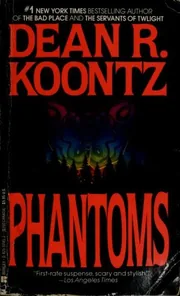
Phantoms is a horror novel by Dean Koontz, first published in 1983. It belongs to the horror and thriller tradition, and it sets its story in California, in a small community high in the mountains called Snowfield. The novel centers on Jenny Paige, a physician, and on the discovery that a hundred and fifty residents of the town have died in horrifying circumstances. Those who arrive to investigate find that nothing in their experience prepares them for what lies behind the deaths.
The book deals with mass murder and with the struggle between good and evil. Its premise draws on the old urban legend of a settlement whose people disappeared without explanation near Angikuni Lake, a story that has since been debunked. Koontz reworks that idea into a modern American setting, trading the remote lake for a Californian mountain town. The novel runs to roughly 442 pages in its median edition, and it has appeared in 46 editions since its first release. It suits readers of supernatural suspense who enjoy a small, isolated location and a mystery that grows more disturbing as it unfolds.
The scream was distant and brief.
Setting
California
Themes
Horror storiesHorror talesWomen physiciansGood and evilMass murder
- Want to read 215
- Reading now 19
- Read 48
Most people shelving it are saving it for later.
Of 282 readers who put it on a shelf, 76% want to read it, 7% are reading it now, 17% have finished it and 0% stopped before the end.
By the numbers
- The median edition runs 442 pages. Counting about 275 words a page and an adult reading pace of 250 words a minute, that is about 8.1 hours of reading.
- Open Library tracks 46 editions from 30 publishers, the earliest dated 1983 and the latest 2021, across 6 languages.
- On reader demand it ranks in the top 2% of the modern books in our catalog (15,152 of them).
- Libraries shelve it under Dewey 813.54 and Library of Congress class PS-3561.00000000.O55 P5 1998.
 BookWard’s take
An isolated mountain town, 150 dead, and a mystery that escalates
Phantoms opens with a scream that is distant and brief, and the book rarely lets up from there. The premise is built for a fast start: a small California mountain town, a hundred and fifty residents dead, and investigators facing something outside their experience. The hook grabs at once, which is exactly what a story like this should do. The pace stays quick across 442 pages, and Jenny Paige gives the story a physician's steady eye at the center. Where it loosens is in familiarity: the isolated-town horror setup is a well-worn shape, even with the Angikuni Lake legend reworked into an American setting. The shock matters too, since the dread is the point, and the book's good-versus-evil frame keeps the darkness purposeful. A strong pick for supernatural suspense.
At 442 pages it is substantial for a thriller, longer than BookWard's tight ideal, though the story is built to keep moving.
Short, charged scenes and a rising mystery keep the pages turning, close to BookWard's quick-paced preference.
The Angikuni Lake legend is reworked into a Californian mountain town, a fresh twist on a known premise, though not wholly new ground.
The prose is plain and propulsive, serving the suspense rather than drawing attention to itself.
Events and the unfolding menace drive the book more than inner change, leaning plot over character.
The tone is dark, yet the good-versus-evil frame leaves room for resistance and survival.
It is built as a straightforward investigation moving forward, with nothing experimental in its layout.
This is a serious, dread-driven book with little room for comedy.
Mass murder and grotesque death place this firmly at the dark end of fiction.
Fear and dread run high, though the feeling is suspense more than deep emotional weight.
See all 50 dialsEvery position, side by side with this book
Where it lines up
- OpeningBookWard 10 · book 10
- PaceBookWard 8 · book 8
- EndingBookWard 8 · book 7
Where it pulls apart
- Familiar tropesBookWard 10 · book 4
- LengthBookWard 1 · book 6
- Internal logicBookWard 10 · book 6
At 442 pages it is substantial for a thriller, longer than BookWard's tight ideal, though the story is built to keep moving.
A distant, brief scream opens the book and the mass-death premise follows fast, which is exactly the immediate grab BookWard rewards.
The isolated-town horror setup is a familiar frame, so it leans on convention more than BookWard prefers, even with a fresh setting.
The mystery is meant to be solved by the investigators, so its rules matter, though supernatural horror asks for some leaps.
Short, charged scenes and a rising mystery keep the pages turning, close to BookWard's quick-paced preference.
The Angikuni Lake legend is reworked into a Californian mountain town, a fresh twist on a known premise, though not wholly new ground.
Jenny Paige anchors the story, but genre thrillers tend toward functional characters over deep portraits, a little under BookWard's taste.
A horror built around uncovering a cause is designed to deliver an answer, which suits BookWard's liking for resolution.
The book is driven by dread and survival rather than tenderness, though genre stories carry some warmth around the heroine.
Gruesome deaths are the engine of the premise, but they serve a good-versus-evil story rather than stand alone.
This is fiction, so the nonfiction dial does not apply.
Koontz writes in a recognizable popular-thriller manner, effective and clear rather than strikingly singular.
This is firmly story-led, with a mystery and its investigators carrying the book rather than any argument.
Mystery plots stop to explain what the investigators find, so this leans more toward telling than BookWard's show-in-scene preference.
A mystery that keeps growing more disturbing is built to sustain tension, though a book this long can drift in places.
The prose is plain and propulsive, serving the suspense rather than drawing attention to itself.
Events and the unfolding menace drive the book more than inner change, leaning plot over character.
The tone is dark, yet the good-versus-evil frame leaves room for resistance and survival.
It is built as a straightforward investigation moving forward, with nothing experimental in its layout.
This is a serious, dread-driven book with little room for comedy.
Clear prose and a propulsive mystery make this an easy, absorbing read.
A town-wide mystery with several people investigating invites more than one perspective, though Jenny Paige is central.
The cause of the deaths lies outside ordinary experience, so this sits well into supernatural territory.
An isolated town and an investigating team make a moderate cast, neither tiny nor sprawling.
The action centers on one small mountain town, keeping the scope close even as the threat feels large.
Investigating and facing the threat are action-heavy, with outer events outweighing inner reflection.
Mystery scenes with investigators trading discoveries lean on conversation, a good amount of talk.
A remote mountain town is a setting most readers will not know firsthand, though it is plainly American.
Published in 1983, it reads as a late-twentieth-century story rather than a present-day one.
The central dread of an emptied town still works, though the book carries marks of its decade.
A good-versus-evil frame points toward clear moral lines rather than shades of grey.
Horror depends on atmosphere and the look of an eerie, emptied town, giving a fair amount of rich description.
This is fiction, so the nonfiction style dial does not apply.
This is fiction, so the nonfiction perspective dial does not apply.
It reads as a self-contained novel rather than an installment in a series.
A mystery that grows more disturbing as it unfolds is built on reveals, giving plenty of surprises.
It unsettles through fear but offers few intellectual or moral demands, so it is more thrill than challenge.
Mass murder and grotesque death place this firmly at the dark end of fiction.
Fear and dread run high, though the feeling is suspense more than deep emotional weight.
There is little humor to place, so the dial does not meaningfully apply.
The premise rests on a hundred and fifty gruesome deaths, so violence is a significant presence.
Nothing in the premise points to sexual content being a feature.
The story is about a supernatural mystery rather than social or political questions.
Plain, direct popular prose with no dialect or dense language to wade through.
Narration stays mostly neutral and focused on events rather than pushing a viewpoint.
The good-versus-evil frame gives it a leaning toward belief in resistance over pure cynicism.
Review written by BookWard, dial version 1, November 2026.
Who is Phantoms right for?
Best suited to adult and older teen readers comfortable with horror. It deals with mass murder and grotesque death, so squeamish readers should expect disturbing material.
Clear prose and a propulsive mystery make this an easy, absorbing read.
Mass murder and grotesque death place this firmly at the dark end of fiction.
Fear and dread run high, though the feeling is suspense more than deep emotional weight.
The premise rests on a hundred and fifty gruesome deaths, so violence is a significant presence.
Book CompanionPhantoms: ideas, characters, themes
A physician and investigators discover a mountain town where a hundred and fifty residents have died horribly, and they must face a cause beyond ordinary experience.
- The empty town. Snowfield, a small California mountain community, is the story's isolated stage, where a mass death has already happened.
- A doctor at the center. Jenny Paige, a physician, anchors the investigation and gives readers a steady point of view.
- Beyond experience. Those who arrive find nothing in their experience prepares them for what lies behind the deaths.
- An old legend retold. The setup draws on the debunked Angikuni Lake story of a vanished settlement, moved to a Californian setting.
- Good against evil. The novel frames its horror as a struggle between good and evil, giving the dread a moral shape.
Characters
Jenny Paige
Physician and central figure
A doctor who comes to the stricken town and helps drive the effort to understand the deaths.
Themes
The story casts its horror as a contest between opposing moral forces.
A remote town cut off from help raises the stakes of every discovery.
The book plays on fear of a threat that ordinary knowledge cannot account for.
The scale of the loss makes the town's silence the story's central horror.
Discussion questions
- Why does an emptied, isolated town make such an effective setting for fear?
- How does Jenny Paige's role as a physician shape the way the mystery unfolds?
- What does the book gain by reworking the Angikuni Lake legend into a modern American setting?
- Does the good-versus-evil framing make the horror more satisfying or more predictable?
- How much of the book's fear comes from what is shown versus what is withheld?
Personalize your Book Companion
This is the general edition. In BookWard, the Companion is written for you: your reading profile, your notes, and spoiler-safe to the page you are on.
Buy, listen or borrow Phantoms
Each link opens a search for this book on that store, in a new tab.
Read on a device
Borrow
Reviews and community
If you liked Phantoms
A grieving mother, a chalkboard message, and a race north
The Dark HalfStephen KingKing's novelist-versus-pseudonym horror, sturdy and fast but familiar
Four Past MidnightStephen KingFour Stephen King novellas, each a different door into the uncanny
WatchersDean KoontzA genetically engineered dog, a state secret, and a killer
Sources: Open Library.
Track Phantoms and find your next favorite
Add it to your shelf, rate what you have read, and BookWard will recommend what fits you.
Free to start. No credit card needed.