Best for adult and mature teen readers who are comfortable with horror.
474 pages, about 7.5 to 11 hours.
King's novelist-versus-pseudonym horror, sturdy and fast but familiar. 53% taste match
The story
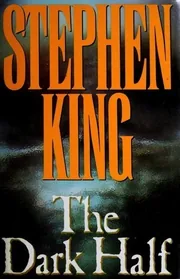
The Dark Half is a horror novel by Stephen King, first published in 1989. It belongs to the suspense and horror tradition, and it centers on an American novelist and the pseudonym he writes under. The story draws on the idea of parasitic and conjoined twins, and it deals with murder and violence along with alcohol abuse and alcoholism.
The setting is Maine, with Castle Rock, the imaginary town that appears across King's work, among the places involved. Ludlow is also part of the novel's landscape. The cast includes figures named Wes, Hilary, Dave, Evelyn, Freida, John, Mary Lou, Nan, and Rosalie, and a character called Machine appears in the text.
The book runs about 474 pages in its median edition, and more than sixty editions have been issued, including audiobook versions. A feature film of the same name followed in 1993. The novel was also among the best-selling books of 1989, placing second for that year behind Tom Clancy's Clear and Present Danger.
People's lives-their real lives, as opposed to their simple physical existences-begin at different times.
Characters
EvelynDaveFreidaHilaryJohnMary Lou
Setting
MaineCastle Rock, Maine (Imaginary place)Castle Rock (Me. : Imaginary place)Castle RockLudlow
Themes
alcohol abuseparasitic twinsalcoholismauthorsConjoined twinssuspenseAnonyms and pseudonymsAmerican novelists
- Want to read 204
- Reading now 8
- Read 76
Most people shelving it are saving it for later.
Of 288 readers who put it on a shelf, 71% want to read it, 3% are reading it now, 26% have finished it and 0% stopped before the end.
By the numbers
- The median edition runs 474 pages. Counting about 275 words a page and an adult reading pace of 250 words a minute, that is about 8.7 hours of reading.
- Open Library tracks 61 editions from 46 publishers, the earliest dated 1989 and the latest 2024, across 9 languages.
- On reader demand it ranks in the top 2% of the modern books in our catalog (15,152 of them).
- Libraries shelve it under Dewey 813.54 and Library of Congress class PS-3561.00000000.I483.
 BookWard’s take
King's novelist-versus-pseudonym horror, sturdy and fast but familiar
Stephen King's 1989 novel follows a writer and the pen name he writes under, with the parasitic twin idea at its core. It reads as a classic King thriller: set in Maine and Castle Rock, driven by murder, and built to keep moving. The pacing and the hook work well together, since the premise grabs early and the plot rarely stalls. The internal logic holds firm once the supernatural rules are set. The weak spots are familiarity and freshness, because doppelganger-style horror is well worn, even if King's authorial angle feels like his own. Length is the other snag: 474 pages is a lot for a reader who favors tight books. If you want a reliable, propulsive horror read with a writerly hook, this delivers.
At 474 pages it runs long for a single-threaded thriller, which sits against BookWard's preference for tight books.
Murder and pursuit keep the plot moving at a brisk clip, close to BookWard's preferred speed.
The writer-and-pen-name angle gives it a distinct hook, though the horror machinery underneath is familiar.
Plain, colloquial prose that favors clarity and rhythm over ornament.
Plot and character share the load, with the thriller mechanics slightly in front.
Dread dominates and the tone leans bleak, with only modest relief.
A straightforward thriller structure with little formal experiment.
Grim and tense throughout, with only occasional dry touches.
Murder and violence put it firmly on the dark end.
Fear and dread run high, with real feeling around family stakes.
See all 50 dialsEvery position, side by side with this book
Where it lines up
- EndingBookWard 8 · book 8
- PaceBookWard 8 · book 7
- Authorial voiceBookWard 9 · book 8
Where it pulls apart
- Familiar tropesBookWard 10 · book 4
- LengthBookWard 1 · book 6
- Internal logicBookWard 10 · book 7
At 474 pages it runs long for a single-threaded thriller, which sits against BookWard's preference for tight books.
The premise of a novelist and his pseudonym pulls you in early, matching BookWard's love of a quick grab.
The doppelganger and twin material is well-trodden horror ground, so it leans on familiar tropes more than BookWard likes.
The supernatural rules hold together once established, which suits BookWard's appetite for airtight internal logic.
Murder and pursuit keep the plot moving at a brisk clip, close to BookWard's preferred speed.
The writer-and-pen-name angle gives it a distinct hook, though the horror machinery underneath is familiar.
The central writer is drawn with real interiority, while many of the surrounding figures work more as types.
King brings the story to a firm, resolved close, in line with BookWard's taste for payoff.
Family and marriage supply some warmth, but the book mostly keeps feeling in check amid the menace.
The violence serves the horror premise rather than existing only to jolt, though it does lean on the gruesome.
This is fiction, so rigor does not apply.
King's conversational, confident voice is unmistakable and carries the book from page one.
The twin and pseudonym concept is striking, but the book is driven by story and suspense rather than argument.
King mixes scene with some direct explanation of the supernatural premise, landing in the middle.
The momentum holds for most of its length, though a book this size can drift in stretches.
Plain, colloquial prose that favors clarity and rhythm over ornament.
Plot and character share the load, with the thriller mechanics slightly in front.
Dread dominates and the tone leans bleak, with only modest relief.
A straightforward thriller structure with little formal experiment.
Grim and tense throughout, with only occasional dry touches.
An accessible, page-turning read that asks little of the reader.
The story moves between several perspectives, including the writer, his family and others.
Events unfold in a mostly linear way.
The supernatural premise is central, though it sits inside an otherwise ordinary Maine world.
A moderate ensemble of family, friends and townspeople, not a sprawling one.
A contained story centered on one family and one town, not a sweeping epic.
Interior dread matters, but the book is driven by events and confrontation.
Plenty of conversational scenes carry the story, typical of King.
A marriage is part of the story, but romance is not the engine.
Small-town Maine and the recurring Castle Rock are familiar ground for King readers.
Set in its late-1980s moment, a few decades back rather than present day.
The writer-and-double idea has lasting appeal, though the book carries its era.
The narration is a conventional, trustworthy third person.
Good and evil are drawn fairly sharply, with little moral haze.
Concrete detail of place and body, but not lavish.
This is fiction, so nonfiction style does not apply.
This is fiction, so perspective type does not apply.
A standalone novel, though it shares Castle Rock with other King work.
The plot delivers escalating turns, with some reveals and reversals.
Unsettling but accessible, closer to a thrilling scare than a hard test.
Murder and violence put it firmly on the dark end.
Fear and dread run high, with real feeling around family stakes.
Humor is sparse and, when present, dry and brief.
Murder and brutal violence are a major part of the page.
Sexual content is present but incidental.
Politics are essentially absent.
Plain, readable language with only light regional color.
The narration is mostly neutral with a touch of King's personality.
Rooted in the past and its consequences, looking back more than ahead.
A fairly cynical view of human darkness, with some hope in loyalty and family.
Review written by BookWard, dial version 1, November 2026.
Who is The Dark Half right for?
Best for adult and mature teen readers who are comfortable with horror. It contains murder, graphic violence and alcohol abuse.
An accessible, page-turning read that asks little of the reader.
Murder and violence put it firmly on the dark end.
Fear and dread run high, with real feeling around family stakes.
Murder and brutal violence are a major part of the page.
Book CompanionThe Dark Half: ideas, characters, themes
A novelist's pseudonym becomes a menacing presence, turning the split between a writer and his alter ego into horror.
- The pen name premise. The story centers on an American novelist and the pseudonym he writes under.
- Parasitic twins. The idea of parasitic and conjoined twins underlies the horror.
- Murder and menace. Murder and violence drive the suspense and raise the stakes.
- Maine setting. The action is rooted in Maine, including the imaginary town of Castle Rock.
- Substance abuse. Alcohol abuse and alcoholism run through the book as part of its darker material.
Themes
The tension between a person and the self he creates or hides.
What it costs a writer to create, and who really owns the work.
How brutality enters ordinary life and what it leaves behind.
The pull of alcohol and its effect on a person and those near him.
Marriage and home as what is at stake when horror closes in.
Discussion questions
- Why does the pseudonym work so well as a source of horror?
- Does the twin idea feel fresh or familiar to you?
- How does the Maine setting shape the mood?
- Where does the book earn its darkness, and where does it lean on it?
- Does a long thriller like this keep its pace to the end?
Personalize your Book Companion
This is the general edition. In BookWard, the Companion is written for you: your reading profile, your notes, and spoiler-safe to the page you are on.
Buy, listen or borrow The Dark Half
Each link opens a search for this book on that store, in a new tab.
Read on a device
Borrow
Reviews and community
If you liked The Dark Half
Four Stephen King novellas, each a different door into the uncanny
FirestarterStephen KingA girl who can start fires, and the people hunting her
PhantomsDean KoontzAn isolated mountain town, 150 dead, and a mystery that escalates
Rose MadderStephen KingA domestic-violence thriller with a Greek-myth painting at its heart
Sources: Open Library.
Track The Dark Half and find your next favorite
Add it to your shelf, rate what you have read, and BookWard will recommend what fits you.
Free to start. No credit card needed.