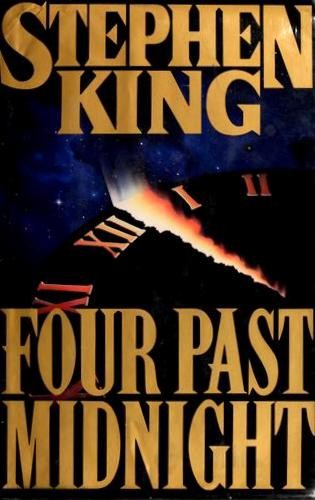
Four Past Midnight
by Stephen King
★ Top 10 book of 1990 · #10 on Best Books of 1990
This collection gathers four novellas, from a flight that lands in an eerily empty world to a writer menaced by a stranger. It also includes a small businessman haunted by the truth and a teenager whose Polaroid brings something supernatural.
Best for: Horror fans who like several chilling novellas in one volume
Four Past Midnight is #10 on BookWard's Best Books of 1990, out of 39 1990 books that cleared our data bar.
What Four Past Midnight is about
Four Past Midnight gathers four novellas that Stephen King wrote in 1988 and 1989. It is his second collection of this kind, following Different Seasons, though he says in his introduction that this one leans more squarely into horror with supernatural elements. It won the Bram Stoker Award for Best Collection in 1990.
In 'The Langoliers', a red-eye flight from L.A. to Boston carries only eleven surviving passengers into an eerily empty world. In 'Secret Window, Secret Garden', recently divorced writer Mort Rainey is alone by Tashmore Lake until a figure named John Shooter turns up. 'The Library Policeman' follows small businessman Sam Peebles in Junction City, Iowa, who fears he may be losing his mind. The tone is dark and unsettling, with themes of isolation, obsession, and the uncanny. Readers who like their fear in long, slow-building doses will find plenty here.
Four Past Midnight on the Best Books of 1990
Four Past Midnight came out in 1990. Of the 39 books first published in 1990 that met BookWard's data bar, it ranks #10 on our Best Books of 1990 list.
Why it made the list: 513 readers have shelved it on Open Library; readers rate it 4 out of 5 (22 ratings); 30 are reading it right now. The list ranks each year’s books on how many readers have picked them up, how highly readers rate them, and how many are reading them right now.
Nearby on the 1990 list
- The Great Hunt (the Wheel of Time Book 2) Robert Jordan, #8
- Maniac Magee Jerry Spinelli, #9
- Gifted Hands Ben Carson, #11
- Oh, the Places You'll Go! Dr. Seuss, #12
See all Best Books of 1990 Best books by year
More years: Best Books of 1991.
The numbers behind it
- Readers: 412 want to read it, 30 are reading it now and 70 have read it, according to Open Library.
- Ratings: 4 out of 5 from 22 Open Library ratings.
| Signal | This book (0 to 100) | Weight |
|---|---|---|
| Reach | 85 | 55% |
| Reader love | 38 | 25% |
| Being read right now | 85 | 20% |
Questions about Four Past Midnight
When was Four Past Midnight published?
Four Past Midnight by Stephen King was first published in 1990.
Was Four Past Midnight one of the best books of 1990?
Four Past Midnight is #10 on BookWard's Best Books of 1990, out of 39 1990 books that cleared our data bar. 513 readers have shelved it on Open Library; readers rate it 4 out of 5 (22 ratings); 30 are reading it right now.
Why is Four Past Midnight on the Best Books of 1990 list?
513 readers have shelved it on Open Library; readers rate it 4 out of 5 (22 ratings); 30 are reading it right now.
More of the best books of 1990
- Good Omens Terry Pratchett, #1
- Jurassic Park Michael Crichton, #2
- The Eye of the World Robert Jordan, #3
- The Witching Hour Anne Rice, #4
- Flow Mihaly Csikszentmihalyi, #5
- The Things They Carried Tim O'Brien, #6
See the full Best Books of 1990, the Top 100, or new books on Rising.
How we know
This page uses public data: Open Library reader counts and ratings, and Wikipedia page views for recent years. The description is paraphrased from real source text. Rankings reflect reading interest, not quality or sales, and can be affected by data gaps. Lists update monthly.
Suits adult readers and mature teens comfortable with sustained horror.
Depends on the edition you pick.
Four Stephen King novellas, each a different door into the uncanny. 53% taste match
 BookWard’s take
Four Stephen King novellas, each a different door into the uncanny
Four Past Midnight gathers four novellas, from a red-eye flight that lands somewhere wrong to a Polaroid that should not be possible. King says in his introduction that this one is stricter horror than Different Seasons, and the premises bear that out. The hook is where it pays off: each novella drops its people into trouble quickly. Length is another matter. These are long novellas, so the book is a big commitment, and it works against a taste for tight reads. Familiar tropes show up too, with a haunted camera, a writer in isolation and a small-town evil, yet King's voice keeps them lively. The pace is brisk and the voice is unmistakable throughout. It won the Bram Stoker Award for Best Collection in 1990.
Four full novellas make for a hefty volume, far from the tight read BookWard prefers.
The novellas move briskly once the trouble starts, close to BookWard's preference for speed.
The premises are inventive in places, but the horror toolkit is familiar, so it sits below BookWard's high bar.
The prose is plainspoken and colloquial rather than ornate, close to BookWard's slightly plain preference.
Plot and character share the load, with strong premises pulling characters through danger.
The tone leans dark and uneasy, with survival and resolution offering only measured relief.
Four self-contained novellas under one cover is a modest structural twist on a conventional approach.
This is serious horror, with only occasional dry asides.
King calls it strictly horror, and the stories go to dark places.
Fear, paranoia and loss run hot, giving the stories real emotional charge.
See all 50 dialsEvery position, side by side with this book
Where it lines up
- Authorial voiceBookWard 9 · book 9
- Story or ideasBookWard 3 · book 3
- PaceBookWard 8 · book 7
Where it pulls apart
- LengthBookWard 1 · book 8
- Familiar tropesBookWard 10 · book 4
- Internal logicBookWard 10 · book 6
Four full novellas make for a hefty volume, far from the tight read BookWard prefers.
Each novella puts its characters in danger or strangeness fast, which suits BookWard's taste for immediate grip.
A haunted photograph, a stalker and small-town evil are well-worn horror ground, though King handles them with some freshness.
The supernatural rules mostly hold within each story, though some explanations stretch, short of the airtight standard BookWard likes.
The novellas move briskly once the trouble starts, close to BookWard's preference for speed.
The premises are inventive in places, but the horror toolkit is familiar, so it sits below BookWard's high bar.
King gives his protagonists real histories and flaws, though some secondary figures are sketched quickly.
Each novella reaches a clear conclusion rather than trailing off, which BookWard appreciates.
The stories lean on dread more than tenderness, with a few warmer beats, a middling fit for BookWard's restraint.
The horror is purposeful within each story's logic, though King does use some visceral set pieces for effect.
This is fiction, so rigor does not apply.
King's conversational, confiding narration is instantly recognizable and a strong match for BookWard.
These are story-first tales driven by situation and menace, in line with BookWard's lean toward narrative.
King mostly shows through scene but pauses for explanation of his supernatural setups, near BookWard's scene-first taste.
Some novellas hold their grip better than others, so tension dips in places across the collection.
The prose is plainspoken and colloquial rather than ornate, close to BookWard's slightly plain preference.
Plot and character share the load, with strong premises pulling characters through danger.
The tone leans dark and uneasy, with survival and resolution offering only measured relief.
Four self-contained novellas under one cover is a modest structural twist on a conventional approach.
This is serious horror, with only occasional dry asides.
King reads easily and rewards quick momentum, so little effort is required.
Each novella centers on a few protagonists, though one has a group of survivors in the mix.
The stories mostly run in a straight line, with backstory filled in along the way.
Each tale hinges on a supernatural premise, from time anomalies to a camera that shouldn't work.
Casts are small to mid-sized per novella, built around a few central figures.
The stakes are mostly personal and local, even when the strangeness is large.
Menace and events drive the action, though paranoia and doubt run through several protagonists' heads.
Talk carries a lot of the tension and characterization, with plenty of back-and-forth.
Romance is minor, appearing at most as backstory or a side thread.
Settings are recognizable American places and a plane, made strange by what happens in them.
Written in 1988 and 1989, the stories reflect that era more than today.
King's craft and durable horror premises have kept the collection in print and award-recognized.
Narration is generally straightforward, with little reason to doubt the account.
Heroes and threats are mostly distinguishable, though some protagonists carry real flaws.
King paints places and unease with generous, concrete detail.
Reveals and reversals show up in most of the stories, giving the collection a steady supply of surprises.
These are entertaining scares rather than intellectual provocation, so the book comforts as much as it unsettles.
King calls it strictly horror, and the stories go to dark places.
Fear, paranoia and loss run hot, giving the stories real emotional charge.
Humor is occasional and mostly dry, a minor note in the mix.
Horror brings real menace and bloodshed, though not constant onslaught.
Sexual content is minimal and not a focus.
Politics are essentially absent from these tales.
Language is plain and colloquial, easy to follow throughout.
King's narrator has a clear, chatty personality, bringing mild opinion into the telling.
The stories are rooted in past wrongs and lingering secrets rather than the future.
The worldview is wary, with evil real and rescue hard-won.
Review written by BookWard, dial version 1, November 2026.
Who is Four Past Midnight right for?
Suits adult readers and mature teens comfortable with sustained horror. It contains menace, violence and psychological distress, so readers sensitive to those themes should proceed carefully.
King reads easily and rewards quick momentum, so little effort is required.
King calls it strictly horror, and the stories go to dark places.
Fear, paranoia and loss run hot, giving the stories real emotional charge.
Horror brings real menace and bloodshed, though not constant onslaught.
Book CompanionFour Past Midnight: ideas, characters, themes
Four novellas, each opening with an ordinary situation that turns uncanny, collected under a midnight-hour frame.
- A strict horror collection. King says in his introduction that, unlike Different Seasons, this book is more strictly horror with supernatural elements.
- The Langoliers. A red-eye flight from L.A. to Boston ends in an eerily empty world, with only eleven passengers surviving.
- Secret Window, Secret Garden. Recently divorced writer Mort Rainey is alone at Tashmore Lake until a figure named John Shooter arrives with an accusation.
- The Library Policeman. Set in Junction City, Iowa, it follows small businessman Sam Peebles, who fears he is losing his mind and must find the truth.
- The Sun Dog. A Polaroid becomes an invitation to the supernatural for fifteen-year-old Kevin Delevan, while Castle Rock trader Pop Merrill eyes a profit.
Characters
Mort Rainey
Protagonist of Secret Window, Secret Garden
A recently divorced, depressed writer alone by Tashmore Lake.
John Shooter
Antagonist of Secret Window, Secret Garden
A figure who arrives at Mort's door pointing an accusing finger.
Sam Peebles
Protagonist of The Library Policeman
A small businessman in Junction City, Iowa, who thinks he may be losing his mind.
Kevin Delevan
Protagonist of The Sun Dog
A fifteen-year-old whose Polaroid photograph opens a door to the supernatural.
Pop Merrill
Antagonist of The Sun Dog
Castle Rock's sharpest trader, who wants to profit from the strange photograph.
Themes
Characters face the uncanny alone or cut off from ordinary help.
Several protagonists must confront facts they would rather avoid.
Planes, lakes, libraries and cameras become sources of dread.
Some characters see profit in what they should fear.
Protagonists doubt their own minds as events escalate.
Discussion questions
- Which of the four novellas builds dread most effectively, and what technique does it use?
- How does the collection's strict horror focus change the feel compared with a mixed-genre set?
- Which protagonist's fear feels most believable, and why?
- How does King use everyday objects and places to make the supernatural land?
- Do the novellas' endings satisfy, or do some feel rushed?
Personalize your Book Companion
This is the general edition. In BookWard, the Companion is written for you: your reading profile, your notes, and spoiler-safe to the page you are on.
Buy, listen or borrow Four Past Midnight
Each link opens a search for this book on that store, in a new tab.
Read on a device
Borrow
Reviews and community
If you liked Four Past Midnight
King's novelist-versus-pseudonym horror, sturdy and fast but familiar
Skeleton crewStephen KingKing's 1985 story collection, from fast chills to the long Mist
FirestarterStephen KingA girl who can start fires, and the people hunting her
PhantomsDean KoontzAn isolated mountain town, 150 dead, and a mystery that escalates
Find your own best books
Add what you have read, rate it, and BookWard will recommend what to read next.
Free to start. No credit card needed.