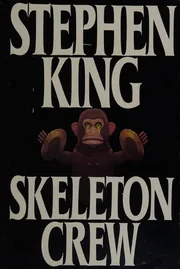
Best suited to adult and older teen readers who enjoy horror.
573 pages, about 9 to 13.5 hours.
King's 1985 story collection, from fast chills to the long Mist. 55% taste match
The story
Skeleton Crew is a collection of horror fiction by Stephen King, first published in 1985. It gathers short stories alongside longer novellas, and it sits within the tradition of American horror tales. The book-length story "The Mist" follows a supermarket that becomes a refuge when a threat from beyond the world arrives. Other stories include "The Man Who Would Not Shake Hands," "The Monkey," "Mrs. Todd's Shortcut," and "Gramma," which centers on a boy left alone with a corpse.
The stories draw on a wide range of material, including alcoholism, heroin, insanity, amputation, and cruise ships. Some are told through diaries, anecdotes, or narratives nested inside other narratives. Many unfold in New England, with Castle Rock, Maine and the town of Bridgton among the settings, while others reach to Goat Island, the Pacific Ocean, Manhattan, Bombay, and Pennsylvania. The time frames vary as well, from stretches of the late 1920s and early 1930s to 1959, 1987, and the 24th century. Characters appear across the stories, among them Missy and Russell Bowie, Mary and Richard Dodge, Freddy and George Dinsmore, Al Curry, and Harley Blood.
This is what happened.
Characters
Harley BloodMissy BowieRussell BowieAl CurryFreddy DinsmoreGeorge Dinsmore
Setting
Goat IslandPacific OceanCastle RockMaineSamuel Claggert Museum
Period
198724th century1927–1933
Themes
American Horror talesnested narrativeNovellasalcoholismanecdotesdiariesheroincruise ships
- Want to read 679
- Reading now 29
- Read 99
Most people shelving it are saving it for later.
Of 807 readers who put it on a shelf, 84% want to read it, 4% are reading it now, 12% have finished it and 0% stopped before the end.
By the numbers
- The median edition runs 573 pages. Counting about 275 words a page and an adult reading pace of 250 words a minute, that is about 11 hours of reading.
- Open Library tracks 75 editions from 49 publishers, the earliest dated 1985 and the latest 2020, across 7 languages.
- On reader demand it ranks in the top 1% of the modern books in our catalog (15,152 of them).
- Libraries shelve it under Dewey 813.54 and Library of Congress class PS-3561.00000000.I483S55 1985.
 BookWard’s take
King's 1985 story collection, from fast chills to the long Mist
Skeleton Crew gathers 22 pieces of Stephen King horror, from short, sharp tales to the book-length "The Mist," and it suits a reader who likes a fast start. Most of these stories grab you within a page or two, and the pace stays quick, with little room for a sagging middle when the stories are this short. Where it falters is in familiar territory: haunted objects, killer vehicles and monsters from beyond the world are well-worn ground, though King's voice is distinctive enough to carry them. Stories like "Gramma" and "The Monkey" show how readily he reaches for darkness, so it's fair to ask whether the shocks are earning their place or simply there for effect. Length is the other drawback, since at 573 pages this is a hefty read, even if it breaks into small bites.
At 573 pages across 22 pieces, it is a large book, far from BookWard's love of tight reads, though each story is short.
Short forms keep things moving, and the stories rarely linger, which matches BookWard's preference for speed.
The premises vary widely, from a supermarket under siege to a story told in diary form, though many sit in familiar horror ground.
King writes in plain, colloquial prose, aiming for momentum over ornament.
Most stories are driven by a threatening situation, with characters reacting to it.
The collection leans bleak, though a few stories offer small gestures of grace.
The collection mixes forms, including a free verse poem, diaries and narratives nested inside others.
Mostly grim, with flashes of dark whimsy rather than real comedy.
Corpses, addiction, madness and bodily harm make this a dark collection.
Fear, grief and desperation run hot throughout, so the feeling is intense.
See all 50 dialsEvery position, side by side with this book
Where it lines up
- PaceBookWard 8 · book 8
- Authorial voiceBookWard 9 · book 9
- Story or ideasBookWard 3 · book 3
Where it pulls apart
- LengthBookWard 1 · book 8
- Familiar tropesBookWard 10 · book 4
- Internal logicBookWard 10 · book 6
At 573 pages across 22 pieces, it is a large book, far from BookWard's love of tight reads, though each story is short.
King tends to open in the middle of trouble, which suits BookWard's appetite for being hooked at once.
Haunted objects, killer trucks and creatures from another dimension are familiar horror staples, so this leans on tropes more than BookWard likes.
Supernatural rules are mostly consistent within each story, but the collection runs on dream logic as often as on tight mechanics.
Short forms keep things moving, and the stories rarely linger, which matches BookWard's preference for speed.
The premises vary widely, from a supermarket under siege to a story told in diary form, though many sit in familiar horror ground.
Short stories leave little room, so characters are drawn quickly and efficiently rather than explored at length.
Horror shorts often end on a sting or an unresolved dread, so closure is mixed rather than fully tied off.
King slips in warmth and nostalgia now and then, so it is less restrained than BookWard prefers.
Gruesome material like amputation, corpses and cannibalism is part of the fun, and some of it is there mainly to unsettle.
This is fiction, so rigor does not apply.
King's conversational, American, instantly recognizable voice runs through every story, which BookWard rewards.
These are story-led pieces built on a situation and a threat, not on arguing an idea.
King mostly lets events and dialogue carry the information, with only the occasional aside to the reader.
Short lengths keep stories tight, and even the long novella holds its tension from start to finish.
King writes in plain, colloquial prose, aiming for momentum over ornament.
Most stories are driven by a threatening situation, with characters reacting to it.
The collection leans bleak, though a few stories offer small gestures of grace.
The collection mixes forms, including a free verse poem, diaries and narratives nested inside others.
Mostly grim, with flashes of dark whimsy rather than real comedy.
The writing is accessible and quick, easy to dip into one story at a time.
Each story has its own narrator and viewpoint, so the collection as a whole offers many voices.
Settings span 1927 to the 24th century, and some stories are told through diaries or nested tales.
Supernatural and science-fiction elements drive nearly every story, from other-dimension creatures to cursed objects.
Dozens of characters appear across the stories, though each tale uses a small group.
Most stories are close, personal and local, with "The Mist" the nearest to a larger threat.
Dread and external menace share the stage, with plenty of action and plenty of nerves.
King leans on talky, naturalistic exchanges to build character and tension.
Romance barely registers in this fear-driven collection.
Much of it is set in recognizable New England towns, with a few stories reaching farther afield.
Many stories sit in the 1980s or earlier, with a few reaching into a future age.
Fear of the unknown ages well, though some references clearly belong to their decade.
Most narrators tell it straight, though in a few the reader may question what is real.
Good and evil are often clear-cut, with a few stories muddying the picture.
King sketches settings quickly and concretely rather than lingering over them.
Standalone collection, though some stories touch on King's recurring Maine settings like Castle Rock.
Many shorts hinge on a final reveal or turn, so surprises come often.
It unsettles more than it provokes thought, so it is more thrill than challenge.
Corpses, addiction, madness and bodily harm make this a dark collection.
Fear, grief and desperation run hot throughout, so the feeling is intense.
When humor appears it is more macabre and broad than dry.
Violence and bodily horror are recurring features rather than rare moments.
Some sexual content appears in places but is not a major feature.
Politics sits in the background and is rarely the point.
The language is plain American English, with some regional speech.
King's narrators often have strong attitudes and a chatty tone.
Mostly rooted in the present of each story or in the past, with only occasional futures.
A cynical streak runs through the collection, with human weakness often on show.
Review written by BookWard, dial version 1, November 2026.
Who is Skeleton crew right for?
Best suited to adult and older teen readers who enjoy horror. It includes graphic violence, disturbing imagery, addiction themes and some sexual content, so sensitive readers may want to choose stories individually.
The writing is accessible and quick, easy to dip into one story at a time.
Corpses, addiction, madness and bodily harm make this a dark collection.
Fear, grief and desperation run hot throughout, so the feeling is intense.
Violence and bodily horror are recurring features rather than rare moments.
Book CompanionSkeleton crew: ideas, characters, themes
A mix of short horror stories and novellas that finds fear in everyday American places, from supermarkets to attics.
- A mixed-length collection. Short stories sit beside longer novellas, so the pace and weight of the reading change from piece to piece.
- The Mist. The longest story has a supermarket become the last refuge when a threat from beyond the world arrives.
- Everyday objects turn menacing. "The Monkey" and "Uncle Otto's Truck" find dread in ordinary things.
- Varied forms. Diaries, anecdotes and nested narratives vary how the stories are told, and one piece is a free verse poem.
- New England roots. Many stories are set in Maine, including Castle Rock and Bridgton, while others reach to Manhattan, Bombay and the Pacific.
Characters
Missy and Russell Bowie
Characters appearing in the collection
A pair of characters named in the stories of the collection.
Freddy and George Dinsmore
Characters appearing in the collection
Two named characters who appear in the stories.
Al Curry
Character appearing in the collection
A named figure who turns up in one of the tales.
Harley Blood
Character appearing in the collection
A named character from the stories.
Themes
Threats that come from beyond ordinary experience, whether other dimensions or cursed objects.
Familiar places like supermarkets and attics become sites of terror.
Ordinary people pushed to extremes when cornered.
Alcoholism, heroin and insanity appear among the subjects the stories touch.
Corpses, amputation and bodily harm recur across the collection.
Discussion questions
- Which stories worked best at short length, and which would you have liked to see run longer?
- How does "The Mist" use a single setting to build pressure?
- Why might King set so many stories in ordinary, familiar places?
- Do the different forms, such as diaries and nested tales, change how scary a story feels?
- Where does horror cross from unsettling into gratuitous, and did any story cross it?
Personalize your Book Companion
This is the general edition. In BookWard, the Companion is written for you: your reading profile, your notes, and spoiler-safe to the page you are on.
Buy, listen or borrow Skeleton crew
Each link opens a search for this book on that store, in a new tab.
Read on a device
Borrow
Reviews and community
If you liked Skeleton crew
Four Stephen King novellas, each a different door into the uncanny
Just After SunsetStephen KingStephen King's short-story set: thirteen tales, mostly dark, mostly fast
FirestarterStephen KingA girl who can start fires, and the people hunting her
The Dark HalfStephen KingKing's novelist-versus-pseudonym horror, sturdy and fast but familiar
Sources: Open Library.
Track Skeleton crew and find your next favorite
Add it to your shelf, rate what you have read, and BookWard will recommend what fits you.
Free to start. No credit card needed.