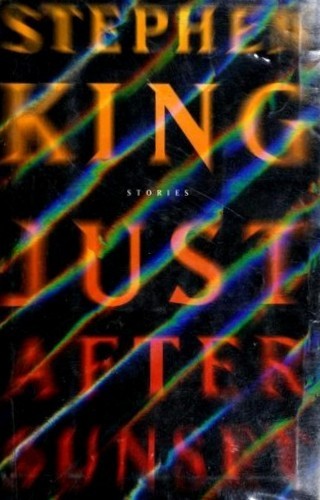
Just After Sunset
by Stephen King
★ Top 25 book of 2008 · #11 on Best Books of 2008
Stephen King's fifth short story collection gathers thirteen tales, including Willa, The Gingerbread Girl, Rest Stop, N. and The Cat From Hell. Other entries include Stationary Bike, Mute, Ayana and A Very Tight Place.
Best for: Readers who like Stephen King in short story form
Just After Sunset is #11 on BookWard's Best Books of 2008, out of 46 2008 books that cleared our data bar.
What Just After Sunset is about
Just After Sunset is Stephen King's fifth collection of short stories, gathering a varied set of tales that find fear in ordinary places: a rest stop, a stationary bike, a graduation afternoon, a tight spot you cannot easily leave. Among them are Willa, The Gingerbread Girl, Harvey's Dream, Ayana and the unsettling N. The collection also brings back The Cat from Hell, an older story from 1977 that had not appeared in a King collection before. King turned to short fiction after being asked to edit The Best American Short Stories 2007, when he had meant to write a novel. The mood is dark and uneasy, and the stories circle around grief, mortality and the way the strange can slip into daily life. They suit readers who like their chills in compact doses.
Just After Sunset on the Best Books of 2008
Just After Sunset came out in 2008. Of the 46 books first published in 2008 that met BookWard's data bar, it ranks #11 on our Best Books of 2008 list.
Why it made the list: 479 readers have shelved it on Open Library; readers rate it 4 out of 5 (43 ratings). The list ranks each year’s books on how many readers have picked them up, how highly readers rate them, and how many are reading them right now.
Nearby on the 2008 list
- Paper Towns John Green, #9
- Thinking in Systems Donella H. Meadows, #10
- What Every BODY Is Saying Joe Navarro, #12
- In Defense of Food Michael Pollan, #13
See all Best Books of 2008 Best books by year
More years: Best Books of 2007 Best Books of 2009.
The numbers behind it
- Readers: 401 want to read it, 18 are reading it now and 60 have read it, according to Open Library.
- Ratings: 4 out of 5 from 43 Open Library ratings.
| Signal | This book (0 to 100) | Weight |
|---|---|---|
| Reach | 78 | 55% |
| Reader love | 43 | 25% |
| Being read right now | 72 | 20% |
Questions about Just After Sunset
When was Just After Sunset published?
Just After Sunset by Stephen King was first published in 2008.
Was Just After Sunset one of the best books of 2008?
Just After Sunset is #11 on BookWard's Best Books of 2008, out of 46 2008 books that cleared our data bar. 479 readers have shelved it on Open Library; readers rate it 4 out of 5 (43 ratings).
Why is Just After Sunset on the Best Books of 2008 list?
479 readers have shelved it on Open Library; readers rate it 4 out of 5 (43 ratings).
More of the best books of 2008
- The Hunger Games Suzanne Collins, #1
- End of Days Sylvia Browne, #2
- The Last Straw Jeff Kinney, #3
- Amulet Kazu Kibuishi, #4
- Outliers Malcolm Gladwell, #5
- Michelle Obama in Her Own Words Michelle Obama, #6
See the full Best Books of 2008, the Top 100, or new books on Rising.
How we know
This page uses public data: Open Library reader counts and ratings, and Wikipedia page views for recent years. The description is paraphrased from real source text. Rankings reflect reading interest, not quality or sales, and can be affected by data gaps. Lists update monthly.
Best suited to adult readers and mature teens comfortable with horror.
Depends on the edition you pick.
Stephen King's short-story set: thirteen tales, mostly dark, mostly fast. 58% taste match
 BookWard’s take
Stephen King's short-story set: thirteen tales, mostly dark, mostly fast
This is King working in short form, thirteen stories collected in 2008, and the format rewards a reader who likes a hook right away. Stories like "Rest Stop", "Stationary Bike" and "A Very Tight Place" establish a situation fast and then tighten it, so the pacing and the openings are strong. The book is compact, which suits anyone who likes tight reading, and a collection lets you stop between pieces. Where it parts ways is in leaning on familiar tropes: King works in recognizable horror and suspense territory, so the originality is steady rather than startling. The shorter the story, the less room for deep characters, though his voice stays distinctive throughout. Expect an outlook on the bleak side, with the shock sometimes earned and sometimes simply there. A good pick for short bursts of unease.
Short stories move briskly by nature, and King keeps the tension tightening, in step with BookWard.
King's premises are inventive in places, but the genre ground is well worn, short of BookWard's high bar.
King's prose is plain and colloquial rather than ornate, close to BookWard's moderate preference.
The stories lean on situation and plot more than inner change, a touch plot-driven for BookWard.
Dread and loss run through most of the collection, darker than BookWard's mildly hopeful lean.
Conventional story shapes dominate, with the occasional unusual form, which fits BookWard's middle position.
The tone is mostly serious and tense, with only flickers of dark humor, less funny than BookWard's lean.
Fear, death and menace are central, though the darkness is not unrelenting, so close to BookWard's midpoint but darker.
Dread and grief come through strongly in several stories, a little more intense than BookWard's lean.
See all 50 dialsEvery position, side by side with this book
Where it lines up
- PaceBookWard 8 · book 8
- Authorial voiceBookWard 9 · book 9
- Story or ideasBookWard 3 · book 4
Where it pulls apart
- Familiar tropesBookWard 10 · book 4
- Internal logicBookWard 10 · book 6
- OriginalityBookWard 9 · book 5
King's short pieces tend to drop you into a tense situation quickly, close to BookWard's own taste for openings that grab.
Horror and suspense conventions are present throughout, so it leans familiar more than BookWard prefers.
Supernatural premises follow their own rules, though short form leaves some of them lightly explained.
Short stories move briskly by nature, and King keeps the tension tightening, in step with BookWard.
King's premises are inventive in places, but the genre ground is well worn, short of BookWard's high bar.
Each story gives its characters a few vivid strokes rather than long development, a bit short of BookWard's depth.
Collections like this mix tidy payoffs with unsettling, unresolved closes, so endings land in the middle.
King can reach for feeling openly, so the restraint BookWard likes is only partly present.
Darkness is a main tool here, sometimes serving the story and sometimes simply there for effect.
This is fiction, so the nonfiction rigor dial does not apply.
King's conversational, confident voice is unmistakable and a clear match for BookWard's love of distinctive authors.
The stories are driven by situations and plot, with a hook and a reversal, and BookWard sits closer to story than idea.
King mixes scene with some direct explaining, a little more telling than BookWard likes.
Short pieces leave little room to sag, though quality across thirteen stories can vary.
King's prose is plain and colloquial rather than ornate, close to BookWard's moderate preference.
The stories lean on situation and plot more than inner change, a touch plot-driven for BookWard.
Dread and loss run through most of the collection, darker than BookWard's mildly hopeful lean.
Conventional story shapes dominate, with the occasional unusual form, which fits BookWard's middle position.
The tone is mostly serious and tense, with only flickers of dark humor, less funny than BookWard's lean.
King's accessible style makes this easy to read, a touch easier than BookWard's moderate level.
Each story brings its own narrator or point of view, so the book as a whole has many voices.
Most stories move forward in plain sequence, with occasional recollection.
Horror and the uncanny appear in many stories, though several stay rooted in the ordinary world.
Each story has a small cast, but across thirteen stories the total is large.
These are small, personal-scale stories of individuals in trouble, more intimate than BookWard's middle.
Fear and dread live in the characters' heads while events push from outside, a roughly even split.
King leans on natural, talky exchanges, close to BookWard's liking for dialogue.
Romance is a minor thread at most, similar to BookWard's lower-middle position.
Settings are mostly contemporary and recognizable, more familiar than BookWard's lean toward the unfamiliar.
Published in 2008 with a contemporary American feel, though "The Cat from Hell" dates from 1977.
King's fear-driven situations travel well, though some details are of their era.
Most narrators are straightforward, with a few unsettled voices, less unreliable than BookWard likes.
Right and wrong are usually fairly legible, with some muddier cases, so clearer than BookWard's lean.
King sketches settings with practical detail rather than lavish description, a little sparser than BookWard's middle.
A standalone collection of stories, not part of a series.
Reversals and sting-in-the-tail endings are common in horror shorts, near BookWard's taste for surprise.
The unease is there, but the style is approachable, so it sits near the middle for BookWard.
Fear, death and menace are central, though the darkness is not unrelenting, so close to BookWard's midpoint but darker.
Dread and grief come through strongly in several stories, a little more intense than BookWard's lean.
What humor there is runs dry and grim, a little drier than BookWard's midpoint.
Horror brings violence onto the page in a number of stories, near BookWard's midpoint but a bit above.
Sexual content is occasional and limited, a little under BookWard's midpoint.
Politics sit almost entirely in the background, well below BookWard's midpoint.
Language is plain and conversational, easier than BookWard's midpoint.
King's narrators are chatty but not preachy, a bit more neutral than BookWard.
The stories dwell on what has happened or what is lurking, looking back more than forward.
The worldview skews wary and fatalistic, more cynical than BookWard's mildly idealistic lean.
Review written by BookWard, dial version 1, November 2026.
Who is Just After Sunset right for?
Best suited to adult readers and mature teens comfortable with horror. Expect fear, death and violence, plus occasional adult content.
King's accessible style makes this easy to read, a touch easier than BookWard's moderate level.
Fear, death and menace are central, though the darkness is not unrelenting, so close to BookWard's midpoint but darker.
Dread and grief come through strongly in several stories, a little more intense than BookWard's lean.
Horror brings violence onto the page in a number of stories, near BookWard's midpoint but a bit above.
Book CompanionJust After Sunset: ideas, characters, themes
A set of short horror and suspense stories in which ordinary people meet fear, loss and the uncanny.
- Fifth story collection. Just After Sunset is King's fifth collection of short stories, published by Scribner in November 2008.
- Born from editing. After editing The Best American Short Stories 2007, King chose to write short fiction instead of starting a new novel.
- An older story included. "The Cat from Hell", first published in 1977, was added to the contents list as a bonus.
- Titles in flux. The collection was announced as Just Past Sunset and shifted to its final title weeks later.
- A story that became animation. "N." was adapted into an online animated series, included on DVD in a limited edition.
Themes
Everyday settings like rest stops and exercise bikes become sources of dread.
Several stories turn on what people lose and how they carry it.
Strange forces intrude on otherwise normal lives.
Characters fixate on something until it takes over.
Discussion questions
- Which story hooked you fastest, and what did King do in the opening?
- Do the stories earn their darkness, or do some lean on shock?
- How does the short form change what horror can do compared with a novel?
- Which endings felt resolved and which stayed unsettled, and which worked better?
- Is the title's sunset image a good fit for the collection as a whole?
Personalize your Book Companion
This is the general edition. In BookWard, the Companion is written for you: your reading profile, your notes, and spoiler-safe to the page you are on.
Buy, listen or borrow Just After Sunset
Each link opens a search for this book on that store, in a new tab.
Read on a device
Borrow
Reviews and community
If you liked Just After Sunset
King's 1985 story collection, from fast chills to the long Mist
Four Past MidnightStephen KingFour Stephen King novellas, each a different door into the uncanny
The Dark HalfStephen KingKing's novelist-versus-pseudonym horror, sturdy and fast but familiar
Middle of the NightRiley SagerA suburban cold case with a hook that lands at once
Find your own best books
Add what you have read, rate it, and BookWard will recommend what to read next.
Free to start. No credit card needed.