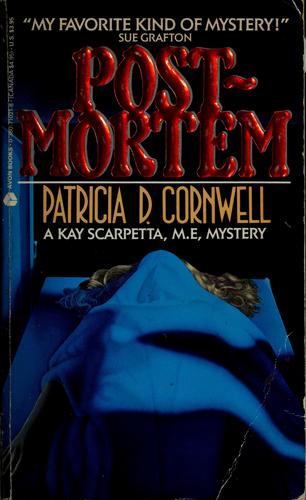
Postmortem
by Patricia Cornwell
★ Top 25 book of 1990 · #18 on Best Books of 1990
A killer is targeting Richmond, Virginia, and Chief Medical Examiner Kay Scarpetta is drawn into the hunt as victims pile up. Relying on forensic science and determination, she faces opposition from all sides, and someone wants her dead.
Best for: Readers who enjoy forensic-driven crime investigations led by a determined medical examiner.
Postmortem is #18 on BookWard's Best Books of 1990, out of 39 1990 books that cleared our data bar.
What Postmortem is about
Dr. Kay Scarpetta is the chief medical examiner of Virginia, and Richmond is in the grip of a killer who strangles his victims and leaves almost nothing behind. He cleans each scene, but the substance he uses glows under laser light, and that small detail gives Scarpetta somewhere to start. She works alongside detective Pete Marino and FBI profiler Benton Wesley, while looking after her ten-year-old niece Lucy and handling a tentative romance with the local Commonwealth's attorney.
The novel is gritty and procedural, built around the slow work of reading evidence. It also pays attention to what the job costs her, including the fear that comes when an investigator becomes a target. It was Patricia Cornwell's debut, the first Scarpetta book, and it won the 1991 Edgar Award for Best First Novel.
Postmortem on the Best Books of 1990
Postmortem came out in 1990. Of the 39 books first published in 1990 that met BookWard's data bar, it ranks #18 on our Best Books of 1990 list.
Why it made the list: 261 readers have shelved it on Open Library; readers rate it 3.8 out of 5 (24 ratings). The list ranks each year’s books on how many readers have picked them up, how highly readers rate them, and how many are reading them right now.
Nearby on the 1990 list
- The Sleepwalker Robert Lawrence Stine, #16
- Dawn V.C. Andrews, #17
- Stormy Surrender Patricia Wilson, #19
- Almost Heaven Judith McNaught, #20
See all Best Books of 1990 Best books by year
More years: Best Books of 1991.
The numbers behind it
- Readers: 199 want to read it, 17 are reading it now and 45 have read it, according to Open Library.
- Ratings: 3.8 out of 5 from 24 Open Library ratings.
| Signal | This book (0 to 100) | Weight |
|---|---|---|
| Reach | 54 | 55% |
| Reader love | 18 | 25% |
| Being read right now | 69 | 20% |
Questions about Postmortem
When was Postmortem published?
Postmortem by Patricia Cornwell was first published in 1990.
Was Postmortem one of the best books of 1990?
Postmortem is #18 on BookWard's Best Books of 1990, out of 39 1990 books that cleared our data bar. 261 readers have shelved it on Open Library; readers rate it 3.8 out of 5 (24 ratings).
Why is Postmortem on the Best Books of 1990 list?
261 readers have shelved it on Open Library; readers rate it 3.8 out of 5 (24 ratings).
More of the best books of 1990
- Good Omens Terry Pratchett, #1
- Jurassic Park Michael Crichton, #2
- The Eye of the World Robert Jordan, #3
- The Witching Hour Anne Rice, #4
- Flow Mihaly Csikszentmihalyi, #5
- The Things They Carried Tim O'Brien, #6
See the full Best Books of 1990, the Top 100, or new books on Rising.
How we know
This page uses public data: Open Library reader counts and ratings, and Wikipedia page views for recent years. The description is paraphrased from real source text. Rankings reflect reading interest, not quality or sales, and can be affected by data gaps. Lists update monthly.
Best for adult and older teen readers who are comfortable with crime fiction.
Depends on the edition you pick.
The forensic procedural that made Kay Scarpetta a fixture of crime fiction. 58% taste match
 BookWard’s take
The forensic procedural that made Kay Scarpetta a fixture of crime fiction
Postmortem opens on a gruesome strangling in Richmond and pulls you straight into Kay Scarpetta's morgue and lab, so it grabs you at once. The forensics are convincing: clues like a substance that fluoresces under laser light are worked through step by step rather than conjured. The pace stays brisk because the investigation keeps tightening, though the book leans on familiar types, including the lone female expert, the gruff detective and the FBI profiler. Where it earns its keep is in Scarpetta herself, whose work and private life press against each other in ways that feel lived in. It won the 1991 Edgar Award for Best First Novel, and it reads as a debut with a clear sense of what it wants to do.
A standard-length thriller that stays focused on one investigation, which suits BookWard's taste for tight books better than a sprawl would.
The case keeps closing in, with each new clue or victim pushing the story forward, close to BookWard's quick preference.
The forensic-pathologist lead and lab-heavy detail felt fresh for 1990, though the killer-hunt shape is familiar.
Plain, controlled prose serves the procedure, a little plainer than BookWard's slightly richer middle ground.
Plot leads, with the murders setting the course, though Scarpetta's character is woven in.
Dark subject matter and a threatened heroine keep the outlook grim, though justice is served.
A conventional investigative arc runs from crime to suspects to confrontation, as BookWard would expect.
Humor is rare in a grim murder investigation, so this sits at the serious end.
Serial strangling and a heroine stalked in her own home make this a dark book.
Tension and dread run high, with only moderate emotional intensity outside the case.
See all 50 dialsEvery position, side by side with this book
Where it lines up
- PaceBookWard 8 · book 8
- EndingBookWard 8 · book 8
- Story or ideasBookWard 3 · book 3
Where it pulls apart
- Familiar tropesBookWard 10 · book 4
- LengthBookWard 1 · book 4
- Shock for effectBookWard 9 · book 5
A standard-length thriller that stays focused on one investigation, which suits BookWard's taste for tight books better than a sprawl would.
It begins at a fresh murder scene, so the story is moving from the first pages, exactly what BookWard wants.
The expert heroine, gruff cop and FBI profiler are well-worn crime roles, which cuts against BookWard's wish to avoid tropes.
Forensic evidence drives the case and the deductions follow from it, matching BookWard's liking for airtight cause and effect.
The case keeps closing in, with each new clue or victim pushing the story forward, close to BookWard's quick preference.
The forensic-pathologist lead and lab-heavy detail felt fresh for 1990, though the killer-hunt shape is familiar.
Scarpetta's professional burden and messy private life give her real dimension, in line with what BookWard values.
The killer is identified and the case closes decisively, which fits BookWard's preference for resolution.
The tone is clinical and tense rather than weepy, with only a little domestic warmth around Scarpetta's niece.
The crimes are grisly, but they serve the investigation rather than existing only to shock, which BookWard accepts.
Forensic detail is a central pleasure here, with the science treated as part of the case rather than decoration.
A confident, procedural voice marks the debut, though it stays more functional than strikingly individual.
This is a story-led thriller, with the hunt for the killer driving everything, which matches BookWard's leaning.
Forensic work gets explained in places, but much of it unfolds through scenes at the morgue and crime scenes.
The investigation keeps producing new angles, so momentum holds, which BookWard rewards.
Plain, controlled prose serves the procedure, a little plainer than BookWard's slightly richer middle ground.
Plot leads, with the murders setting the course, though Scarpetta's character is woven in.
Dark subject matter and a threatened heroine keep the outlook grim, though justice is served.
A conventional investigative arc runs from crime to suspects to confrontation, as BookWard would expect.
Humor is rare in a grim murder investigation, so this sits at the serious end.
The forensic detail asks for attention, but the story is easy to follow, which suits BookWard.
The story stays anchored mainly to Scarpetta, narrower than BookWard's taste for many viewpoints.
The investigation moves forward in order, which is more linear than BookWard's mixed preference.
Entirely grounded in real forensic work and police procedure, well below BookWard's middle ground.
A contained group of police, medical and legal figures keeps the cast near BookWard's modest size.
The story stays within one city and one case, which keeps it intimate rather than epic.
Investigative action and Scarpetta's private worries share the page about evenly.
Conversations among Scarpetta, Marino and Wesley carry a good share of the case, close to BookWard's liking.
A tentative relationship with the Commonwealth's attorney is a side thread rather than the heart of the book.
The morgue, lab and Richmond police world will feel specialized to most readers, a draw for BookWard.
Set in its own 1990 moment, it sits in the past from today's point of view.
The cat-and-mouse hunt endures, though the technology and methods mark it as a product of its time.
The narration is straightforward and trustworthy, with no unreliable twist, short of BookWard's taste.
Right and wrong are fairly clear: a killer is hunted by those trying to stop him.
Crime scenes and lab work get concrete, clinical detail without lingering on scenery.
A suspected husband and a late reveal of the killer's identity give it a few turns.
A grim, tense read that tests nerves without being formally difficult.
Serial strangling and a heroine stalked in her own home make this a dark book.
Tension and dread run high, with only moderate emotional intensity outside the case.
What humor exists is dry and sparse, mostly in the cops' banter.
The murders are described graphically, with aftermath given vivid forensic detail.
Sex plays almost no part, apart from the threat the killer represents.
Office politics and media pressure appear, but they are not the focus.
Plain, direct language with technical terms explained, so it reads without strain.
The narration stays close to Scarpetta's professional perspective without editorializing much.
It looks at present-day crime and technology of its time, more than it looks ahead.
Scarpetta's commitment to truth and justice is steady, though the world around her is harsh.
Review written by BookWard, dial version 1, November 2026.
Who is Postmortem right for?
Best for adult and older teen readers who are comfortable with crime fiction. It includes graphic descriptions of murder and its forensic aftermath, plus a scene of a heroine threatened in her home.
The forensic detail asks for attention, but the story is easy to follow, which suits BookWard.
Serial strangling and a heroine stalked in her own home make this a dark book.
Tension and dread run high, with only moderate emotional intensity outside the case.
The murders are described graphically, with aftermath given vivid forensic detail.
Book CompanionPostmortem: ideas, characters, themes
A chief medical examiner works alongside police and the FBI to catch a killer who erases evidence while the strain reaches into her own life.
- A string of murders in Richmond. Dr. Kay Scarpetta is called to a strangling that is the latest in an unsolved run of killings.
- The glowing clue. The killer cleans scenes with a substance that fluoresces under laser light, giving the team an unusual trail.
- A wrong suspect. Early evidence points to a victim's husband, but Scarpetta disagrees with Marino about it.
- The media gambit. Scarpetta, Wesley and reporter Abby Turnbull plan a news story meant to provoke the killer.
- Work meets home. Her niece Lucy and a tentative romance with the Commonwealth's attorney press on her professional life.
Characters
Kay Scarpetta
Chief medical examiner of Virginia
She leads the forensic investigation and carries both its weight and its danger.
Pete Marino
Richmond police detective
A blunt detective who works the case with Scarpetta and clashes with her over the husband.
Benton Wesley
FBI profiler
He helps build a picture of the killer's psychology.
Lucy
Scarpetta's niece
A precocious ten-year-old whose presence adds pressure to Scarpetta's home life.
Abby Turnbull
Investigative reporter
She joins the plan to use the press to draw the killer out.
Themes
Evidence and forensic method are how truth is found and the guilty held to account.
Scarpetta holds authority in a world of police and officials that often tests it.
The press can be used to provoke a killer, at a cost to those who do the provoking.
The case crowds out family and romance in Scarpetta's days.
Those who hunt a killer can become his prey.
Discussion questions
- Why does Scarpetta resist the early suspect even when Marino is so sure?
- How does the glowing substance change the way the team reads a crime scene?
- Is using the media to bait the killer a reasonable risk or a reckless one?
- How do Lucy and the romance subplot reshape our sense of Scarpetta?
- Which procedural details felt most convincing, and which felt dated?
Personalize your Book Companion
This is the general edition. In BookWard, the Companion is written for you: your reading profile, your notes, and spoiler-safe to the page you are on.
Buy, listen or borrow Postmortem
Each link opens a search for this book on that store, in a new tab.
Read on a device
Borrow
Reviews and community
If you liked Postmortem
A hitchhiking drifter, a Texas ranch, and a family worth fearing
The VisitorLee ChildA fast Reacher thriller built around a killer who leaves nothing behind
Glory in DeathNora RobertsA brisk 2058 murder hunt where duty collides with desire
Along Came a SpiderJames PattersonA fast, familiar kidnapping thriller that launched the Alex Cross series
Find your own best books
Add what you have read, rate it, and BookWard will recommend what to read next.
Free to start. No credit card needed.