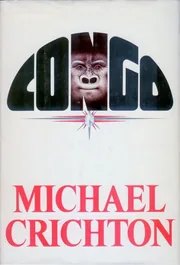
Suits older teens and adults who enjoy brisk adventure and science-flavored thrillers.
348 pages, about 5.5 to 8 hours.
A fast, gadget-laden lost world adventure, more machine than mood.. 45% taste match
The story
Congo is an adventure thriller by Michael Crichton, first published in 1980, with elements of science fiction and horror. It belongs to the lost world tradition, and its pages run to about 348 in the typical edition. Crichton wrote it as his fifth novel under his own name.
The story follows an expedition into the dense rainforest of the Congo, where a team goes in search of diamonds and tries to learn what happened to an earlier party that died under mysterious circumstances. The cast includes Karen Ross, who begins her part of the story at a computer terminal in Houston studying satellite images of Africa, along with Peter Elliot, Charles Munro, and a gorilla named Amy. The action moves between places such as San Francisco, Houston, Tangier, Nairobi, and the Virunga region, and the setting reaches from the present day of 1979 back to the year 1642. Archaeology and the lost city of Zinj also figure in the book, which has appeared in 49 editions.
Ten thousand mile away, in the cold, windowless main data room of earth resources technology services, inc., of houston, karen ross sat hunched over a mug of coffee in front of a computer terminal, reviewing the latest landsat images from africa.
Characters
Karen RossPeter ElliotAmyCharles Munro
Setting
Congo (Democratic Republic)Congo (Brazzaville)ZinjCongoSan Francisco
Period
16421979
Themes
kakundakaritype IIbdiamondsthrillersadventure storiesArchaeologyGorillaHorror stories
- Want to read 159
- Reading now 6
- Read 78
Most people shelving it are saving it for later.
Of 243 readers who put it on a shelf, 65% want to read it, 2% are reading it now, 32% have finished it and 0% stopped before the end.
By the numbers
- The median edition runs 348 pages. Counting about 275 words a page and an adult reading pace of 250 words a minute, that is about 6.4 hours of reading.
- Open Library tracks 49 editions from 41 publishers, the earliest dated 1980 and the latest 2015, across 8 languages.
- On reader demand it ranks in the top 2% of the modern books in our catalog (15,152 of them).
- Libraries shelve it under Dewey 813.54 and Library of Congress class PS-3553.00000000.R48 C65 1980.
 BookWard’s take
A fast, gadget-laden lost world adventure, more machine than mood.
Congo is Crichton in full expedition mode: diamonds, a vanished earlier party, and a lost-world rainforest to cross. The hook is immediate, and the pace stays brisk across about 348 pages, which suits a reader who likes a fast, gripping opening. Where it falls short is character depth and freshness. The adventure-thriller scaffolding is well worn, and the cast exists to serve the plot rather than to be deeply drawn. What it does offer is internal logic: the science and technology are laid out with confident, explanatory detail, spelled out plainly rather than hinted at, and the book leans toward ideas as much as story. It is a page-turner first, and an efficient one, if you can accept a plot that leans on convention.
At around 348 pages it is lean for an expedition thriller, though not as compact as BookWard's preference.
The plot is built for speed, matching and slightly exceeding BookWard's appetite for fast momentum.
It openly works within a Haggard-style tradition, so it is more a polished variation than a fresh invention.
The writing is plain and functional, built to move the reader along rather than to ornament.
Events and the expedition drive everything, well away from BookWard's character-led lean.
It sits near the middle, with menace in the jungle balanced by the survivors' determination.
A straightforward forward-moving adventure, a bit more conventional than BookWard's middle ground.
It plays its adventure seriously, with little humor, short of BookWard's lightly funny tilt.
The deaths and dangers give it real menace, edging past BookWard's middle.
Feeling stays secondary to suspense, so intensity is modest.
See all 50 dialsEvery position, side by side with this book
Where it lines up
- PaceBookWard 8 · book 9
- EndingBookWard 8 · book 7
- SentimentBookWard 8 · book 7
Where it pulls apart
- Familiar tropesBookWard 10 · book 3
- ExpositionBookWard 2 · book 8
- OriginalityBookWard 9 · book 4
At around 348 pages it is lean for an expedition thriller, though not as compact as BookWard's preference.
It drops into the mission quickly, with the diamond hunt and the dead earlier party giving it momentum from the start.
The lost-world, expedition-into-the-jungle template is deliberately classic, which leans on trope more than BookWard would like.
Crichton lays out the technology and field science with methodical detail, which fits BookWard's love of airtight reasoning.
The plot is built for speed, matching and slightly exceeding BookWard's appetite for fast momentum.
It openly works within a Haggard-style tradition, so it is more a polished variation than a fresh invention.
Characters are defined mostly by role and expertise, which is thinner than the drawn-from-within people BookWard favors.
This is a plot-driven thriller that builds toward a clear payoff, in line with BookWard's taste for resolution.
Feeling is kept in the background in favor of mission and mechanism, though it is not austere.
Danger and darkness serve the adventure, with a touch more spectacle than BookWard prizes.
Crichton's technical detail is the draw, though it is a thriller's rigor rather than a scholar's.
Its brisk, explanatory, technically assured style is recognizably Crichton, if not strikingly personal.
The story leads, but the book is unusually interested in explaining technology and science along the way.
Crichton tends to explain his science and setting outright, far more than BookWard's show-in-scene preference.
Momentum is built in throughout, with few lulls across the journey.
The writing is plain and functional, built to move the reader along rather than to ornament.
Events and the expedition drive everything, well away from BookWard's character-led lean.
It sits near the middle, with menace in the jungle balanced by the survivors' determination.
A straightforward forward-moving adventure, a bit more conventional than BookWard's middle ground.
It plays its adventure seriously, with little humor, short of BookWard's lightly funny tilt.
It reads easily and quickly, comfortably on the accessible side of BookWard's range.
The story follows the expedition's key members, narrower than the broad viewpoint spread BookWard enjoys.
The action runs forward along the expedition, with only minor historical background, so it reads as largely linear.
The lost-world premise adds fantastical elements, but the tone stays near the realistic edge of science fiction.
A compact expedition party keeps the main cast at a manageable size, near BookWard's comfort zone.
A continent-spanning expedition gives it a wider canvas than intimate, leaning toward epic.
The book lives in action and external events, with little time spent inside anyone's head.
Conversation carries a lot of explanation and planning, putting it on the heavier side.
Romance sits in the background of what is mainly a mission and survival story.
The rainforest and the lost city give it a distinctly unfamiliar setting, which BookWard enjoys.
Written in 1980 and tied to its contemporary technology, it reads as a past-day adventure.
Its technology dates it, though the adventure framework itself continues to travel well.
A straightforward third-person telling with no unreliability to speak of.
Heroes and threats are drawn clearly, with little moral gray, short of BookWard's ambiguity.
It gives the jungle and its hazards moderate detail, serving the action more than lingering.
Not applicable to a work of fiction.
Not applicable to a work of fiction.
It stands on its own as a self-contained adventure with no need for other books.
The mystery of the earlier expedition and the dangers ahead supply a fair share of surprises.
It entertains rather than unsettles, firmly on the comforting side of BookWard's range.
The deaths and dangers give it real menace, edging past BookWard's middle.
Feeling stays secondary to suspense, so intensity is modest.
Humor is occasional and lightly dry rather than broad.
Peril and attacks are part of the jungle adventure, a bit above BookWard's midpoint.
Sexual content is minimal, which is closer to BookWard's low end.
Corporate and geopolitical maneuvering appears in the background but never takes over.
The language is plain and easy to follow throughout.
Narration mostly stays neutral and explanatory, with little editorializing.
It looks to technology and the future while also reaching back toward an ancient lost city.
It balances the cynicism of corporate rivalry against the team's determination, landing slightly toward cynical.
Review written by BookWard, dial version 1, November 2026.
Who is Congo right for?
Suits older teens and adults who enjoy brisk adventure and science-flavored thrillers. It contains jungle peril, deaths and some violence, though little sexual content.
It reads easily and quickly, comfortably on the accessible side of BookWard's range.
The deaths and dangers give it real menace, edging past BookWard's middle.
Feeling stays secondary to suspense, so intensity is modest.
Peril and attacks are part of the jungle adventure, a bit above BookWard's midpoint.
Book CompanionCongo: ideas, characters, themes
An expedition into the Congo rainforest to find diamonds and learn why an earlier party died becomes a race through a lost-world mystery.
- The Mission. A team heads into the dense Congo rainforest seeking diamonds and answers about a previous expedition's deaths.
- Lost World Tradition. Crichton frames the book as a lost world novel in the line of Haggard's King Solomon's Mines.
- Science and Technology. Satellite imagery and computer work in Houston anchor the expedition's modern, technical side.
- Zinj and the Past. Archaeology and the lost city of Zinj tie the present expedition to a much older history.
- A Global Canvas. The story moves between places such as San Francisco, Houston, Tangier, Nairobi and the Virunga region.
Characters
Karen Ross
Expedition member
Her part of the story begins at a computer terminal in Houston, where she studies satellite images of Africa.
Peter Elliot
Expedition member
One of the central figures drawn into the Congo journey.
Charles Munro
Expedition member
A key figure in the party heading into the rainforest.
Amy
Gorilla
A gorilla who is part of the story's cast.
Themes
The pull of venturing into unmapped, dangerous territory.
How the hunt for diamonds shapes the expedition's choices.
Modern tools set against an unforgiving jungle.
The idea of a hidden place that history left behind.
Discussion questions
- Does the lost-world formula still feel fresh, or is it mainly a comfortable template?
- How much do the characters matter compared to the plot and the technology?
- What does the book's heavy use of explained science add or take away?
- How does the 1980 publication date shape the technology on the page?
- Which part of the expedition kept you turning pages the most?
Personalize your Book Companion
This is the general edition. In BookWard, the Companion is written for you: your reading profile, your notes, and spoiler-safe to the page you are on.
Buy, listen or borrow Congo
Each link opens a search for this book on that store, in a new tab.
Read on a device
Borrow
Reviews and community
If you liked Congo
Crichton's nanobot thriller runs fast but trades depth for ideas
The Lost WorldMichael CrichtonCrichton's only sequel trades wonder for a fast island chase
Deception PointDan BrownA fast, twisty Arctic thriller that trades subtlety for momentum
PhantomsDean KoontzAn isolated mountain town, 150 dead, and a mystery that escalates
Sources: Open Library.
Track Congo and find your next favorite
Add it to your shelf, rate what you have read, and BookWard will recommend what fits you.
Free to start. No credit card needed.