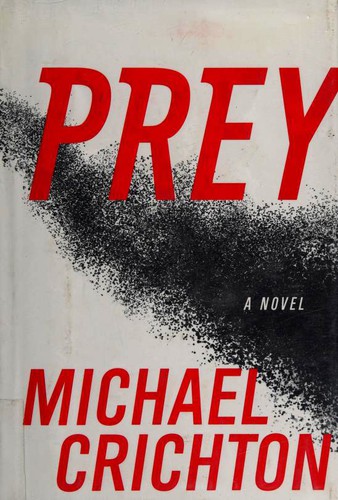
Prey
by Michael Crichton
★ Top 25 book of 2002 · #16 on Best Books of 2002
Michael Crichton's first novel of the new century is a warning about emerging technology. It draws on nanotechnology, genetic engineering and distributed artificial intelligence, with artificial life, emergence and host-parasite coevolution at its core.
Best for: Readers who like cautionary science fiction rooted in cutting-edge technology
Prey is #16 on BookWard's Best Books of 2002, out of 32 2002 books that cleared our data bar.
What Prey is about
Jack Forman is an unemployed software programmer and stay-at-home husband whose wife Julia works at Xymos, a nanorobotics company. Lately she has been acting strangely, even cruelly, and Jack suspects she is having an affair. When he is called to the company's research facility in the Nevada desert, he finds something far stranger than infidelity. Microscopic machines have escaped into the desert, where they gather in swarms that feed on sunlight, multiply and evolve fast. They seem to hunt, and they can mimic the look and movement of people.
Crichton's thirteenth novel under his own name is a cautionary tale about nanotechnology, genetic engineering and artificial intelligence. It blends the scientific unease of Jurassic Park and The Andromeda Strain, and will appeal to readers who enjoy a fast techno-thriller.
Prey on the Best Books of 2002
Prey came out in 2002. Of the 32 books first published in 2002 that met BookWard's data bar, it ranks #16 on our Best Books of 2002 list.
Why it made the list: 235 readers have shelved it on Open Library; readers rate it 3.5 out of 5 (44 ratings). The list ranks each year’s books on how many readers have picked them up, how highly readers rate them, and how many are reading them right now.
Nearby on the 2002 list
- Understanding Power Noam Chomsky, #14
- Without Fail Lee Child, #15
- Hoot Carl Hiaasen, #17
- The Contaxis Baby Lynne Graham, #18
See all Best Books of 2002 Best books by year
More years: Best Books of 2001 Best Books of 2003.
The numbers behind it
- Readers: 149 want to read it, 9 are reading it now and 77 have read it, according to Open Library.
- Ratings: 3.5 out of 5 from 44 Open Library ratings.
| Signal | This book (0 to 100) | Weight |
|---|---|---|
| Reach | 56 | 55% |
| Reader love | 6 | 25% |
| Being read right now | 50 | 20% |
Questions about Prey
When was Prey published?
Prey by Michael Crichton was first published in 2002.
Was Prey one of the best books of 2002?
Prey is #16 on BookWard's Best Books of 2002, out of 32 2002 books that cleared our data bar. 235 readers have shelved it on Open Library; readers rate it 3.5 out of 5 (44 ratings).
Why is Prey on the Best Books of 2002 list?
235 readers have shelved it on Open Library; readers rate it 3.5 out of 5 (44 ratings).
More of the best books of 2002
- Romancing Mister Bridgerton Julia Quinn, #1
- Coraline Neil Gaiman, #2
- Why Does He Do That? Lundy Bancroft, #3
- Room on the Broom Julia Donaldson, #4
- Stories of Your Life and Others Ted Chiang, #5
- Everything's Eventual. 14 Dark Tales Stephen King, #6
See the full Best Books of 2002, the Top 100, or new books on Rising.
How we know
This page uses public data: Open Library reader counts and ratings, and Wikipedia page views for recent years. The description is paraphrased from real source text. Rankings reflect reading interest, not quality or sales, and can be affected by data gaps. Lists update monthly.
Suits adult and mature teen readers who enjoy science-driven thrillers.
Depends on the edition you pick.
Crichton's nanobot thriller runs fast but trades depth for ideas. 48% taste match
 BookWard’s take
Crichton's nanobot thriller runs fast but trades depth for ideas
Prey drops a stay-at-home programmer into a nanorobotics company where something has gone wrong in the Nevada desert, and the setup pulls you in fast. The opening grabs and the pace rarely lets up. The internal logic is a real strength: the science is laid out carefully enough that the threat feels reasoned rather than arbitrary. Where it wobbles is in the explaining. Crichton tells outright and often, where I would rather see things play out in scene. Familiar tropes also show up, with the runaway-technology warning echoing his earlier work, so the book feels only moderately original. Characters serve the plot more than they deepen. It is a brisk, idea-led techno-thriller, best taken as a propulsive cautionary tale about nanotechnology and distributed intelligence.
A mid-sized thriller built to be read in a few sittings rather than a sprawling epic, though not as lean as BookWard prefers.
Short chapters and a steady stream of new dangers keep it moving, matching BookWard's taste for speed.
The nanotech premise is fresh in detail but the shape recalls Jurassic Park and The Andromeda Strain.
Clean and functional sentences with little ornament, plainer than BookWard's slight lean toward style.
Events and the unfolding threat carry the book far more than inner change in anyone.
A cautionary tale about technology gone wrong, it leans pessimistic about human control over what it builds.
A straightforward chronological thriller with no formal experiments.
Serious and tense throughout, with little room for comedy.
The swarms kill and the menace is real, giving it a fairly dark edge.
Fear and urgency drive it more than deep feeling.
See all 50 dialsEvery position, side by side with this book
Where it lines up
- PaceBookWard 8 · book 9
- EndingBookWard 8 · book 7
- OpeningBookWard 10 · book 8
Where it pulls apart
- Familiar tropesBookWard 10 · book 4
- ExpositionBookWard 2 · book 8
- Story or ideasBookWard 3 · book 8
A mid-sized thriller built to be read in a few sittings rather than a sprawling epic, though not as lean as BookWard prefers.
It opens on a domestic puzzle and a suspicious marriage, then moves quickly into the company's secrets, which suits BookWard well.
The runaway-technology warning is well-worn Crichton territory, so it leans on familiar beats more than BookWard likes.
The nanobot threat follows from clearly stated mechanisms, so events feel reasoned, which BookWard values.
Short chapters and a steady stream of new dangers keep it moving, matching BookWard's taste for speed.
The nanotech premise is fresh in detail but the shape recalls Jurassic Park and The Andromeda Strain.
People are defined mostly by their jobs and function in the plot, which falls short of BookWard's appetite for depth.
The central threat is driven toward a clear resolution rather than left hanging, in line with BookWard.
Family stakes add some warmth, but the book stays largely brisk and unsentimental.
The danger escalates to serve the premise, though some peril is there for jolts rather than meaning.
Real concepts like emergence and genetic algorithms ground the fiction, but this is a novel, not a rigorous text.
The plain, efficient narration is recognizably Crichton but not especially distinctive on the page.
The concepts drive the book more than the characters do, sitting well toward the idea-led end.
Characters stop to explain the science directly, which is the clearest mismatch with BookWard's preference for showing.
The momentum mostly holds, with only brief pauses for explanation between set pieces.
Clean and functional sentences with little ornament, plainer than BookWard's slight lean toward style.
Events and the unfolding threat carry the book far more than inner change in anyone.
A cautionary tale about technology gone wrong, it leans pessimistic about human control over what it builds.
A straightforward chronological thriller with no formal experiments.
Serious and tense throughout, with little room for comedy.
Technical ideas are explained clearly, so it reads easily despite the subject.
The story is told from a single programmer's perspective.
Events move forward in a mostly linear sequence.
Rooted in real science, with the nanobot swarms pushed into speculative territory.
A small programming team and a few family members make up the cast.
Contained largely to one facility and its surrounding desert, though the stakes grow larger.
Action, pursuit and survival dominate over reflection.
Conversation carries a lot of the explanation and plot, making it moderately heavy on talk.
A marriage under suspicion sits in the background but does not drive the story.
Corporate labs and the Nevada desert are somewhat unfamiliar settings for most readers.
Set in the then-present of the early 2000s, with technology that still feels contemporary in spirit.
Its specific tech references date it, though the cautionary theme still travels.
The narrator tells things plainly, with no sign of unreliability.
The danger of unchecked technology is framed in a fairly clear way.
Description is functional, focused on machinery and landscape rather than lush detail.
A standalone novel that needs no other book.
Reversals about the company and the swarms arrive regularly.
A tense, gripping read that raises concerns but does not push hard on the reader.
The swarms kill and the menace is real, giving it a fairly dark edge.
Fear and urgency drive it more than deep feeling.
There is very little humor, and what exists is dry.
The swarms kill wildlife and people on the page, with a steady threat of harm.
Sex is minimal, appearing only in the background of a marital subplot.
Corporate ethics and technology risk are present but not the main thrust.
Technical terms appear but the language stays plain and accessible.
The narration pushes a clear wary stance toward technology without being a polemic.
Concerned with where emerging science is heading, so it faces forward.
Its view of corporate and scientific ambition is skeptical, bordering on cynical.
Review written by BookWard, dial version 1, November 2026.
Who is Prey right for?
Suits adult and mature teen readers who enjoy science-driven thrillers. It contains deaths, animal killings and suspense that some younger readers may find intense.
Technical ideas are explained clearly, so it reads easily despite the subject.
The swarms kill and the menace is real, giving it a fairly dark edge.
Fear and urgency drive it more than deep feeling.
The swarms kill wildlife and people on the page, with a steady threat of harm.
Book CompanionPrey: ideas, characters, themes
A programmer discovers that his wife's company has loosed self-evolving nanobot swarms, and that the technology is turning predatory.
- A domestic start. The story opens on an unemployed programmer at home, uneasy about his wife's long hours and secrecy at work.
- The nanobot company. Xymos, a nanorobotics firm, is where the wife works and where the central trouble begins.
- Out in the desert. The research facility in Nevada's Basin Desert is where the team and the swarms are met.
- Swarms that evolve. The nanobots reproduce and adapt quickly, becoming a predatory presence beyond human control.
- Science as warning. The novel draws on emergence, artificial life and agent-based computing to frame a cautionary tale.
Characters
Jack Forman
Narrator and software programmer
An unemployed programmer and stay-at-home husband drawn into the company's crisis.
Julia
Jack's wife
An executive at Xymos whose long hours and secrecy trouble her husband.
Ricky
Project manager at Xymos
Struggling to manage the nanobots and the problems around them.
Mae
Member of the programming team
One of the programmers at the Nevada research facility.
Themes
Human-made systems can evolve beyond what their creators intended.
Hidden work and unshared code let dangerous problems grow unseen.
Simple parts can combine into complex, unpredictable behavior.
Suspicion and secrecy strain a close relationship.
Artificial systems can mimic natural competition with deadly effect.
Discussion questions
- Does the book make nanotechnology feel plausible or purely cinematic?
- How much does explaining the science help or hinder the suspense?
- What does the marriage subplot add to the larger story?
- Is the warning about technology still relevant today?
- Do the characters feel like people or like roles in the plot?
Personalize your Book Companion
This is the general edition. In BookWard, the Companion is written for you: your reading profile, your notes, and spoiler-safe to the page you are on.
Buy, listen or borrow Prey
Each link opens a search for this book on that store, in a new tab.
Read on a device
Borrow
Reviews and community
If you liked Prey
A fast, gadget-laden lost world adventure, more machine than mood.
AirframeMichael CrichtonA tight, clever corporate thriller built on an airliner mystery
Tunnel in the skyRobert A. HeinleinHeinlein strands a class of students and watches society form
The Day of the TriffidsJohn WyndhamA quiet-voiced catastrophe where the walking plants are the lesser danger
Find your own best books
Add what you have read, rate it, and BookWard will recommend what to read next.
Free to start. No credit card needed.