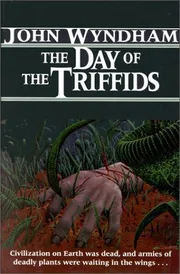
The Day of the Triffids
by John Wyndham, Marcel Battin · 1951
Suited to teens and adults who enjoy classic science fiction.
270 pages, about 4.5 to 6.5 hours.
A quiet-voiced catastrophe where the walking plants are the lesser danger. 58% taste match
The story
The Day of the Triffids is a post-apocalyptic science fiction novel by the English author John Wyndham, first published in 1951. It was the first of his novels to appear under the name John Wyndham, after earlier books issued under other combinations of his real name. The story is set in England and belongs to the tradition of English fantasy and horror fiction, with a long publishing life that includes translations into Russian and 63 editions of roughly 270 pages.
Bill Masen wakes in a hospital with bandaged eyes and finds that a meteor shower has left nearly everyone else blind, while he alone can still see. With society collapsing, the triffids, tall venomous plants that can move on their roots and feed on people, become a growing danger. The book takes up the fears of its postwar period, including Cold War tension, biological experimentation and the prospect of a man-made catastrophe, along with the genetic alteration of plants.
When a day that you happen to know is Wednesday starts off by sounding like Sunday, there is something seriously wrong somewhere.
Setting
EnglandNew York (N.Y.)
Themes
BlindHorrorMeteoritesClassic LiteraturePlant mutationCarnivorous plantsPlantsBlindness
- Want to read 202
- Reading now 9
- Read 71
Most people shelving it are saving it for later.
Of 282 readers who put it on a shelf, 72% want to read it, 3% are reading it now, 25% have finished it and 0% stopped before the end.
By the numbers
- The median edition runs 270 pages. Counting about 275 words a page and an adult reading pace of 250 words a minute, that is about 5.0 hours of reading.
- Open Library tracks 63 editions from 50 publishers, the earliest dated 1951 and the latest 2022, across 5 languages.
- On reader demand it ranks in the top 4% of the classic books in our catalog (8,749 of them).
- Libraries shelve it under Dewey 823.912 and Library of Congress class PR-6045.00000000.Y64 D3 2003.
Read it
A digital copy can be borrowed for free.
1 ebook provider carry it and a scanned copy is on the Internet Archive.
 BookWard’s take
A quiet-voiced catastrophe where the walking plants are the lesser danger
Wyndham opens with one of the great hooks in science fiction: a narrator who wakes bandaged in hospital to a world gone strangely silent. That first line sets the tone, calm and plain-spoken while everything falls apart. The premise holds together tightly, from the meteor shower to the venomous triffids, and each step follows logically from the last. The pace is brisk without being breathless, and the prose is clear rather than ornate. My main quibble is the exposition, since Bill Masen often explains his world outright instead of letting scenes carry it. It is also more driven by ideas than most stories, with Cold War and genetic-engineering fears shaping the questions it asks. Still, at 270 pages it stays lean and sustained.
At 270 pages it is compact for an end-of-the-world story, close to BookWard's liking for tight books.
Events move steadily from the hospital outward, quick enough to keep turning pages without feeling rushed.
Walking, venomous plants as the instrument of collapse was a striking idea for its time, and it still stands out.
The writing is plain and lucid, serving the story without ornament, which sits close to BookWard's middle ground.
The unfolding crisis drives the narrative far more than any inner change in its people, leaning plot-first against BookWard's lean toward character.
It balances grim loss with a thread of rebuilding, landing in the middle, a touch less hopeful than BookWard prefers.
It follows a straightforward first-person progression, more conventional than BookWard's mild appetite for formal play.
The tone is sober and serious, with only dry flashes, well short of the humor BookWard enjoys.
Mass blindness, death and social breakdown make it grim, a shade darker than BookWard's middle setting.
Loss is felt but handled with composure, giving moderate emotional weight in line with BookWard's range.
See all 50 dialsEvery position, side by side with this book
Where it lines up
- OpeningBookWard 10 · book 10
- PaceBookWard 8 · book 7
- SentimentBookWard 8 · book 7
Where it pulls apart
- Familiar tropesBookWard 10 · book 5
- ExpositionBookWard 2 · book 7
- Story or ideasBookWard 3 · book 7
At 270 pages it is compact for an end-of-the-world story, close to BookWard's liking for tight books.
A narrator waking to a Wednesday that sounds like Sunday grabs you in the first line, exactly the immediate opening BookWard rewards.
It helped define the post-apocalyptic template, so later imitators have worn its ideas familiar, though it still feels fresh in its own hands.
The meteor shower, the blindness and the engineered plants follow a clear chain of cause and effect, matching BookWard's love of airtight worlds.
Events move steadily from the hospital outward, quick enough to keep turning pages without feeling rushed.
Walking, venomous plants as the instrument of collapse was a striking idea for its time, and it still stands out.
Bill Masen is a clear, capable guide, but he is drawn more as a vantage point than a deep psychological portrait.
The tone is level and unsentimental even in disaster, though it stops short of the full restraint BookWard prizes.
The darkness grows out of the premise and its consequences instead of being added for effect, which suits BookWard well.
Wyndham's calm, reasonable narrator makes catastrophe feel conversational, a distinctive register BookWard admires.
The story is built to examine ideas about science, society and survival, leaning more toward concept than BookWard usually does.
Masen frequently explains how the world works in his own words, a habit BookWard would rather see handled in scene.
Momentum holds as the situation widens, with new problems keeping the middle active, though not quite as sharp as the opening.
The writing is plain and lucid, serving the story without ornament, which sits close to BookWard's middle ground.
The unfolding crisis drives the narrative far more than any inner change in its people, leaning plot-first against BookWard's lean toward character.
It balances grim loss with a thread of rebuilding, landing in the middle, a touch less hopeful than BookWard prefers.
It follows a straightforward first-person progression, more conventional than BookWard's mild appetite for formal play.
The tone is sober and serious, with only dry flashes, well short of the humor BookWard enjoys.
Clear prose and a direct narrator make it an easy read, a little lighter than BookWard's mid-range preference.
The story is told through a single narrator, narrower than BookWard's taste for multiple voices.
The events unfold in a largely linear sequence, more straightforward than BookWard's slight lean toward shifting time.
Mobile carnivorous plants and a cosmic cause push it into speculative territory, though it is rooted in believable science.
A handful of key figures carry the story against a vast unseen population, keeping the cast modest.
A whole nation's collapse gives it wide scope, even though we experience it through one person's journey.
Survival, scavenging and confrontation keep attention on external events more than on interior reflection.
Conversations carry much of the debate over what to do next, a fairly strong presence matching BookWard's liking.
Relationships appear but stay secondary to the larger struggle, a lighter touch than the central role BookWard tolerates.
A blinded England overrun by mobile plants is strange enough to feel unfamiliar, though set in recognizable places.
It is a 1951 story, so its concerns belong to the postwar past rather than the present day.
Fears of engineered nature and man-made disaster keep it relevant long after publication, which BookWard values.
Masen tells his story plainly and reliably, offering no hidden distortions, unlike BookWard's taste for slippery narrators.
Hard choices about duty and survival are weighed without easy verdicts, close to BookWard's comfort with ambiguity.
Wyndham sketches the triffids botanically but leaves room for imagination, giving moderate rather than lush detail.
New dangers keep arriving as the crisis evolves, delivering a fair share of surprises just under BookWard's high mark.
It raises uneasy questions about progress and responsibility, though it entertains more than it confronts.
Mass blindness, death and social breakdown make it grim, a shade darker than BookWard's middle setting.
Loss is felt but handled with composure, giving moderate emotional weight in line with BookWard's range.
Any humor is understated and dry, lower on the dial than BookWard's neutral midpoint.
Attacks and deaths occur regularly yet mostly without lingering gore, so violence is present but not dominant.
Sexual content is minimal and restrained, well below BookWard's neutral midpoint.
Cold War anxiety and questions of governing a broken society run through the story, more forward than BookWard's midpoint.
The language is plain and accessible, with no dense dialect to slow a reader.
Masen openly weighs in on what he sees, giving the narration a clear point of view in line with BookWard.
It looks outward at where science and society might head while rooted in its own moment, slightly forward-facing.
The mood leans pragmatic and wary, less idealistic than BookWard's mildly hopeful tilt.
Review written by BookWard, dial version 1, November 2026.
Who is The Day of the Triffids right for?
Suited to teens and adults who enjoy classic science fiction. It deals with mass death, blindness and threat from predatory plants, which may unsettle younger readers.
Clear prose and a direct narrator make it an easy read, a little lighter than BookWard's mid-range preference.
Mass blindness, death and social breakdown make it grim, a shade darker than BookWard's middle setting.
Loss is felt but handled with composure, giving moderate emotional weight in line with BookWard's range.
Attacks and deaths occur regularly yet mostly without lingering gore, so violence is present but not dominant.
Book CompanionThe Day of the Triffids: ideas, characters, themes
When almost everyone loses their sight and engineered plants turn predator, civilization's fragility is tested by a single sighted survivor.
- The opening. Bill Masen wakes in hospital with bandaged eyes to a day that sounds wrong, and discovers he alone can see.
- The catastrophe. A meteor shower blinds nearly everyone, collapsing ordinary life almost overnight.
- The triffids. Tall, venomous plants that move on their roots and feed on people become a growing threat.
- Postwar anxieties. The book reflects Cold War tension, biological experimentation and fear of a man-made apocalypse.
- Wyndham's breakthrough. It was the first novel published under the name John Wyndham, after earlier books under other combinations of his real name.
Characters
Bill Masen
Narrator and protagonist
A sighted man in a sightless world who must navigate the collapse and the danger of the triffids.
Themes
How quickly order can unravel when a basic assumption disappears.
The risks of tampering with nature, especially through the genetic alteration of plants.
Anxiety about catastrophe made by human hands.
The hard moral decisions people face when rules no longer hold.
Discussion questions
- Why does the book open with a quiet, ordinary-sounding morning instead of an explosion?
- How does Masen's being sighted shape the choices he makes?
- Are the triffids the real danger, or something else in the story?
- Which of the book's postwar fears still feel current today?
- How does Wyndham's calm narration change the feel of a disaster story?
Personalize your Book Companion
This is the general edition. In BookWard, the Companion is written for you: your reading profile, your notes, and spoiler-safe to the page you are on.
Buy, listen or borrow The Day of the Triffids
Each link opens a search for this book on that store, in a new tab.
Read on a device
Borrow
Reviews and community
If you liked The Day of the Triffids
Heinlein strands a class of students and watches society form
The ChrysalidsJohn WyndhamA short, sharp post-apocalyptic novel about hiding what makes you different
Fahrenheit 451Ray BradburyA short, fierce warning about a world that burns its books
CongoMichael CrichtonA fast, gadget-laden lost world adventure, more machine than mood.
Sources: Open Library.
Track The Day of the Triffids and find your next favorite
Add it to your shelf, rate what you have read, and BookWard will recommend what fits you.
Free to start. No credit card needed.