Suits teens and adults, and it is a common school read.
190 pages, about 3 to 4.5 hours.
A short, fierce warning about a world that burns its books. 64% taste match
The story
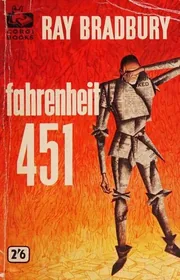
Fahrenheit 451 is a science fiction novel by Ray Bradbury, first published in 1953. It belongs to the dystopian tradition and also draws on political fiction and satire. The story is set in a future America where the possession of books is forbidden and a corps of firemen is employed to set fire to any that turn up. The title refers to the temperature at which paper ignites.
The central figure is Guy Montag, one of those firemen, whose view of his work changes until he leaves the job and devotes himself to saving literary and cultural writings. Captain Beatty and Clarisse McClellan also appear in the story, along with a Mechanical Hound and a girl who lives next door. The book deals with censorship, book burning, totalitarianism and state-sponsored terrorism. Bradbury linked its origins to his worries during the McCarthy era, and later said it was also about the way mass media draws people away from reading. It runs to roughly 190 pages in a typical edition, and it has appeared in 266 editions.
Yakmak bir zevkti. Bir şeylerin yendiğini görmek, karardığını ve değiştirildiğini görmek özel bir zekti.
Characters
Guy MontagCaptain BeattyClarisse McClellan
Setting
Mei guo
Themes
Mechanical Houndgirl next doorLong Now Manual for CivilizationTerrorismo estatalCensuraNovelaTotalitarismosatire
- Want to read 3,583
- Reading now 181
- Read 734
- Stopped 1
Most people shelving it are saving it for later.
Of 4499 readers who put it on a shelf, 80% want to read it, 4% are reading it now, 16% have finished it and 0% stopped before the end.
By the numbers
- The median edition runs 190 pages. Counting about 275 words a page and an adult reading pace of 250 words a minute, that is about 3.5 hours of reading.
- Open Library tracks 266 editions from 146 publishers, the earliest dated 1953 and the latest 2024, across 19 languages.
- On reader demand it ranks in the top 1% of the classic books in our catalog (8,749 of them).
- Libraries shelve it under Dewey 823.91 and Library of Congress class PS-3503.00000000.R167 F3 2005.
 BookWard’s take
A short, fierce warning about a world that burns its books
Fahrenheit 451 is Bradbury's 1953 dystopia, and it is a close fit for how I like to read. At about 190 pages it is pleasingly short, and its premise, a fireman who burns books, hooks you at once. The pace stays quick, and the story holds together as a single argument, so there is no sagging middle to worry about. The internal logic is strong: the world's rules follow cleanly from its one idea. The prose is more lyrical than I usually prefer, and the ending leaves more open than I would like. It is also more idea-led than I tend to enjoy, yet Guy Montag's change keeps it human. A compact, urgent read that still earns its reputation.
At roughly 190 pages it is lean and compact, which matches BookWard's love of short books exactly.
The story moves briskly toward Montag's break with his work, close to BookWard's preference for speed.
Its central image of firemen who start fires was bold in 1953 and still reads as inventive.
Bradbury's imagery runs poetic and lush, richer than BookWard's middle-of-the-road taste in prose.
Montag's inner change steers events, but the premise and the argument drive the story as much.
It faces a bleak, book-burning society yet closes on the survival of memory and ideas.
The story is told in a straightforward, conventional arc.
The tone is serious and urgent, with little room for humor.
Book burning and a state that suppresses thought give it real weight without being gratuitous.
Montag's break with his world carries real feeling and urgency.
See all 50 dialsEvery position, side by side with this book
Where it lines up
- LengthBookWard 1 · book 1
- PaceBookWard 8 · book 8
- Authorial voiceBookWard 9 · book 9
Where it pulls apart
- Story or ideasBookWard 3 · book 8
- Familiar tropesBookWard 10 · book 7
- ExpositionBookWard 2 · book 6
At roughly 190 pages it is lean and compact, which matches BookWard's love of short books exactly.
A fireman who burns books is a premise that grips from the first scenes, close to BookWard's taste for immediate openings.
Its dystopian ideas now feel familiar because later fiction borrowed them, though the book itself stays fresh.
A society that outlaws books and employs firemen to burn them follows its own rules consistently, which BookWard values.
The story moves briskly toward Montag's break with his work, close to BookWard's preference for speed.
Its central image of firemen who start fires was bold in 1953 and still reads as inventive.
Montag's disillusionment gives the book real feeling, though the cast serves the argument more than BookWard's deeper portraits.
The book resolves Montag's path but leaves the wider world's fate more open than BookWard prefers.
It carries real feeling about books and memory, and lets some of it run warmer than BookWard's restraint.
The darkness comes from the premise and its consequences, which earns it rather than shocking for effect.
Bradbury's voice is unmistakable, vivid and urgent, well above the generic and in line with BookWard.
The story exists to carry an argument about censorship and mass media, leaning idea-led where BookWard favors story.
Characters like Captain Beatty explain the world's logic outright at times, more than BookWard likes.
At this length the book sustains its drive without a slack stretch.
Bradbury's imagery runs poetic and lush, richer than BookWard's middle-of-the-road taste in prose.
Montag's inner change steers events, but the premise and the argument drive the story as much.
It faces a bleak, book-burning society yet closes on the survival of memory and ideas.
The story is told in a straightforward, conventional arc.
The tone is serious and urgent, with little room for humor.
The prose is vivid but the book is short and readable, an easy to moderate effort.
The story follows Montag's viewpoint alone.
Events unfold in a clear, forward sequence.
It is near-future science fiction, with inventions like the Mechanical Hound but a recognizable world.
A handful of figures, Montag, Beatty and Clarisse among them, carry the story.
It stays tied to one man and his city while gesturing at a larger society.
Montag's doubts and the action of the burnings share the stage.
Conversations, especially with Beatty, carry much of the book's argument.
Romance is not a concern here; the book is about books, memory and conformity.
A future America with firemen who burn books is unfamiliar enough to feel strange.
Written in 1953 and set in a future America, it sits between past and present.
Its concerns with censorship and mass media still feel current decades on.
The narration follows Montag directly and plainly, with no sign of unreliability.
The book takes a clear stand against censorship and the burning of books.
Vivid sensory imagery of fire and the city gives the book a rich surface.
It stands alone as a single novel.
Montag's path holds some turns, but the book is not built on surprises.
It asks readers to consider their own habits with media and reading, which is uncomfortable.
Book burning and a state that suppresses thought give it real weight without being gratuitous.
Montag's break with his world carries real feeling and urgency.
What humor exists is dry and tinged with satire.
There is burning, state force and the menace of the Mechanical Hound, but little graphic detail.
Sexual content is minimal.
Censorship and totalitarianism sit at the core, and it was written in response to McCarthy-era fears.
The language is plain to lyrical, never dense.
Bradbury's stance on censorship and media is plain throughout.
It warns about a possible future while recalling what is lost from the past.
A cynical world is met by Montag's idealistic commitment to preserve books.
Review written by BookWard, dial version 1, November 2026.
Who is Fahrenheit 451 right for?
Suits teens and adults, and it is a common school read. It deals with book burning and state violence in a restrained, non-graphic way.
The prose is vivid but the book is short and readable, an easy to moderate effort.
Book burning and a state that suppresses thought give it real weight without being gratuitous.
Montag's break with his world carries real feeling and urgency.
There is burning, state force and the menace of the Mechanical Hound, but little graphic detail.
Book CompanionFahrenheit 451: ideas, characters, themes
A fireman whose job is to burn books comes to see what a society loses when it forbids reading and thought.
- A job in reverse. Firemen start fires rather than stop them, and Guy Montag burns books for a living until he begins to doubt.
- The title. The title refers to the temperature at which paper ignites.
- A world that outlaws books. Possessing books is forbidden in this future America, and the state treats them as dangerous.
- Voices that push him. Captain Beatty and Clarisse McClellan pull Montag in opposite directions, and a Mechanical Hound hints at the state's reach.
- Two sources of fear. Bradbury tied the book to McCarthy-era book burning, and later to the way mass media draws people from reading.
Characters
Guy Montag
Protagonist
A fireman who grows disillusioned with burning books and turns to preserving them.
Captain Beatty
Montag's superior
A figure of the system whom Montag must answer to.
Clarisse McClellan
The girl next door
A neighbor whose presence shakes Montag's settled view of his world.
Themes
The suppression of ideas by forbidding the books that hold them.
Destroying knowledge as a way to control a society.
A state that shapes what people may read and think.
Entertainment that draws people away from reading and reflection.
Saving ideas and culture so they survive.
Discussion questions
- Why does Bradbury make the firemen the ones who start the fires?
- Is the threat in the book the state, the public, or both?
- How does Montag's view of his work change, and what pushes him?
- Does the book's warning about mass media feel truer now than in 1953?
- What would you choose to preserve if books were outlawed?
Personalize your Book Companion
This is the general edition. In BookWard, the Companion is written for you: your reading profile, your notes, and spoiler-safe to the page you are on.
Buy, listen or borrow Fahrenheit 451
Each link opens a search for this book on that store, in a new tab.
Read on a device
Borrow
Reviews and community
If you liked Fahrenheit 451
A quiet-voiced catastrophe where the walking plants are the lesser danger
The Word for World is ForestUrsula K. Le GuinA short, furious novel about a forest world under occupation
Tunnel in the skyRobert A. HeinleinHeinlein strands a class of students and watches society form
Narrative of the life of Frederick DouglassFrederick DouglassA short, plain-spoken memoir that still lands with force
Sources: Open Library.
Track Fahrenheit 451 and find your next favorite
Add it to your shelf, rate what you have read, and BookWard will recommend what fits you.
Free to start. No credit card needed.