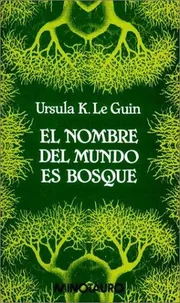
The Word for World is Forest
by Ursula K. Le Guin · 1972
Suits teens and adults who are comfortable with serious themes.
169 pages, about 2.5 to 4 hours.
A short, furious novel about a forest world under occupation. 68% taste match
The story
The Word for World is Forest is a science fiction novel by Ursula K. Le Guin, first published in 1972 and part of her Hainish Cycle. It runs to about 169 pages and has appeared in many editions since it first came out.
The story is set around the year 2368 on Athshe, a planet covered in forest. Human colonists from Terra have set up a logging settlement and military base there called New Tahiti. The planet's native people, the Athsheans, are small, green-furred and big-eyed, and their culture centers on lucid dreaming. The colonists clear trees, plant farms, dig mines and force the natives into servitude, while Captain Davidson, Selver and Raj Lj(y)ubov are among the figures caught up in the conflict. News from the League of Worlds reaches the colony by ansible, a newly discovered way to send messages across the distance from Terra. The book looks at resource use, colonial occupation and rebellion, and it fits into the larger Hainish setting, in which humanoid peoples across many worlds trace their origins to the planet Hain.
Als Captain Davidson erwachte, fielen ihm sofort wieder zwei Nachrichten ein, die ihm am Tag zuvor übermittelt worden waren, und er blieb liegen, um eine Weile über sie nachzudenken.
Characters
AthsheansSelverCaptain DavidsonRaj Lj(y)ubovHainishLeague of Worlds
Setting
AthsheSornolTerraWorld 41/New TahitiPrestno
Period
c 2368 AD
Themes
Hainish Cycleresource conservationrebellionPs3562.e42 w67 2010813/.54
- Want to read 130
- Reading now 6
- Read 18
Most people shelving it are saving it for later.
Of 154 readers who put it on a shelf, 84% want to read it, 4% are reading it now, 12% have finished it and 0% stopped before the end.
By the numbers
- The median edition runs 169 pages. Counting about 275 words a page and an adult reading pace of 250 words a minute, that is about 3.1 hours of reading.
- Open Library tracks 39 editions from 27 publishers, the earliest dated 1972 and the latest 2024, across 8 languages.
- On reader demand it ranks in the top 10% of the classic books in our catalog (8,749 of them).
- Libraries shelve it under Dewey 823.91 and Library of Congress class PS-3562.00000000.E42 Wo 1977.
 BookWard’s take
A short, furious novel about a forest world under occupation
At 169 pages, this is science fiction at its tightest: no padding, and a pace that holds because the conflict is set up almost at once. Le Guin builds the colony of New Tahiti, with its loggers and its military base, on a clear internal logic, and the Athsheans' dream-centered culture is invented with real originality rather than borrowed from familiar alien templates. The brevity and the momentum are where I'm most fully on the book's side. Where I part ways with it is in the exposition and the prose: Le Guin states her argument openly, and the writing is more pointed than lush. It is idea-led and angry, and it earns its darkness rather than using it for effect. A strong fit for me.
At 169 pages it is about as short as a full novel gets, which matches BookWard's love of tight books exactly.
A lean page count keeps the conflict moving, close to BookWard's preference for brisk reading.
The dream-centered forest culture and the Hainish framework feel invented rather than borrowed, which BookWard values highly.
Clear and controlled rather than ornate, a little plainer than BookWard's midpoint.
Plot and character share the weight evenly, leaning slightly less character-driven than BookWard likes.
The outlook is grim, with only a measured hope, darker than BookWard's mildly hopeful lean.
The structure is conventional, with shifting viewpoints but no formal experiment, close to BookWard's middle position.
This is a serious, angry book with almost no comedy, well below BookWard's lightly funny lean.
The book is dark in its themes of enslavement and violence, above BookWard's moderate middle.
Feeling runs high but is channeled through anger and grief rather than melodrama, a little above BookWard's level.
See all 50 dialsEvery position, side by side with this book
Where it lines up
- LengthBookWard 1 · book 1
- PaceBookWard 8 · book 8
- SentimentBookWard 8 · book 8
Where it pulls apart
- Story or ideasBookWard 3 · book 7
- ExpositionBookWard 2 · book 6
- OpeningBookWard 10 · book 8
At 169 pages it is about as short as a full novel gets, which matches BookWard's love of tight books exactly.
The colonial setup and its tension arrive quickly, though the opening is more steadily gripping than instantly grabbing.
It takes the familiar colonial invasion story and gives it a fresh setting and culture, though the broad shape is known.
The colony, the ansible and the Athshean way of life hang together with a clear, consistent internal logic.
A lean page count keeps the conflict moving, close to BookWard's preference for brisk reading.
The dream-centered forest culture and the Hainish framework feel invented rather than borrowed, which BookWard values highly.
Davidson, Selver and Lj(y)ubov are drawn with purpose, though the book serves its argument as much as its people.
The conflict reaches a firm outcome, in line with BookWard's taste for resolution, even as consequences linger.
Le Guin avoids easy consolation and treats the cruelty of the colonizers plainly, suiting BookWard's restraint.
Its darkness serves the argument about occupation and rebellion, which is exactly the kind BookWard trusts.
This is a novel, so the nonfiction rigor scale does not apply.
Le Guin's voice is unmistakable, direct and morally charged, which BookWard rates very highly.
It is idea-led more than BookWard usually likes, with the colonial argument driving the story.
The politics and history are stated fairly openly, which is more explanation than BookWard prefers.
At this length there is no room to sag, and the tension is sustained from start to finish.
Clear and controlled rather than ornate, a little plainer than BookWard's midpoint.
Plot and character share the weight evenly, leaning slightly less character-driven than BookWard likes.
The outlook is grim, with only a measured hope, darker than BookWard's mildly hopeful lean.
The structure is conventional, with shifting viewpoints but no formal experiment, close to BookWard's middle position.
This is a serious, angry book with almost no comedy, well below BookWard's lightly funny lean.
It reads quickly and clearly, though its moral weight asks for some thought, close to BookWard's comfort zone.
The story moves between human and Athshean figures, giving it a many-sided view of the conflict.
It is clearly science fiction, with dream culture and alien worlds, but it stays rooted in recognizable human behavior.
A compact group of key figures carries the story, close to BookWard's modest cast preference.
The action is centered on one planet and one colony, with wider stakes hinted through the League of Worlds.
Events and conflict dominate over inner reflection, tilting toward action more than BookWard usually does.
Conversation carries a fair share of the story without dominating it, slightly lighter than BookWard's liking.
Romance plays no real role in this story.
Athshe and its forest people are a fully unfamiliar setting, which BookWard enjoys.
Set in the 24th century, it feels distant in time though its concerns are close to ours.
The themes of colonial exploitation and resistance have kept it relevant for decades, a strong match for BookWard.
The narration is straightforward and trustworthy, quite far from BookWard's taste for unreliability.
The book leaves little doubt where its sympathies lie, though it still lets the characters be complicated.
The forest world is vividly rendered, a touch richer than BookWard's middle position.
As a novel, the nonfiction style scale does not apply.
This is fiction, so the nonfiction perspective scale does not apply.
It belongs to the Hainish Cycle but works as its own story.
The path of the conflict is fairly clear, with fewer surprises than BookWard likes.
It confronts uncomfortable ideas about occupation and exploitation, which suits BookWard's appetite for challenge.
The book is dark in its themes of enslavement and violence, above BookWard's moderate middle.
Feeling runs high but is channeled through anger and grief rather than melodrama, a little above BookWard's level.
There is no real humor to place on this scale.
Violence is an important part of the story, more present than BookWard's middle position.
Sexual content is minor and not a focus.
Colonialism and resource exploitation sit at the center of the book, far beyond BookWard's middle position.
The language is plain and accessible, well below BookWard's middle position.
Le Guin's stance is clear and forceful throughout, more opinionated than BookWard's typical taste.
It looks both back at colonial history and forward to a possible future, close to BookWard's balance.
It holds out a hope for a better way of living while showing how cruel people can be, leaning slightly idealistic.
Review written by BookWard, dial version 1, November 2026.
Who is The Word for World is Forest right for?
Suits teens and adults who are comfortable with serious themes. It deals with enslavement, violence and exploitation, so younger or sensitive readers may want some context first.
It reads quickly and clearly, though its moral weight asks for some thought, close to BookWard's comfort zone.
The book is dark in its themes of enslavement and violence, above BookWard's moderate middle.
Feeling runs high but is channeled through anger and grief rather than melodrama, a little above BookWard's level.
Violence is an important part of the story, more present than BookWard's middle position.
Book CompanionThe Word for World is Forest: ideas, characters, themes
A peaceful forest people are overrun by Terran colonists, and one act of violence changes both worlds forever.
- The setting. New Tahiti is a logging colony and military base on Athshe, a planet covered in forest.
- The Athsheans. The native people are small, green-furred and big-eyed, with a culture built around lucid dreaming.
- The colonial model. The Terran settlers fell trees, plant farms, dig mines and force the natives into servitude.
- The Hainish background. Humanoid peoples across many worlds trace their origins to Hain, tying this book into Le Guin's wider cycle.
- The ansible. News from the League of Worlds reaches the colony through a newly discovered way to send messages across great distances.
Characters
Selver
Athshean figure caught in the conflict
One of the central figures in the clash between the colonists and the native people.
Captain Davidson
Terran colonist
A human figure at the heart of the occupation and the conflict that follows.
Raj Lj(y)ubov
Terran colonist
Another human figure caught up in the story of the colony.
Themes
One people taking land and labor from another and justifying it.
What it costs to treat a living forest as raw material.
How a gentle society responds when pushed past what it can bear.
A culture's inner life as a source of strength and understanding.
Two ways of seeing the world failing to understand each other.
Discussion questions
- Why might Le Guin have chosen a short, direct form for such a large subject?
- How does the Athsheans' lack of any tradition of war shape what happens?
- What does the forest stand for to the colonists compared with the natives?
- Does the book treat its human characters fairly, or is it one-sided?
- What parallels do you see between the colony and real colonial histories?
Personalize your Book Companion
This is the general edition. In BookWard, the Companion is written for you: your reading profile, your notes, and spoiler-safe to the page you are on.
Buy, listen or borrow The Word for World is Forest
Each link opens a search for this book on that store, in a new tab.
Read on a device
Borrow
Reviews and community
If you liked The Word for World is Forest
A short, fierce warning about a world that burns its books
The player of gamesIain BanksA bored game master walks into an empire built on one game
UnwindNeal ShustermanA chilling dystopian chase built on a monstrous compromise
Narrative of the life of Frederick DouglassFrederick DouglassA short, plain-spoken memoir that still lands with force
Sources: Open Library.
Track The Word for World is Forest and find your next favorite
Add it to your shelf, rate what you have read, and BookWard will recommend what fits you.
Free to start. No credit card needed.