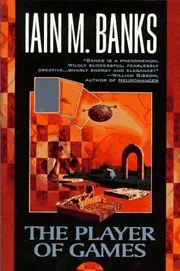
The player of games
by Iain Banks · 1988
It suits adult and older teen readers who enjoy science fiction built on ideas.
320 pages, about 5 to 7.5 hours.
A bored game master walks into an empire built on one game. 71% taste match
The story
The Player of Games is a science-fiction novel by Scottish writer Iain Banks, first published in 1988. It is the second Culture novel to appear in print. The Culture is a society in which humans and machines live together, and the story follows one of its most accomplished game players, Jernau Morat Gurgeh, whose skill spans board games, computer games, and games of strategy.
Gurgeh's success has left him restless, and he travels to the Empire of Azad, a wealthy and ruthless realm. There he takes up the empire's celebrated game, one so intricate that the person who wins it becomes emperor. Along the way he faces ridicule, blackmail, and an attempt on his life, and the contest becomes the greatest test of his career. The book centers on games and gameplay, set against the contrast between the Culture and the empire it visits. It runs to roughly 320 pages and has appeared in 23 editions.
- Want to read 155
- Reading now 5
- Read 116
Readers are split between finishing it and saving it for later.
Of 276 readers who put it on a shelf, 56% want to read it, 2% are reading it now, 42% have finished it and 0% stopped before the end.
By the numbers
- The median edition runs 320 pages. Counting about 275 words a page and an adult reading pace of 250 words a minute, that is about 5.9 hours of reading.
- Open Library tracks 23 editions from 14 publishers, the earliest dated 1988 and the latest 2023, across 3 languages.
- On reader demand it ranks in the top 2% of the modern books in our catalog (15,152 of them).
- Libraries shelve it under Dewey 823.914 and Library of Congress class PR-6052.00000000.A485 P54 1989.
 BookWard’s take
A bored game master walks into an empire built on one game
The Player of Games is compact for science fiction at 320 pages, and it moves like it knows that. Gurgeh is a restless master of every game, and the Empire of Azad hands him a contest so intricate the winner becomes emperor. The hook is immediate: you are in the game almost at once. The internal logic is airtight in the way a book about rules should be, and the ideas feel fresh, since the contest between the Culture and the empire carries them through story rather than lectures. The pace stays brisk and the middle holds, because every round raises the stakes. The prose is clean rather than ornate, and the Culture setting is unfamiliar in the best sense. It is a tight, clever, idea-rich novel that rewards a reader who likes a mind at work.
At 320 pages it is lean for science fiction, which suits BookWard's love of tight books.
The contest drives events forward steadily, close to BookWard's preferred brisk rhythm.
A society of humans and machines set against a game-ruled empire is a distinctive premise, well matched to BookWard.
The writing is clear and measured rather than ornate, a little plainer than BookWard's midpoint.
Plot and character are balanced, with Gurgeh's choices driving the contest forward.
The outlook is mixed, with the Culture and the empire weighed against each other rather than judged simply.
The structure is conventional, a quest-like progression through a long contest.
There is dry wit throughout, though the book stays largely serious about its stakes.
A cruel empire, blackmail and a murder attempt give it real menace without making it grim throughout.
The feeling runs cool and controlled, with tension more present than raw emotion.
See all 50 dialsEvery position, side by side with this book
Where it lines up
- OriginalityBookWard 9 · book 9
- EndingBookWard 8 · book 8
- SentimentBookWard 8 · book 8
Where it pulls apart
- OpeningBookWard 10 · book 8
- Familiar tropesBookWard 10 · book 8
- Story or ideasBookWard 3 · book 6
At 320 pages it is lean for science fiction, which suits BookWard's love of tight books.
A master player bored by success is pulled toward a dangerous game early, which matches BookWard's taste for an immediate pull.
It reworks the stranger-in-a-foreign-empire idea through games and a machine-assisted society, which keeps it fresh for BookWard.
A story built around the rules of an elaborate game rewards careful structure, and BookWard values that discipline.
The contest drives events forward steadily, close to BookWard's preferred brisk rhythm.
A society of humans and machines set against a game-ruled empire is a distinctive premise, well matched to BookWard.
Gurgeh's restlessness and pride give the story a real center, though ideas lead more than inner life.
The central contest builds toward a firm conclusion, which fits BookWard's liking for resolution.
The tone is cool and clear-eyed rather than tender, in line with BookWard's restraint.
Blackmail and danger arise from the story's pressures rather than as spectacle, which BookWard respects.
This is a novel, so the nonfiction rigor dial does not apply.
Banks writes with a confident, wry, unmistakable voice that BookWard prizes.
The novel turns on ideas about games and societies, though it is carried by a clear storyline.
Ideas arrive mostly through events and encounters, which BookWard prefers to explanation.
Each stage of the contest raises the stakes, so the middle stays taut, as BookWard likes.
The writing is clear and measured rather than ornate, a little plainer than BookWard's midpoint.
Plot and character are balanced, with Gurgeh's choices driving the contest forward.
The outlook is mixed, with the Culture and the empire weighed against each other rather than judged simply.
The structure is conventional, a quest-like progression through a long contest.
There is dry wit throughout, though the book stays largely serious about its stakes.
The game's rules and the setting ask some attention, but the prose stays approachable.
The story stays close to Gurgeh, so it is built around a single perspective.
Events move in a straightforward sequence, with no jumps back and forth in time.
A far-future galaxy of machines and empires is thoroughly speculative, a step beyond BookWard's middle ground.
The focus stays on a modest group around Gurgeh rather than a sprawling ensemble.
It joins an individual's story to the clash of two civilizations, giving it wide reach.
Gurgeh's thoughts and the external contest share the stage fairly evenly.
Conversation carries a fair share of the contest and the cultural friction, though it does not dominate.
Romance is not the engine here, which stays on the game and the clash of societies.
A galaxy-spanning society and a distant empire are about as unfamiliar as settings get, which BookWard enjoys.
It is set in a far future, well away from the present day.
Its ideas about games, power and societies keep it relevant decades after 1988.
The narration is straightforward and trustworthy rather than slippery.
The Culture and the empire both invite judgment, and the book lets readers weigh them without easy answers.
The setting and the game are drawn with enough detail to feel vivid without being heavy.
This is fiction, so the nonfiction style dial does not apply.
This is fiction, so the nonfiction perspective dial does not apply.
It is the second published Culture novel, though it stands as its own story.
The contest and its dangers deliver turns that keep the reader guessing.
It asks readers to think about power, games and societies, but never turns punishing.
A cruel empire, blackmail and a murder attempt give it real menace without making it grim throughout.
The feeling runs cool and controlled, with tension more present than raw emotion.
The humor is wry and understated rather than broad.
Danger and an attempt on Gurgeh's life are present, but the story is not dominated by violence.
The contrast between two societies makes power and governance central to the story.
The language is plain and readable despite the invented setting.
The narration carries an evident point of view about the societies it contrasts.
Set in the far future, it looks ahead more than back.
The Culture offers an appealing ideal but is examined critically, so the book sits near the middle.
Review written by BookWard, dial version 1, November 2026.
Who is The player of games right for?
It suits adult and older teen readers who enjoy science fiction built on ideas. It includes menace, blackmail and an attempt on a character's life, along with themes of cruelty and power.
The game's rules and the setting ask some attention, but the prose stays approachable.
A cruel empire, blackmail and a murder attempt give it real menace without making it grim throughout.
The feeling runs cool and controlled, with tension more present than raw emotion.
Danger and an attempt on Gurgeh's life are present, but the story is not dominated by violence.
Book CompanionThe player of games: ideas, characters, themes
A master of games leaves a gentle society to play the game that rules a cruel empire, and the contest tests him and the worlds behind him.
- A bored master. Gurgeh's skill spans board games, computer games and strategy, and his success has left him restless.
- The Empire of Azad. A wealthy and ruthless realm whose celebrated game is so intricate that the winner becomes emperor.
- Two societies in contrast. The human and machine society of the Culture is set against the empire it visits.
- Pressure from every side. Gurgeh faces ridicule, blackmail and an attempt on his life as he accepts the challenge.
- Games as a lens. The book uses gameplay to explore how rules, skill and power shape societies and lives.
Characters
Jernau Morat Gurgeh
Protagonist
The Player of Games, a Culture master of every board, computer and strategy game, bored by his own success.
Themes
The empire's game is described as so complex that it resembles life itself.
The contest decides who becomes emperor, tying play to rule.
The Culture and the Empire of Azad are weighed against each other.
Gurgeh's drive to take on the challenge puts his life in danger.
Discussion questions
- Why does success leave Gurgeh restless, and what does he hope to find in Azad?
- What does it mean for a game to resemble life, and does that make the stakes feel real?
- How does the contrast between the Culture and the empire shape your sympathies?
- Is the empire's choice of ruler by game strange or just a sharper version of familiar systems?
- How does the book's brisk length affect the way its ideas land?
Personalize your Book Companion
This is the general edition. In BookWard, the Companion is written for you: your reading profile, your notes, and spoiler-safe to the page you are on.
Buy, listen or borrow The player of games
Each link opens a search for this book on that store, in a new tab.
Read on a device
Borrow
Reviews and community
If you liked The player of games
A Holmes-and-Watson murder mystery inside a leviathan-haunted fantasy empire
A Memory Called EmpireArkady MartineA murder mystery wrapped in an empire that devours its neighbors
The Word for World is ForestUrsula K. Le GuinA short, furious novel about a forest world under occupation
Small GodsTerry PratchettA tortoise god, one true believer, and a very funny argument about faith
Sources: Open Library.
Track The player of games and find your next favorite
Add it to your shelf, rate what you have read, and BookWard will recommend what fits you.
Free to start. No credit card needed.