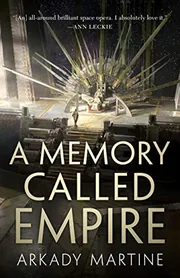
A Memory Called Empire
by Arkady Martine · 2019
Suits adult and mature teen readers who enjoy political science fiction and mysteries.
464 pages, about 7.5 to 11 hours.
A murder mystery wrapped in an empire that devours its neighbors. 64% taste match
The story
A Memory Called Empire is a science fiction novel by Arkady Martine, first published in 2019 and her debut. It won the Hugo Award for Best Novel in 2020, as well as the Compton Crook Award that year. The story centers on Mahit Dzmare, an ambassador from Lsel Station, a mining outpost, who is sent to Teixcalaan, the capital of a vast empire.
On arrival, Mahit learns that the ambassador she was sent to replace has died, and that his death was no accident, though few will say so. She sets out to find the killer while making her way through the empire's dangerous political circles, where Three Seagrass and Nineteen Adze also figure. Her station's independence is under threat from Teixcalaanli annexation, and she carries a technological secret that could either ruin her home or protect it. The book combines murder mystery, political intrigue, and encounters with an unfamiliar culture. It runs about 464 pages in a typical edition and is included among LGBTQ science fiction and fantasy.
In Teixcalaan, these things are ceaseless: star-charts and disembarkments.
Characters
Mahit DzmareThree SeagrassNineteen Adze
Setting
Lsel StationTeixcalaan
Themes
American literatureAmbassadorsMurderExtraterrestrial beings
- Want to read 125
- Read 52
Most people shelving it are saving it for later.
Of 177 readers who put it on a shelf, 71% want to read it, 0% are reading it now, 29% have finished it and 0% stopped before the end.
By the numbers
- The median edition runs 464 pages. Counting about 275 words a page and an adult reading pace of 250 words a minute, that is about 8.5 hours of reading.
- Open Library tracks 8 editions from 6 publishers, the earliest dated 2019 and the latest 2020.
- On reader demand it ranks in the top 4% of the recent books in our catalog (6,647 of them).
- Libraries shelve it under Library of Congress class PS-3613.00000000.A786325M46.
 BookWard’s take
A murder mystery wrapped in an empire that devours its neighbors
Mahit Dzmare arrives in the imperial capital to find her predecessor dead and nobody willing to call it murder. From there, Martine builds a political thriller that rewards close attention. On hook, it grabs quickly, putting a stranger in a hostile court with a body already in the ground. Originality is a real strength: Teixcalaan is a culture with its own poetry, manners and appetites, and it never feels like a recycled space opera. Internal logic holds tight, which matters in a book of schemes and secrets. Character depth is good, anchored in an outsider who loves the empire she fears. The weaker fit is demand, since this wants patience with unfamiliar names and customs. Rich in ideas, but the story stays in front.
At 464 pages it is mid-sized, longer than BookWard's tight ideal but kept moving by its mystery.
Political maneuvering and investigation keep things moving, though it takes time over court customs, a touch slower than BookWard likes.
Teixcalaan is a fully imagined culture, an original take on empire that BookWard rates highly.
The prose is polished and a little formal, richer than plain but not ornate, a bit above BookWard's midpoint.
The mystery drives events while Mahit's inner conflict matters equally, balanced and near BookWard's slight character lean.
Survival feels uncertain and the empire is menacing, so the outlook sits darker than BookWard's mildly hopeful lean.
This is a serious book of intrigue with little comic relief, less playful than BookWard's tone.
A murder and political menace add weight without pushing into relentless grimness, near BookWard's middle.
Feeling runs underneath, moderate and steady rather than overwhelming, close to BookWard's level.
See all 50 dialsEvery position, side by side with this book
Where it lines up
- OriginalityBookWard 9 · book 9
- Character depthBookWard 8 · book 8
- SentimentBookWard 8 · book 8
Where it pulls apart
- LengthBookWard 1 · book 6
- OpeningBookWard 10 · book 8
- Familiar tropesBookWard 10 · book 8
At 464 pages it is mid-sized, longer than BookWard's tight ideal but kept moving by its mystery.
A murdered predecessor and a lone ambassador in an alien court pull you in from the start, which BookWard loves.
The imperial setting and its poetry-steeped culture feel fresh rather than borrowed, which suits BookWard well.
Schemes, loyalties and consequences fit together coherently, and BookWard prizes that kind of airtight plotting.
Political maneuvering and investigation keep things moving, though it takes time over court customs, a touch slower than BookWard likes.
Teixcalaan is a fully imagined culture, an original take on empire that BookWard rates highly.
Mahit is drawn with real ambivalence toward the empire she both admires and fears, close to BookWard's taste.
The central plot reaches a satisfying point while leaving room beyond it, a little looser than BookWard prefers.
Feelings are handled with restraint and the intrigue stays cool-headed, which BookWard appreciates.
The danger feels earned by the politics rather than staged for effect, in line with BookWard's taste.
Martine's voice is distinctive, with its own idiom for imperial manners and poetry, which BookWard rewards.
Ideas about empire and identity matter, but the murder plot leads, leaning more toward story than BookWard's usual idea-heavy pull.
Much of the culture is learned through scenes and Mahit's missteps, though some explaining happens, close to BookWard's preference.
Tension from the investigation and the threat to her station stays up across the book, as BookWard likes.
The prose is polished and a little formal, richer than plain but not ornate, a bit above BookWard's midpoint.
The mystery drives events while Mahit's inner conflict matters equally, balanced and near BookWard's slight character lean.
Survival feels uncertain and the empire is menacing, so the outlook sits darker than BookWard's mildly hopeful lean.
This is a serious book of intrigue with little comic relief, less playful than BookWard's tone.
Unfamiliar names, customs and layers of politics ask for attention, more effort than BookWard's moderate level.
Events unfold in a clear line, simpler than BookWard's occasional appetite for shifting time.
A far-future empire with a notable technological secret puts it well toward the fantastical.
A court full of officials and rivals gives it a fair-sized cast, a little bigger than BookWard's norm.
The fate of an empire and an independent station raises the stakes, though events stay focused on one person.
Mahit's thoughts and the external intrigue share the page evenly, right at BookWard's slightly inward lean.
Much of the plot moves through tense conversation and negotiation, close to BookWard's liking for dialogue.
Romance is a minor thread against the mystery and politics, around BookWard's modest interest.
A vast empire and a mining station are far from everyday life, which suits BookWard's love of unfamiliar settings.
A far-future setting sits well away from the present day, unlike BookWard's lean toward contemporary.
Its themes of empire and identity will outlast the moment, which BookWard values.
No faction is simply right, and Mahit's allegiances are tangled, which fits BookWard's taste for ambiguity.
The capital and its customs are vividly drawn, richer than BookWard's average.
This is the first of a series, leaning further toward series than BookWard's standalone-leaning middle.
The mystery delivers surprises regularly, about right for BookWard.
Questions of empire, assimilation and loyalty push back on easy comfort, matching BookWard's preference.
A murder and political menace add weight without pushing into relentless grimness, near BookWard's middle.
Feeling runs underneath, moderate and steady rather than overwhelming, close to BookWard's level.
Humor is rare and dry where it appears, drier than BookWard's average.
Sexual content is limited and not a focus, a little below BookWard's midpoint.
Empire, annexation and court intrigue drive the whole story, far more political than BookWard's average.
Teixcalaanli names and customs add some density but the language stays readable, slightly above BookWard's midpoint.
The narration observes rather than lectures, more neutral than BookWard's slight lean.
It looks to a distant future yet dwells on how empires remember, about even, a touch backward-leaning versus BookWard.
Power is shown as seductive and corrosive, cynical compared with BookWard's mild idealism.
Review written by BookWard, dial version 1, November 2026.
Who is A Memory Called Empire right for?
Suits adult and mature teen readers who enjoy political science fiction and mysteries. It includes a murder and threats of violence, and is listed among LGBTQ science fiction.
Unfamiliar names, customs and layers of politics ask for attention, more effort than BookWard's moderate level.
A murder and political menace add weight without pushing into relentless grimness, near BookWard's middle.
Feeling runs underneath, moderate and steady rather than overwhelming, close to BookWard's level.
Book CompanionA Memory Called Empire: ideas, characters, themes
A lone ambassador must find a killer inside an empire that threatens to swallow her home, while carrying a secret that could save or doom it.
- A murdered predecessor. Mahit arrives to find the ambassador she was sent to replace dead, and few will admit it was no accident.
- An outsider in the capital. She is posted from Lsel Station, a mining outpost, to Teixcalaan, a glorious and unfamiliar empire.
- A threatened homeland. Teixcalaanli annexation looms over her fiercely independent colony, raising the cost of every move.
- A dangerous secret. Mahit hides a technological secret that could ruin her station or protect it.
- Intrigue as method. The book blends murder mystery, court politics and culture shock into one investigation.
Characters
Mahit Dzmare
Ambassador from Lsel Station
Sent to the capital to replace her dead predecessor, she investigates his death while protecting her home.
Three Seagrass
Figure in the imperial capital
A Teixcalaanli presence in Mahit's world as she navigates the capital's dangerous circles.
Nineteen Adze
Figure in the imperial capital
Another name among the powerful players Mahit must reckon with.
Themes
How a vast power absorbs, charms and threatens smaller cultures.
What it costs to live between your own people and a culture you admire.
The struggle of a small station to remain itself.
How hidden knowledge becomes both weapon and danger.
How manners, language and poetry shape power.
Discussion questions
- Why does Mahit feel drawn to the empire that threatens her home?
- How does the book make Teixcalaan feel like a real culture?
- What does Mahit's secret change about the stakes?
- Who in the capital can be trusted, and how can you tell?
- How does the murder mystery serve the larger political story?
Personalize your Book Companion
This is the general edition. In BookWard, the Companion is written for you: your reading profile, your notes, and spoiler-safe to the page you are on.
Buy, listen or borrow A Memory Called Empire
Each link opens a search for this book on that store, in a new tab.
Read on a device
Borrow
Reviews and community
If you liked A Memory Called Empire
A desert planet, a doomed duke, and a vast, patient epic
The Tainted CupRobert Jackson BennettA Holmes-and-Watson murder mystery inside a leviathan-haunted fantasy empire
The player of gamesIain BanksA bored game master walks into an empire built on one game
Northern LightsPhilip PullmanA girl, a truth-telling compass, and an Arctic rescue that earns its stakes
Sources: Open Library.
Track A Memory Called Empire and find your next favorite
Add it to your shelf, rate what you have read, and BookWard will recommend what fits you.
Free to start. No credit card needed.