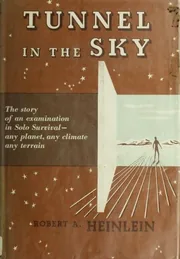
Tunnel in the sky
by Robert A. Heinlein · 1955
It suits teen and adult readers who enjoy classic science fiction and survival stories.
272 pages, about 4.5 to 6.5 hours.
Heinlein strands a class of students and watches society form. 59% taste match
The story
Tunnel in the Sky is a science fiction novel by Robert A. Heinlein, first published in 1955 by Scribner's. It belongs to the group of books known as the Heinlein juveniles, written with younger readers in mind, and it has since been counted among the classics of the genre. The story opens at Patrick Henry High School, where a flashing red light on a bulletin board outside a lecture hall sets events in motion.
The novel follows a group of students who take part in a survival test on an uninhabited planet. What begins as an exercise soon changes, as they find that they are stranded there. From that point the book is concerned with staying alive far from home, and with what a group of young people must do to organize themselves once no one is coming to direct them. Community, society and politics take shape among the stranded students as they work out how to live together.
The book combines interplanetary travel with adventure and survival fiction. It runs to roughly 272 pages in its typical edition, and about thirty editions have been issued over the years. It suits readers who enjoy classic space stories, tales of people tested in isolated settings, and early science fiction aimed at a teenage audience.
The bulletin board outside lecture hall 1712-a of patrick henry high school showed a flashing red light.
Themes
societySurvivalpoliticalInterplanetary voyagesadventurespace travelLong Now Manual for CivilizationClassics
- Want to read 101
- Reading now 9
- Read 31
Most people shelving it are saving it for later.
Of 141 readers who put it on a shelf, 72% want to read it, 6% are reading it now, 22% have finished it and 0% stopped before the end.
By the numbers
- The median edition runs 272 pages. Counting about 275 words a page and an adult reading pace of 250 words a minute, that is about 5.0 hours of reading.
- Open Library tracks 30 editions from 21 publishers, the earliest dated 1955 and the latest 2015, across 3 languages.
- On reader demand it ranks in the top 9% of the classic books in our catalog (8,749 of them).
- Libraries shelve it under Dewey 813.54 and Library of Congress class PS-3515.00000000.E288 Tu.
 BookWard’s take
Heinlein strands a class of students and watches society form
Tunnel in the Sky is a Heinlein juvenile that turns a school survival test into a stranding, and then into a study of how people organize themselves. It opens with a flashing red light outside a lecture hall and never really slows down. This is Heinlein at his most absorbed in questions of politics and community, yet the book stays rooted in scenes of simply staying alive. At 272 pages it is a satisfying length, long enough to build its world without wearing out its welcome. Where it tests patience is in the explaining, since Heinlein is perfectly happy to have characters stop and spell out how things work. Its familiarity cuts both ways: the stranded-group premise has been borrowed many times over, partly because this book helped set it up.
At 272 pages it is compact, which fits BookWard's preference for tight books.
Events move steadily once the test goes wrong, a little calmer than BookWard's fast preference.
The writing is plain and functional, slightly plainer than BookWard's middle-leaning taste.
Plot and character share the work, with the situation driving most of what happens.
It leans toward hope, with people proving able to build order from difficulty.
The structure is conventional and linear, in line with BookWard's moderate taste.
It is mainly serious in tone, with only light touches of humor.
Being stranded brings real danger, but the book stays within the bounds of juvenile fiction.
Feelings run at a measured level, with tension coming mostly from circumstances.
See all 50 dialsEvery position, side by side with this book
Where it lines up
- LengthBookWard 1 · book 2
- PaceBookWard 8 · book 7
- EndingBookWard 8 · book 7
Where it pulls apart
- Familiar tropesBookWard 10 · book 5
- ExpositionBookWard 2 · book 6
- OpeningBookWard 10 · book 8
At 272 pages it is compact, which fits BookWard's preference for tight books.
A flashing red light on a bulletin board starts things off, close to BookWard's liking for immediate openings.
The survival and social setup follows practical cause and effect, which suits BookWard's taste for airtight logic.
Events move steadily once the test goes wrong, a little calmer than BookWard's fast preference.
The students are shaped mostly by what they must do, so depth is moderate rather than deep.
The story closes its main thread of survival and rescue with a clear sense of resolution.
It carries some warmth about growing up and community but avoids heavy sentimentality.
Hardship is part of the survival story and serves it rather than being used for effect.
This is a novel, so the rigor dial does not apply.
Heinlein's confident, practical narration is recognizable, which BookWard values.
Ideas about society and politics matter here, but the story still leads, a bit more idea-heavy than BookWard prefers.
Heinlein often lets characters explain how things work, which runs against BookWard's liking for showing in scene.
The survival and community-building keeps developing, so the middle holds up well.
The writing is plain and functional, slightly plainer than BookWard's middle-leaning taste.
Plot and character share the work, with the situation driving most of what happens.
It leans toward hope, with people proving able to build order from difficulty.
The structure is conventional and linear, in line with BookWard's moderate taste.
It is mainly serious in tone, with only light touches of humor.
A juvenile written for teen readers, so it reads easily, close to BookWard's comfortable middle.
The story follows a single central perspective rather than many voices.
Events unfold in order from the test to the stranding and beyond.
Interplanetary travel gives it a science-fiction frame, but the survival events stay grounded.
A whole group of students is involved, so the cast is larger than BookWard's small-cast taste.
The focus stays on one group on one planet, though the setup spans worlds.
The story is driven by what the students do and face, more than by inner thought.
Heinlein's characters talk through plans and ideas often, in line with BookWard's taste for dialogue.
Romance is not a central concern of this survival story.
An uninhabited alien planet is far from everyday experience, which BookWard enjoys.
Written in 1955, the book belongs to its mid-century era rather than the present.
The questions about community and survival still hold, though the style is dated.
The narration is straightforward and can be taken at face value.
The book has a clear sense of what it values, though situations leave room for judgment.
Description is functional and economical rather than lush.
This is fiction, so the nonfiction style dial does not apply.
This is fiction, so the perspective dial does not apply.
It reads as a standalone story, even though it belongs to the Heinlein juveniles.
The stranding is the central turn, with surprises that follow from the situation.
It is an accessible adventure that raises questions without being heavy going.
Being stranded brings real danger, but the book stays within the bounds of juvenile fiction.
Feelings run at a measured level, with tension coming mostly from circumstances.
Any humor is dry and incidental rather than broad.
Survival involves real threat, though handled with the restraint of a young-reader book.
Sexual content is essentially absent from this juvenile.
Politics and the formation of society are a real strand, though woven into the adventure.
The language is plain and direct throughout.
Heinlein's views on self-reliance and social order come through in the narration.
It looks ahead to space travel and to the building of new societies.
It believes in people's ability to organize themselves and cope, an idealistic streak.
Review written by BookWard, dial version 1, November 2026.
Who is Tunnel in the sky right for?
It suits teen and adult readers who enjoy classic science fiction and survival stories. It involves real danger and hardship, but nothing beyond what is typical for a juvenile novel of its time.
A juvenile written for teen readers, so it reads easily, close to BookWard's comfortable middle.
Being stranded brings real danger, but the book stays within the bounds of juvenile fiction.
Feelings run at a measured level, with tension coming mostly from circumstances.
Survival involves real threat, though handled with the restraint of a young-reader book.
Book CompanionTunnel in the sky: ideas, characters, themes
A group of students on a survival test find themselves stranded on an uninhabited planet and must form a working community.
- A test turns real. What starts as a survival exercise becomes a genuine stranding, shifting the stakes entirely.
- Starting from school. The story opens at Patrick Henry High School, rooting an interplanetary tale in ordinary student life.
- Survival first. Early concerns center on staying alive far from home, before larger questions of order arise.
- Society takes shape. With no one coming to direct them, the students must work out how to live together.
- A Heinlein juvenile. The book belongs to a series of novels written with younger readers in mind, first published by Scribner's in 1955.
Themes
What it takes to stay alive when no help is coming.
How a group of individuals becomes a working society.
How leadership and rules emerge among people without authority over them.
Depending on your own abilities and those of your peers.
Young people taking on adult responsibilities under pressure.
Discussion questions
- How does the shift from test to genuine stranding change what the students must do?
- What makes a group of stranded young people choose some forms of organization over others?
- How well do the book's ideas about society hold up today?
- Why might this premise have been so often imitated in later stories?
- What does it mean for a juvenile novel to take politics and community seriously?
Personalize your Book Companion
This is the general edition. In BookWard, the Companion is written for you: your reading profile, your notes, and spoiler-safe to the page you are on.
Buy, listen or borrow Tunnel in the sky
Each link opens a search for this book on that store, in a new tab.
Read on a device
Borrow
Reviews and community
If you liked Tunnel in the sky
A short, sharp post-apocalyptic novel about hiding what makes you different
The Day of the TriffidsJohn WyndhamA quiet-voiced catastrophe where the walking plants are the lesser danger
Maniac MageeJerry SpinelliA tall-tale runaway crosses a segregated town and refuses to see the line
The Street LawyerJohn GrishamA big-firm lawyer walks out and takes a secret file with him
Sources: Open Library.
Track Tunnel in the sky and find your next favorite
Add it to your shelf, rate what you have read, and BookWard will recommend what fits you.
Free to start. No credit card needed.