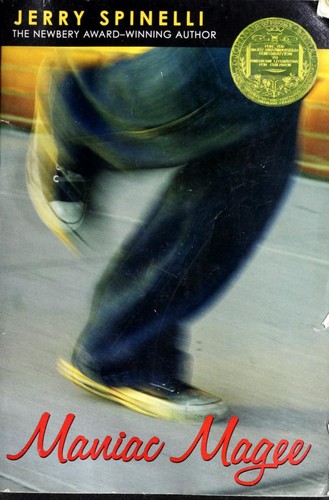
Maniac Magee
by Jerry Spinelli
★ Top 10 book of 1990 · #9 on Best Books of 1990
After a freak accident leaves him orphaned, a boy endures eight years with his unhappy aunt and uncle before he simply runs. His legendary feats begin to change a small town divided by race.
Best for: Young readers who enjoy legendary heroes and stories about bridging divides
Maniac Magee is #9 on BookWard's Best Books of 1990, out of 39 1990 books that cleared our data bar.
What Maniac Magee is about
Jeffrey Lionel Magee lost his parents in a freak accident and spent eight years with an unhappy, uptight aunt and uncle before deciding to run. He ends up in Two Mills, a town sharply divided between its Black East side and its white West side. Known as Maniac, he becomes a local legend for his athletic feats, his readiness to help, and his complete failure to notice the lines everyone else treats as fixed.
Told with a warm, lyrical, fable-like touch, the story looks honestly at racism and inequality while asking what it means to have a home and to belong somewhere. It is popular in middle school curricula and has been used in social studies on the premises of reaction to racial identity and reading.
Maniac Magee on the Best Books of 1990
Maniac Magee came out in 1990. Of the 39 books first published in 1990 that met BookWard's data bar, it ranks #9 on our Best Books of 1990 list.
Why it made the list: 327 readers have shelved it on Open Library; readers rate it 4.1 out of 5 (40 ratings); 27 are reading it right now. The list ranks each year’s books on how many readers have picked them up, how highly readers rate them, and how many are reading them right now.
Nearby on the 1990 list
- Little Girl Lost Drew Barrymore, #7
- The Great Hunt (the Wheel of Time Book 2) Robert Jordan, #8
- Four Past Midnight Stephen King, #10
- Gifted Hands Ben Carson, #11
See all Best Books of 1990 Best books by year
More years: Best Books of 1991.
The numbers behind it
- Readers: 245 want to read it, 27 are reading it now and 54 have read it, according to Open Library.
- Ratings: 4.1 out of 5 from 40 Open Library ratings.
| Signal | This book (0 to 100) | Weight |
|---|---|---|
| Reach | 72 | 55% |
| Reader love | 77 | 25% |
| Being read right now | 79 | 20% |
Questions about Maniac Magee
When was Maniac Magee published?
Maniac Magee by Jerry Spinelli was first published in 1990.
Was Maniac Magee one of the best books of 1990?
Maniac Magee is #9 on BookWard's Best Books of 1990, out of 39 1990 books that cleared our data bar. 327 readers have shelved it on Open Library; readers rate it 4.1 out of 5 (40 ratings); 27 are reading it right now.
Why is Maniac Magee on the Best Books of 1990 list?
327 readers have shelved it on Open Library; readers rate it 4.1 out of 5 (40 ratings); 27 are reading it right now.
More of the best books of 1990
- Good Omens Terry Pratchett, #1
- Jurassic Park Michael Crichton, #2
- The Eye of the World Robert Jordan, #3
- The Witching Hour Anne Rice, #4
- Flow Mihaly Csikszentmihalyi, #5
- The Things They Carried Tim O'Brien, #6
See the full Best Books of 1990, the Top 100, or new books on Rising.
How we know
This page uses public data: Open Library reader counts and ratings, and Wikipedia page views for recent years. The description is paraphrased from real source text. Rankings reflect reading interest, not quality or sales, and can be affected by data gaps. Lists update monthly.
It suits middle-grade readers and is widely used in middle school classrooms.
Depends on the edition you pick.
A tall-tale runaway crosses a segregated town and refuses to see the line. 66% taste match
 BookWard’s take
A tall-tale runaway crosses a segregated town and refuses to see the line
Maniac Magee reads like a legend told straight, and that is its trick. The opening hooks at once: an orphaned boy runs, and the town starts telling stories about him. It is short and quick, so the pace never drags and the middle holds. The voice is distinctive, part folktale and part schoolyard gossip, which gives a fresh feel to the familiar orphan setup. The book is idea-led for a children's novel, using a divided town to look at racism with a straight face, and the humor keeps it from turning preachy. Where BookWard prizes restraint, the book is warmer than it is dry, and its hopefulness runs a little higher than our usual taste. It is also plainly written, which suits its audience.
A short children's novel that moves briskly, which matches BookWard's love of tight books.
Brisk and episodic, with a legend's momentum that comes close to BookWard's fast preference.
Telling a story of racial division as a folk legend is an unusual angle, though the premise itself is familiar.
Plain and quick on the surface, with playful touches, so it is less ornate than average.
The legend-making plot and the boy at its center share the load fairly evenly.
For all its hard themes, it leans toward connection and belonging, a touch warmer than BookWard's usual.
Told in a conventional run, with only the legend-style framing as a twist.
Tall-tale exaggeration brings real humor to a serious subject, matching BookWard's lean toward funny.
Orphanhood and racism are present but handled gently for younger readers.
It builds real feeling around loneliness and belonging without overwhelming the reader.
See all 50 dialsEvery position, side by side with this book
Where it lines up
- PaceBookWard 8 · book 8
- Authorial voiceBookWard 9 · book 9
- Sagging middleBookWard 8 · book 8
Where it pulls apart
- Familiar tropesBookWard 10 · book 6
- Internal logicBookWard 10 · book 6
- SentimentBookWard 8 · book 5
A short children's novel that moves briskly, which matches BookWard's love of tight books.
An orphaned boy's running away and the legend forming around him grab attention from the first pages, just as BookWard likes.
The orphan wanderer is a familiar figure, though the tall-tale framing keeps it from feeling stock.
Its legend-like events stretch belief on purpose, so the internal rules are looser than BookWard's airtight ideal.
Brisk and episodic, with a legend's momentum that comes close to BookWard's fast preference.
Telling a story of racial division as a folk legend is an unusual angle, though the premise itself is familiar.
Maniac is drawn as part boy, part myth, so he is vivid but less layered than BookWard prefers.
It settles its central questions with real closure rather than leaving them hanging, close to BookWard's taste.
It goes for warmth and uplift openly, so it is more sentimental than BookWard's restrained taste.
The hard moments, including loss and prejudice, serve the story rather than shock for effect.
A novel, so rigor does not apply.
The tall-tale narration, with its schoolyard-legend swagger, is unmistakable and very much in BookWard's wheelhouse.
Story comes first, but the themes of race and home carry real weight, so it sits mid-scale, higher than BookWard.
Mostly shown through episodes and legend, though it states its themes plainly in places for young readers.
Short and episodic, it holds its energy to the end, just what BookWard values.
Plain and quick on the surface, with playful touches, so it is less ornate than average.
The legend-making plot and the boy at its center share the load fairly evenly.
For all its hard themes, it leans toward connection and belonging, a touch warmer than BookWard's usual.
Told in a conventional run, with only the legend-style framing as a twist.
Tall-tale exaggeration brings real humor to a serious subject, matching BookWard's lean toward funny.
Written for middle-grade readers, it is easy to read, easier than BookWard's usual level.
The story stays mostly with Maniac, with a wider sense of the town around him.
Events follow a clear forward line from the boy's flight onward.
The legend's feats are exaggerated but the world is real, so it sits near the middle.
A town's worth of people drift through, making the cast moderately large for a short book.
One boy and one town keep it fairly personal, though the themes reach wider.
It follows what Maniac does and the reaction around him more than his private thoughts.
Talk carries a fair share of scenes without dominating the book.
Romance is not a concern of the book.
A fictional divided town that is still recognizable, so neither strange nor wholly familiar.
Published in 1990 and not set in the present day, though its concerns persist.
Its themes of belonging and prejudice keep it in school use decades on.
The narration is straightforward and trustworthy, even as it tells a legend.
The book takes a clear stance against racism, which makes it more clear-cut than BookWard's preference.
Sketched in quick, vivid strokes rather than dwelt on at length.
A novel, so this dial does not apply.
A novel, so this dial does not apply.
Stands on its own as a single novel.
Events turn at a steady clip, but it is not built on big surprises.
It asks readers to face prejudice head on, though it stays accessible and kind.
Orphanhood and racism are present but handled gently for younger readers.
It builds real feeling around loneliness and belonging without overwhelming the reader.
The humor is broad, rooted in exaggerated legend and playful claims.
Conflict exists, but little violence is shown on the page.
No sexual content appears in this children's novel.
Race and segregation are central to its subject, so it is outspoken on social questions.
The language is plain and easy to follow throughout.
The narrator has a clear attitude and loves a good legend, so it is far from neutral.
Rooted in a divided present with hope for a more connected future.
It believes in kindness and in crossing lines, which is firmly idealistic.
Review written by BookWard, dial version 1, November 2026.
Who is Maniac Magee right for?
It suits middle-grade readers and is widely used in middle school classrooms. It deals directly with racism and loss, so younger readers may want an adult to talk it through with.
Written for middle-grade readers, it is easy to read, easier than BookWard's usual level.
Orphanhood and racism are present but handled gently for younger readers.
It builds real feeling around loneliness and belonging without overwhelming the reader.
Conflict exists, but little violence is shown on the page.
Book CompanionManiac Magee: ideas, characters, themes
A boy who does not see a town's racial lines becomes a legend by crossing them, and the story asks what it takes to belong.
- A boy with no home. After becoming an orphan, Maniac lives with an unhappy aunt and uncle for eight years, then decides to run.
- Running as a way of life. His running starts as escape and grows into the feats that make him a legend.
- A town split in two. Two Mills is sharply divided between East and West, black and white.
- Legend versus person. The town turns Maniac into a myth, which raises the question of who he really is.
- Ignorance of the boundaries. His unawareness of the town's racial lines is part of what makes him stand out.
Characters
Jeffrey Lionel "Maniac" Magee
Protagonist
An orphan who runs away and becomes a local legend through athletic and helpful feats.
Aunt and uncle
Guardians
The unhappy, uptight relatives Maniac lives with for eight years before he runs.
Themes
Prejudice that splits Two Mills into East and West along racial lines.
The unfair divide between the town's black and white communities.
The search for a true home that begins when Maniac runs from his aunt and uncle.
How a town turns a real boy into a story.
A child's unawareness of boundaries adults take for granted.
Discussion questions
- Why does the town turn Maniac into a legend, and what does that cost him?
- How does Maniac's ignorance of racial boundaries help and hurt him?
- What does the book suggest a home is?
- Why might the author tell a serious story in a tall-tale voice?
- Which parts of Two Mills's divisions feel familiar today?
Personalize your Book Companion
This is the general edition. In BookWard, the Companion is written for you: your reading profile, your notes, and spoiler-safe to the page you are on.
Buy, listen or borrow Maniac Magee
Each link opens a search for this book on that store, in a new tab.
Read on a device
Borrow
Reviews and community
If you liked Maniac Magee
A girl, a green-bearded grandfather, and magic that moves feelings
Tunnel in the skyRobert A. HeinleinHeinlein strands a class of students and watches society form
American Born ChineseGene Luen YangThree tales braid into one sharp story about self-acceptance
The Prince and the PauperMark TwainTwain's classic swap story: a prince and a pauper trade places
Find your own best books
Add what you have read, rate it, and BookWard will recommend what to read next.
Free to start. No credit card needed.