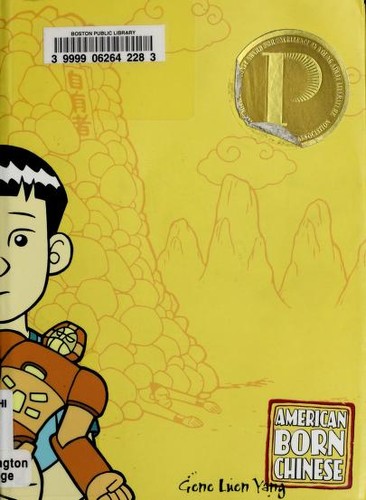
American Born Chinese
by Gene Luen Yang
★ Top 25 book of 2006 · #24 on Best Books of 2006
Three interrelated stories alternate to explore the problems faced by young Chinese Americans trying to take part in popular culture. Gene Luen Yang tells them in comic book format, with the stories linked together.
Best for: Comic readers interested in the experiences of young Chinese Americans and popular culture
American Born Chinese is #24 on BookWard's Best Books of 2006, out of 47 2006 books that cleared our data bar.
What American Born Chinese is about
Jin Wang, Danny and the Monkey King seem to have nothing to do with one another, and that is the surprise of this graphic novel. It braids together three stories. One retells the Monkey King of Flower-Fruit Mountain, who is deeply unhappy being a monkey and keeps trying to become something else. Another follows Jin, the child of Chinese immigrants, who moves from San Francisco's Chinatown to a suburb where hardly any classmates are Asian. He makes a friend in Wei-Chen Sun, dates Amelia Harris, and finds that fitting in comes at a cost. The third centers on Danny, a 16-year-old whose cousin Chin-Kee arrives as a walking racist stereotype and mortifies him. Humorous and thoughtful by turns, it explores racial identity, assimilation and self-acceptance, and asks what it means to be comfortable in your own skin.
American Born Chinese on the Best Books of 2006
American Born Chinese came out in 2006. Of the 47 books first published in 2006 that met BookWard's data bar, it ranks #24 on our Best Books of 2006 list.
Why it made the list: 228 readers have shelved it on Open Library; readers rate it 4 out of 5 (23 ratings). The list ranks each year’s books on how many readers have picked them up, how highly readers rate them, and how many are reading them right now.
Nearby on the 2006 list
- The Innocent Man John Grisham, #22
- Wintersmith Terry Pratchett, #23
- The Husband Dean Koontz, #25
See all Best Books of 2006 Best books by year
More years: Best Books of 2005 Best Books of 2007.
The numbers behind it
- Readers: 180 want to read it, 13 are reading it now and 35 have read it, according to Open Library.
- Ratings: 4 out of 5 from 23 Open Library ratings.
| Signal | This book (0 to 100) | Weight |
|---|---|---|
| Reach | 51 | 55% |
| Reader love | 40 | 25% |
| Being read right now | 55 | 20% |
Questions about American Born Chinese
When was American Born Chinese published?
American Born Chinese by Gene Luen Yang was first published in 2006.
Was American Born Chinese one of the best books of 2006?
American Born Chinese is #24 on BookWard's Best Books of 2006, out of 47 2006 books that cleared our data bar. 228 readers have shelved it on Open Library; readers rate it 4 out of 5 (23 ratings).
Why is American Born Chinese on the Best Books of 2006 list?
228 readers have shelved it on Open Library; readers rate it 4 out of 5 (23 ratings).
More of the best books of 2006
- The Sea of Monsters Rick Riordan, #1
- The Book Thief Markus Zusak, #2
- Half of a Yellow Sun Chimamanda Ngozi Adichie, #3
- The Boy in the Striped Pyjamas John Boyne, #4
- The Secret Rhonda Byrne, #5
- Mindset Carol S. Dweck, #6
See the full Best Books of 2006, the Top 100, or new books on Rising.
How we know
This page uses public data: Open Library reader counts and ratings, and Wikipedia page views for recent years. The description is paraphrased from real source text. Rankings reflect reading interest, not quality or sales, and can be affected by data gaps. Lists update monthly.
It suits teens and up, and works well for younger readers ready for themes of identity and prejudice.
Depends on the edition you pick.
Three tales braid into one sharp story about self-acceptance. 75% taste match
 BookWard’s take
Three tales braid into one sharp story about self-acceptance
Gene Luen Yang braids three storylines that seem unrelated until the final pages pull them together: a retelling of the Monkey King legend, the story of Jin Wang, a Chinese American boy adjusting to a new suburban school, and a third thread that stays hidden until the end. It hooks you fast, and it never drags, because each strand moves in short, vivid scenes. It feels fresh, too. Setting old myth against modern adolescence inside a graphic novel gives the structure a spark you don't often find. The ending resolves everything, with the three strands snapping into place in a way the story's own logic supports. There's real humor along the way, and the emotion stays restrained rather than syrupy. The prose is plain, as comics tend to be, and the art, along with colorist Lark Pien, carries the description. This is the kind of book that rewards a second pass.
A single graphic novel that moves through its three threads quickly, close to the tight end BookWard prefers.
Short, punchy scenes keep it moving, in line with BookWard's taste for speed.
Setting a classic Chinese myth beside a modern coming-of-age tale in comic form is a distinctive pairing.
Words are spare and plain, as the art does much of the work.
Both plot and inner struggle drive it, with a slight lean toward character.
It moves toward acceptance and a hopeful note despite painful stretches.
Three seemingly separate stories converge, which is more adventurous than a straight narrative.
Humor runs through it, from sitcom-style gags to light touches in the myth.
There is cruelty and pain, but it stays accessible for young readers.
Feelings of shame and longing land with real force without overwhelming.
See all 50 dialsEvery position, side by side with this book
Where it lines up
- PaceBookWard 8 · book 8
- OriginalityBookWard 9 · book 9
- EndingBookWard 8 · book 8
Where it pulls apart
- Familiar tropesBookWard 10 · book 7
- OpeningBookWard 10 · book 8
- Internal logicBookWard 10 · book 8
A single graphic novel that moves through its three threads quickly, close to the tight end BookWard prefers.
It opens straight into the Monkey King's story, so the pull starts at once, which suits BookWard.
It plays with stereotypes on purpose, but the Monkey King retelling is fresh enough to avoid feeling stale.
The three threads obey their own rules and connect in the end, which BookWard values.
Short, punchy scenes keep it moving, in line with BookWard's taste for speed.
Setting a classic Chinese myth beside a modern coming-of-age tale in comic form is a distinctive pairing.
Jin Wang and the Monkey King are drawn with real inner conflict, though the cast is compact.
The three storylines are tied together at the end, giving a full sense of resolution.
Emotions are present but handled with some restraint rather than pushed for tears.
Hard moments serve the story's themes rather than existing just to jolt the reader.
This is fiction, so the rigor dial does not apply.
Yang's blend of myth, humor and personal identity feels unmistakably his own.
Ideas about identity run through it, but story and image lead the way.
The meaning comes through scenes and pictures more than through explanation.
Three alternating threads keep the middle lively and sustained.
Words are spare and plain, as the art does much of the work.
Both plot and inner struggle drive it, with a slight lean toward character.
It moves toward acceptance and a hopeful note despite painful stretches.
Three seemingly separate stories converge, which is more adventurous than a straight narrative.
Humor runs through it, from sitcom-style gags to light touches in the myth.
Easy to read in the sitting, though the structure rewards attention.
Three storylines give it multiple viewpoints, even if they eventually merge.
The threads are told in parallel, giving it some layered timing without heavy time-jumping.
Gods and a kung fu Monkey King sit beside a realistic school story.
The core cast is limited, with a handful of figures carrying each thread.
Even the myth thread stays focused on personal feelings rather than epic stakes.
It balances inner insecurity with visible action and social scenes.
Conversation drives many scenes, helped by the comic format.
Romantic feelings appear in the school story but are not the center.
The settings are familiar, from school halls to suburban streets.
Its modern school thread and 2006 publication place it closer to the present day.
Questions about belonging and self-image still resonate, which suits BookWard.
The story is shown plainly with no sense of an unreliable teller.
The lesson about self-acceptance is clear, though how to get there is less tidy.
The pictures and color supply rich visual detail even as the text stays lean.
It stands alone as a single book.
The way the threads join delivers a satisfying surprise.
It confronts racial identity and self-image with some bite beyond a comfort read.
There is cruelty and pain, but it stays accessible for young readers.
Feelings of shame and longing land with real force without overwhelming.
Mixes broad comedic bits with sharper satire.
There are fights in the myth thread, but little that lingers.
Essentially absent beyond schoolyard crushes.
Race and prejudice are central, though handled through story rather than argument.
Language is plain and accessible throughout.
The point of view is clear but delivered through story, not lecture.
It balances heritage and tradition with a look toward how to live now.
It leans toward believing people can come to accept themselves.
Review written by BookWard, dial version 1, November 2026.
Who is American Born Chinese right for?
It suits teens and up, and works well for younger readers ready for themes of identity and prejudice. It deals with racism and bullying, which may need conversation.
Easy to read in the sitting, though the structure rewards attention.
There is cruelty and pain, but it stays accessible for young readers.
Feelings of shame and longing land with real force without overwhelming.
There are fights in the myth thread, but little that lingers.
Book CompanionAmerican Born Chinese: ideas, characters, themes
Accepting who you are, rather than reshaping yourself to please others, is the way to feel at home.
- Three threads. The book alternates among a Monkey King tale, Jin Wang's school story, and a third storyline that connects them.
- A myth reworked. Yang adapts a figure from the classic novel Journey to the West and adds a Christian-influenced deity.
- Wanting to be different. The Monkey King is unhappy as a monkey and tries to become something else, while Jin struggles with his own identity.
- Moving schools. Jin's family leaves San Francisco's Chinatown for a suburb where he is one of only two Asian students.
- Recognition. It was a finalist for the 2006 National Book Awards and won the 2007 Printz Award and an Eisner Award.
Characters
Jin Wang
Protagonist
A child of Chinese immigrants who struggles with his identity at a mostly non-Asian school.
The Monkey King
Mythic figure
A kung fu practicing monkey who is unhappy with himself and keeps trying to change.
Suzy Nakamura
Classmate
The only other Asian student at Jin's school.
Tze-Yo-Tzuh
Deity
A powerful being who tries to help the Monkey King accept himself.
Wong Lai-Tsao
Monk
Sent on a mission to the west, he frees the Monkey King from the mountain.
Themes
How you see yourself versus how others see you.
The wish to fit into a group or place.
Making peace with who you are.
Oversimplified ideas about groups of people.
Old stories shedding light on current experience.
Discussion questions
- Why might Yang pair a myth with a school story?
- How does the Monkey King's desire to change himself echo Jin's struggles?
- What role do stereotypes play in how characters treat each other?
- How do the art and color shape the tone?
- What changes for you once the three storylines connect?
Personalize your Book Companion
This is the general edition. In BookWard, the Companion is written for you: your reading profile, your notes, and spoiler-safe to the page you are on.
Buy, listen or borrow American Born Chinese
Each link opens a search for this book on that store, in a new tab.
Read on a device
Borrow
Reviews and community
If you liked American Born Chinese
A tall-tale runaway crosses a segregated town and refuses to see the line
The Graveyard BookNeil GaimanA boy raised by ghosts, with a murderer still looking
Mayowa and the Sea of WordsChibundu OnuzoA girl, a green-bearded grandfather, and magic that moves feelings
Tomorrow, and Tomorrow, and TomorrowGabrielle ZevinA thirty-year friendship told through the games two people build
Find your own best books
Add what you have read, rate it, and BookWard will recommend what to read next.
Free to start. No credit card needed.