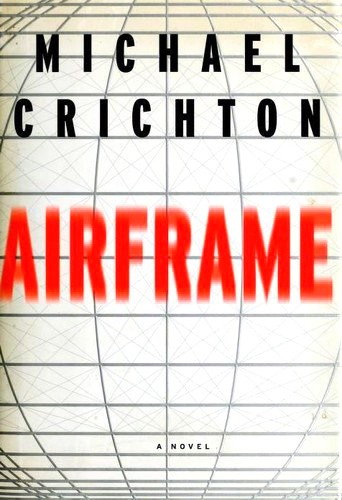
Airframe
by Michael Crichton
★ Top 10 book of 1996 · #10 on Best Books of 1996
Casey Singleton, a quality assurance vice president at aerospace maker Norton Aircraft, digs into what went wrong on one of the company's airliners. An in-flight accident left three passengers dead and 56 hurt, and she must find the cause.
Best for: Readers who like a corporate investigation built around an aviation disaster
Airframe is #10 on BookWard's Best Books of 1996, out of 39 1996 books that cleared our data bar.
What Airframe is about
When TransPacific Flight 545 suffers severe pitch oscillations over the Pacific, three passengers die and 56 are hurt. The plane is a Norton N-22 widebody, and Norton Aircraft has just one week to explain what went wrong before a major sale to China collapses. Casey Singleton, the company's vice president of quality assurance, is put on the review team and handed the job of finding the truth.
Nobody around her wants the same answer. A television producer is pursuing a story about the plane's flaws, the factory union is concerned the China sale will offset the wing to China and threaten jobs, and an arrogant Norton employee assigned to assist her becomes the subject of her suspicion. Crichton works through how a company weighs pressure against safety, how the news can bend a story, and how hard it is to separate what happened from what people believe happened. The tone is brisk and technical, with enough detail to feel like real investigative work.
Airframe on the Best Books of 1996
Airframe came out in 1996. Of the 39 books first published in 1996 that met BookWard's data bar, it ranks #10 on our Best Books of 1996 list.
Why it made the list: 527 readers have shelved it on Open Library; readers rate it 3.7 out of 5 (85 ratings); 27 are reading it right now. The list ranks each year’s books on how many readers have picked them up, how highly readers rate them, and how many are reading them right now.
Nearby on the 1996 list
- Angela's Ashes Frank McCourt, #8
- Desperation Stephen King, #9
- Into the Wild Jon Krakauer, #11
- The Night Stalker Philip Carlo, #12
See all Best Books of 1996 Best books by year
More years: Best Books of 1995 Best Books of 1997.
The numbers behind it
- Readers: 368 want to read it, 27 are reading it now and 132 have read it, according to Open Library.
- Ratings: 3.7 out of 5 from 85 Open Library ratings.
| Signal | This book (0 to 100) | Weight |
|---|---|---|
| Reach | 85 | 55% |
| Reader love | 13 | 25% |
| Being read right now | 87 | 20% |
Questions about Airframe
When was Airframe published?
Airframe by Michael Crichton was first published in 1996.
Was Airframe one of the best books of 1996?
Airframe is #10 on BookWard's Best Books of 1996, out of 39 1996 books that cleared our data bar. 527 readers have shelved it on Open Library; readers rate it 3.7 out of 5 (85 ratings); 27 are reading it right now.
Why is Airframe on the Best Books of 1996 list?
527 readers have shelved it on Open Library; readers rate it 3.7 out of 5 (85 ratings); 27 are reading it right now.
More of the best books of 1996
- A Game of Thrones George R. R. Martin, #1
- The Green Mile Stephen King, #2
- Forbidden Knowledge Roger Shattuck, #3
- Fight Club Chuck Palahniuk, #4
- Push Sapphire, #5
- Neverwhere Neil Gaiman, #6
See the full Best Books of 1996, the Top 100, or new books on Rising.
How we know
This page uses public data: Open Library reader counts and ratings, and Wikipedia page views for recent years. The description is paraphrased from real source text. Rankings reflect reading interest, not quality or sales, and can be affected by data gaps. Lists update monthly.
Suits adult and older teen readers who enjoy procedural thrillers.
Depends on the edition you pick.
A tight, clever corporate thriller built on an airliner mystery. 57% taste match
 BookWard’s take
A tight, clever corporate thriller built on an airliner mystery
Airframe drops you straight into an in-flight accident and gives Casey Singleton a week to find the cause before a major sale collapses. That ticking clock is a strong hook, and the investigation moves at a brisk, procedural pace. The internal logic is its real pleasure: each system gets checked, each theory tested, and the answer is earned rather than conjured. The book is idea-led and explains a great deal outright, which suits BookWard less than scenes that show. Characters are workable rather than deeply drawn, and the corporate and media pressures lean on familiar thriller moves. Still, it is restrained about its darkness and wraps up cleanly. A good choice for readers who like their suspense technical and fully resolved.
A one-week deadline and a steady stream of discoveries keep the investigation moving briskly.
The aviation-accident procedural gives it a distinct angle, even though the thriller scaffolding around it is familiar.
Plain, functional sentences keep the focus on information and action rather than ornament.
Events and the investigation steer the book far more than inner change in its people.
The tone is sober but not despairing, with competence and persistence winning out.
A straightforward investigation told in order with no formal tricks.
Serious throughout, with little room for jokes under the weight of a fatal accident.
Deaths and injuries frame the story but the treatment stays clinical and contained.
Tension is high but feeling is held in check by the procedural focus.
See all 50 dialsEvery position, side by side with this book
Where it lines up
- PaceBookWard 8 · book 8
- EndingBookWard 8 · book 8
- SentimentBookWard 8 · book 8
Where it pulls apart
- Familiar tropesBookWard 10 · book 4
- ExpositionBookWard 2 · book 8
- LengthBookWard 1 · book 4
It opens on a mid-flight disaster with dead and injured passengers, so the stakes are set immediately, just what BookWard wants.
Corporate pressure, a media hunter and a quiet heroine are well-worn thriller furniture, though the aviation setting freshens them somewhat.
The team checks each aircraft system methodically, so the solution is reasoned out step by step, which BookWard rates highly.
A one-week deadline and a steady stream of discoveries keep the investigation moving briskly.
The aviation-accident procedural gives it a distinct angle, even though the thriller scaffolding around it is familiar.
Casey is competent and clearly defined, but the cast serves the investigation more than it invites deep portraiture.
The mystery is solved and the threads close, giving the kind of resolution BookWard prizes.
The story stays practical and unsentimental, treating the deaths and injuries as problems to solve rather than occasions for pathos.
The accident is grim but the book earns its tension through investigation rather than gratuitous shocks.
Crichton grounds the plot in real aviation and manufacturing detail, giving the fiction a researched, technical backbone.
A crisp, informed, journalistic voice is recognisably Crichton, though less idiosyncratic than a strong stylist's.
The engineering puzzle and the way institutions handle blame drive the book as much as any individual's story.
Technical explanation is delivered directly and often at length, which sits against BookWard's preference for showing in scene.
The structured, clue-by-clue investigation keeps momentum up, with only brief stretches of procedural detail.
Plain, functional sentences keep the focus on information and action rather than ornament.
Events and the investigation steer the book far more than inner change in its people.
The tone is sober but not despairing, with competence and persistence winning out.
A straightforward investigation told in order with no formal tricks.
Serious throughout, with little room for jokes under the weight of a fatal accident.
The technical subject is explained for general readers, so the book is easy to follow.
The story stays mostly with Casey, with a few other threads around the media and the factory.
Events unfold in order across a single tight week.
Entirely grounded in the real world of airliners, manufacturers and television news.
Executives, engineers, union figures and journalists make for a fairly sizable working ensemble.
Large consequences ride on it, but the action stays in offices, hangars and interview rooms.
Investigation, interviews and inspections dominate over reflection.
Much of the plot is carried through meetings, interviews and conversation among colleagues.
Romance is not the point; the book is about the investigation and corporate pressure.
Airline manufacturing and accident investigation will be unfamiliar territory to most readers.
Set in the mid-1990s, recognisably recent but not present day.
The human mechanics of blame and cover-up endure, though the technology and media landscape date it.
A straightforward third-person account with no sign of deception.
Right and wrong are fairly legible, though corporate and media motives muddy the waters a little.
Technical settings are described with precision, though the book does not linger on scenery.
Though a novel, it reads with a reportorial, explanatory tilt toward analysis.
The perspective is close to Casey but mostly professional in tone rather than intimate.
A self-contained novel with no sequel hooks.
Revelations arrive regularly as new findings overturn earlier theories.
A satisfying puzzle rather than an unsettling read, leaning toward the comfortable side.
Deaths and injuries frame the story but the treatment stays clinical and contained.
Tension is high but feeling is held in check by the procedural focus.
Humor is minimal and mostly dry when it appears.
The accident leaves casualties, yet the book stays away from graphic depiction.
Sexual content is essentially absent.
Corporate, union and trade pressures play a role but not as an ideological argument.
Technical jargon appears but is explained for lay readers, keeping the language accessible.
The narration mostly reports, though Crichton's views on media and institutions come through.
It focuses on a present-tense crisis, with some concern about how institutions will cope.
Careful, honest work is rewarded, though the surrounding institutions are portrayed with skepticism.
Review written by BookWard, dial version 1, November 2026.
Who is Airframe right for?
Suits adult and older teen readers who enjoy procedural thrillers. It involves an accident with deaths and injuries, but treats them in a restrained, non-graphic way.
The technical subject is explained for general readers, so the book is easy to follow.
Deaths and injuries frame the story but the treatment stays clinical and contained.
Tension is high but feeling is held in check by the procedural focus.
The accident leaves casualties, yet the book stays away from graphic depiction.
Book CompanionAirframe: ideas, characters, themes
After a mid-flight accident kills passengers, a quality assurance executive has one week to uncover the cause while corporate, union and media pressures push in on a major sale.
- A disaster at the start. Flight 545 suffers severe pitch oscillations over the Pacific, leaving three dead and 56 injured.
- A ticking clock. Casey Singleton joins the Incident Review Team with a week to find the cause before a China sale is threatened.
- A methodical search. With flight recorder problems, the team has to check the aircraft's systems by hand.
- Pressure from outside. Union worries and a television producer's interest in the story complicate the investigation.
- Clues and counterfeit parts. The inquiry turns up troubling findings that suggest the answer is more tangled than a single fault.
Characters
Casey Singleton
Quality assurance vice president at Norton Aircraft
Assigned to the Incident Review Team, she leads the effort to find what went wrong on Flight 545.
John Marder
Norton's chief operating officer
He assigns Casey to the investigation and presses for answers tied to the China sale.
Bob Richman
Norton employee assisting Casey
An arrogant colleague whose behavior leaves Casey wary.
Jennifer Malone
Producer for the TV magazine Newsline
She pursues a story on the aircraft's alleged flaws, raising the pressure on Norton.
Themes
How the drive to close a major sale collides with the duty to find the truth about an accident.
How coverage and footage can shape perception of an aircraft before the facts are established.
How companies, workers and regulators manage responsibility when something goes wrong.
The value of methodical, evidence-based investigation over assumptions.
How job security shapes the choices and loyalties of the people involved.
Discussion questions
- How does the one-week deadline shape the choices Casey and the team make?
- Is the media's role in the story portrayed fairly, or as a villain?
- What does the story suggest about trusting a safety record versus checking every system?
- How do the competing interests of management, union and press complicate the search for truth?
- Does the book's heavy use of direct technical explanation help or hinder your enjoyment?
Personalize your Book Companion
This is the general edition. In BookWard, the Companion is written for you: your reading profile, your notes, and spoiler-safe to the page you are on.
Buy, listen or borrow Airframe
Each link opens a search for this book on that store, in a new tab.
Read on a device
Borrow
Reviews and community
If you liked Airframe
A big-firm lawyer walks out and takes a secret file with him
Tunnel in the skyRobert A. HeinleinHeinlein strands a class of students and watches society form
CongoMichael CrichtonA fast, gadget-laden lost world adventure, more machine than mood.
The ClientJohn GrishamA boy, a dead body, and a lawyer worth rooting for
Find your own best books
Add what you have read, rate it, and BookWard will recommend what to read next.
Free to start. No credit card needed.