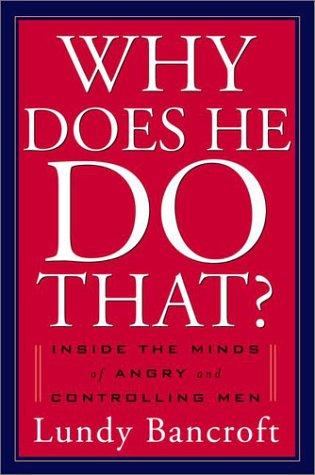
Why Does He Do That?
by Lundy Bancroft
★ Top 5 book of 2002 · #3 on Best Books of 2002
A counselor who works with abusive men explains how they think, helping women spot control and devaluation in a relationship. He covers warning signs, myths, personality types, and what can and cannot be fixed, plus how to leave safely.
Best for: Women questioning a partner's controlling behaviour and seeking a safe way out
Why Does He Do That? is #3 on BookWard's Best Books of 2002, out of 32 2002 books that cleared our data bar.
What Why Does He Do That? is about
Lundy Bancroft is a counselor who specializes in working with abusive men, and he uses his knowledge of how abusers think to help women. His aim is to help women recognize when a partner is controlling or belittling them, often before they have words for what is happening. He describes early warning signs, tackles common myths about abusers, and sets out ten abusive personality types. He also looks at the part drugs and alcohol play, and at what can and cannot be changed in a man who behaves this way.
The tone is direct and urgent, and the book ends with practical advice on leaving an abusive relationship safely. It will help women who suspect something is wrong in their relationship, as well as friends, family and professionals who want to understand it. A Harvard public health expert has called it the most useful book on the subject.
Why Does He Do That? on the Best Books of 2002
Why Does He Do That? came out in 2002. Of the 32 books first published in 2002 that met BookWard's data bar, it ranks #3 on our Best Books of 2002 list.
Why it made the list: 384 readers have shelved it on Open Library; readers rate it 4.2 out of 5 (12 ratings); 32 are reading it right now. The list ranks each year’s books on how many readers have picked them up, how highly readers rate them, and how many are reading them right now.
It earns Being read right now.
Nearby on the 2002 list
- Romancing Mister Bridgerton Julia Quinn, #1
- Coraline Neil Gaiman, #2
- Room on the Broom Julia Donaldson, #4
- Stories of Your Life and Others Ted Chiang, #5
See all Best Books of 2002 Best books by year
More years: Best Books of 2001 Best Books of 2003.
The numbers behind it
- Readers: 334 want to read it, 32 are reading it now and 18 have read it, according to Open Library.
- Ratings: 4.2 out of 5 from 12 Open Library ratings.
| Signal | This book (0 to 100) | Weight |
|---|---|---|
| Reach | 91 | 55% |
| Reader love | 66 | 25% |
| Being read right now | 94 | 20% |
Questions about Why Does He Do That?
When was Why Does He Do That? published?
Why Does He Do That? by Lundy Bancroft was first published in 2002.
Was Why Does He Do That? one of the best books of 2002?
Why Does He Do That? is #3 on BookWard's Best Books of 2002, out of 32 2002 books that cleared our data bar. 384 readers have shelved it on Open Library; readers rate it 4.2 out of 5 (12 ratings); 32 are reading it right now.
Why is Why Does He Do That? on the Best Books of 2002 list?
384 readers have shelved it on Open Library; readers rate it 4.2 out of 5 (12 ratings); 32 are reading it right now.
More of the best books of 2002
- Romancing Mister Bridgerton Julia Quinn, #1
- Coraline Neil Gaiman, #2
- Room on the Broom Julia Donaldson, #4
- Stories of Your Life and Others Ted Chiang, #5
- Everything's Eventual. 14 Dark Tales Stephen King, #6
- The Theory of Everything Stephen Hawking, #7
See the full Best Books of 2002, the Top 100, or new books on Rising.
How we know
This page uses public data: Open Library reader counts and ratings, and Wikipedia page views for recent years. The description is paraphrased from real source text. Rankings reflect reading interest, not quality or sales, and can be affected by data gaps. Lists update monthly.
Best suited to adult readers, and useful for older teens who want to understand unhealthy relationships.
Depends on the edition you pick.
A counselor's clear-eyed guide to recognizing and leaving abusive men. 56% taste match
 BookWard’s take
A counselor's clear-eyed guide to recognizing and leaving abusive men
Lundy Bancroft drew on his work counseling abusive men to write a guide for women trying to make sense of a partner's behavior. It opens well, naming the problem straight away, and it keeps moving thanks to short, practical chapters. What makes it distinctive is the angle: Bancroft explains abusive thinking from the abuser's side, then sorts abusers into ten personality types. The book rests on long clinical experience rather than anecdote alone, though it reads as a guide, not a study. His voice is firm and unsentimental, and he handles violence and darkness on the page through explanation, not spectacle. It is driven by ideas, direct, and built to be used, not just read.
A substantial guide with many chapters, longer than a quick read but organized so readers can find what they need.
Chapters move briskly and stay practical, though the subject matter makes it a book to take in slowly.
Explaining abuse from the abuser's own reasoning, drawn from counseling work, is a fresh and useful angle.
The writing is clear and plain, chosen to be understood by readers who may be in distress.
It is organized by concepts and patterns of behavior, with no plot to speak of.
It is honest about how hard abuse is to escape, yet offers a clear path toward safety and freedom.
A conventional guide format of warnings, types, myths and next steps that readers can navigate easily.
Humor has no place here; the subject is serious and the book treats it that way.
It deals with abuse and control throughout, with care taken to keep the focus on understanding and safety.
The subject cuts deep for many readers, though the book keeps a steady, practical hand.
See all 50 dialsEvery position, side by side with this book
Where it lines up
- SentimentBookWard 8 · book 8
- Shock for effectBookWard 9 · book 9
- Authorial voiceBookWard 9 · book 9
Where it pulls apart
- ExpositionBookWard 2 · book 9
- LengthBookWard 1 · book 5
- Story or ideasBookWard 3 · book 9
A substantial guide with many chapters, longer than a quick read but organized so readers can find what they need.
It sets aside popular myths about abusers and offers a framework most self-help writing on relationships does not.
Its argument about abusive thinking is laid out step by step and holds together across the types it describes.
Chapters move briskly and stay practical, though the subject matter makes it a book to take in slowly.
Explaining abuse from the abuser's own reasoning, drawn from counseling work, is a fresh and useful angle.
It describes patterns and types of men rather than developing individual characters, as a guide should.
Bancroft is plainspoken and avoids comforting excuses, which keeps the tone restrained and honest.
Hard material is there to inform and protect the reader, never to startle for effect.
It rests on long clinical work with abusive men and reads as expert practice, though not a formal study.
Bancroft's firm, direct, compassionate voice is unmistakable and carries real authority.
The book is built around ideas and frameworks, with examples serving the argument rather than driving a plot.
It explains its points outright, naming patterns, types and warning signs rather than leaving readers to infer them.
The structure of types, myths and practical steps keeps the material moving without a slack stretch.
The writing is clear and plain, chosen to be understood by readers who may be in distress.
It is organized by concepts and patterns of behavior, with no plot to speak of.
It is honest about how hard abuse is to escape, yet offers a clear path toward safety and freedom.
A conventional guide format of warnings, types, myths and next steps that readers can navigate easily.
Humor has no place here; the subject is serious and the book treats it that way.
Easy to follow on the page, though the subject can be emotionally heavy to absorb.
It speaks mainly from Bancroft's perspective as a counselor, explaining how abusers think for a reader.
Information flows in a straightforward order from warning signs through to leaving.
It is entirely grounded in real relationships and real behavior.
It describes types of men in general rather than introducing a roster of named people.
It stays close to the intimate life of a single relationship and the woman inside it.
It is largely about thinking, attitudes and control, tracing the mindset behind outward behavior.
It relies on explanation and short illustrations over extended exchanges.
Relationships are the subject, but only as the setting where control and abuse play out.
The settings are ordinary homes and relationships, familiar to most readers.
Its concerns remain current, though it was first published in the early 2000s.
The patterns it describes are enduring, which is why the book keeps finding readers.
Bancroft addresses readers directly and plainly, with no unreliable framing.
It is clear that abuse is a choice and that the abuser, not the victim, is responsible.
It describes behavior and thinking precisely, with little scenery or ornament.
It leans analytical, sorting abusers into types and patterns, with illustration rather than storytelling.
It draws on Bancroft's professional experience while addressing the reader's own situation directly.
It stands on its own as a complete guide.
A guide has no plot reversals; its surprises are in the insights about how abusers think.
It asks readers to question comforting beliefs about the person they love, which is hard to hear.
It deals with abuse and control throughout, with care taken to keep the focus on understanding and safety.
The subject cuts deep for many readers, though the book keeps a steady, practical hand.
Abuse is discussed frankly, mostly in terms of patterns and tactics rather than graphic scenes.
Sexual coercion is addressed as part of abusive behavior but not dwelt on.
It touches on social attitudes that excuse abuse, but its main concern is personal safety.
Language is plain and accessible throughout.
Bancroft states his conclusions firmly and does not hide where he stands.
It looks toward the reader's future safety and freedom, with an eye on what can change.
It believes women can recognize abuse and get free, while staying realistic about abusers' capacity to change.
Review written by BookWard, dial version 1, November 2026.
Who is Why Does He Do That? right for?
Best suited to adult readers, and useful for older teens who want to understand unhealthy relationships. It discusses emotional, physical and sexual abuse frankly, so some readers may find it painful or triggering.
Easy to follow on the page, though the subject can be emotionally heavy to absorb.
It deals with abuse and control throughout, with care taken to keep the focus on understanding and safety.
The subject cuts deep for many readers, though the book keeps a steady, practical hand.
Abuse is discussed frankly, mostly in terms of patterns and tactics rather than graphic scenes.
Book CompanionWhy Does He Do That?: ideas, characters, themes
Abusive behavior comes from a way of thinking about control and entitlement, and recognizing that thinking is the first step to protecting yourself.
- Abuse is a choice. Bancroft argues that abusive behavior comes from the abuser's beliefs and decisions, not from the victim's actions.
- Early warning signs. The book teaches readers to spot early signals of control and disrespect before patterns harden.
- Myths about abusers. It takes apart common explanations that make excuses for abusive men.
- Ten abusive types. Bancroft sorts abusers into ten personality types to help readers recognize what they face.
- What can and cannot change. It offers a candid look at what a partner can realistically fix and how to leave safely.
Themes
Abuse as a pattern of one person seeking power over another.
Placing blame for abusive behavior on the abuser, not the victim.
Learning to see warning signs and name what is happening.
Practical steps for getting out and staying protected.
Popular beliefs that excuse abusers or confuse their targets.
Discussion questions
- Which of the myths about abusers did you find most surprising or most common?
- How does explaining abuse from the abuser's mindset change the way you understand it?
- Why might early warning signs be so easy to explain away?
- What does the book suggest about whether abusive men can change?
- How might this book be useful to someone supporting a friend or family member?
Personalize your Book Companion
This is the general edition. In BookWard, the Companion is written for you: your reading profile, your notes, and spoiler-safe to the page you are on.
Buy, listen or borrow Why Does He Do That?
Each link opens a search for this book on that store, in a new tab.
Read on a device
Borrow
Reviews and community
If you liked Why Does He Do That?
A philosophical case for giving up on getting everything done
The Anxious GenerationJonathan HaidtA data-driven case against smartphone childhood, and what to do
All About Lovebell hooksA short, plain-spoken case for love as practice
ScatteredGabor MatéA physician's personal, environment-first case about attention deficit disorder
Find your own best books
Add what you have read, rate it, and BookWard will recommend what to read next.
Free to start. No credit card needed.