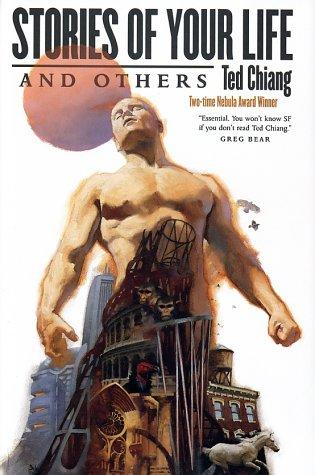
Stories of Your Life and Others
by Ted Chiang
★ Top 5 book of 2002 · #5 on Best Books of 2002
This collection brings together eight stories by an award-winning science fiction writer, one written just for the volume. Each starts from a bold what-if, from towers reaching Heaven to alien language reshaping our sense of time.
Best for: Readers who love idea-driven science fiction built on big speculative questions
Stories of Your Life and Others is #5 on BookWard's Best Books of 2002, out of 32 2002 books that cleared our data bar.
What Stories of Your Life and Others is about
Ted Chiang's first eight stories appear together here, published in 2002. They are science fiction and fantasy, but each one starts from a single 'what if' question and follows it with care. What if a tower really did reach Heaven? What if religious belief were literally true? What if learning an alien language changed how you experience time? The questions draw on mathematics, language and religion, and the answers are thoughtful rather than flashy.
The tone is cerebral and reflective, yet the stories carry real feeling, often about faith, free will and human curiosity. One was written especially for the volume, and the rest had appeared elsewhere. 'Story of Your Life' later became the film Arrival. The collection won the Locus Award for Best Collection in 2003, and several of its stories won major awards on their own, including the Nebula Award, the Theodore Sturgeon Memorial Award, the Sidewise Award and the Hugo Award. It will appeal to readers who enjoy ideas that linger after the last page, including those new to science fiction.
Stories of Your Life and Others on the Best Books of 2002
Stories of Your Life and Others came out in 2002. Of the 32 books first published in 2002 that met BookWard's data bar, it ranks #5 on our Best Books of 2002 list.
Why it made the list: 367 readers have shelved it on Open Library; readers rate it 4.4 out of 5 (94 ratings). The list ranks each year’s books on how many readers have picked them up, how highly readers rate them, and how many are reading them right now.
It earns Reader favorite.
Nearby on the 2002 list
- Why Does He Do That? Lundy Bancroft, #3
- Room on the Broom Julia Donaldson, #4
- Everything's Eventual. 14 Dark Tales Stephen King, #6
- The Theory of Everything Stephen Hawking, #7
See all Best Books of 2002 Best books by year
More years: Best Books of 2001 Best Books of 2003.
The numbers behind it
- Readers: 239 want to read it, 8 are reading it now and 120 have read it, according to Open Library.
- Ratings: 4.4 out of 5 from 94 Open Library ratings.
| Signal | This book (0 to 100) | Weight |
|---|---|---|
| Reach | 84 | 55% |
| Reader love | 97 | 25% |
| Being read right now | 38 | 20% |
Questions about Stories of Your Life and Others
When was Stories of Your Life and Others published?
Stories of Your Life and Others by Ted Chiang was first published in 2002.
Was Stories of Your Life and Others one of the best books of 2002?
Stories of Your Life and Others is #5 on BookWard's Best Books of 2002, out of 32 2002 books that cleared our data bar. 367 readers have shelved it on Open Library; readers rate it 4.4 out of 5 (94 ratings).
Why is Stories of Your Life and Others on the Best Books of 2002 list?
367 readers have shelved it on Open Library; readers rate it 4.4 out of 5 (94 ratings).
More of the best books of 2002
- Romancing Mister Bridgerton Julia Quinn, #1
- Coraline Neil Gaiman, #2
- Why Does He Do That? Lundy Bancroft, #3
- Room on the Broom Julia Donaldson, #4
- Everything's Eventual. 14 Dark Tales Stephen King, #6
- The Theory of Everything Stephen Hawking, #7
See the full Best Books of 2002, the Top 100, or new books on Rising.
How we know
This page uses public data: Open Library reader counts and ratings, and Wikipedia page views for recent years. The description is paraphrased from real source text. Rankings reflect reading interest, not quality or sales, and can be affected by data gaps. Lists update monthly.
Best for adult and older teen readers who enjoy thoughtful, idea-driven fiction.
Depends on the edition you pick.
Eight stories where one big idea drives everything. 64% taste match
 BookWard’s take
Eight stories where one big idea drives everything
Ted Chiang's first collection pairs a single outrageous premise with a story built to test it, and the premises are the draw: a tower reaching Heaven, an alien language that changes how time is perceived, a world where divine visitations are routine. Nothing here reads like standard science fiction, and the originality is close to unmatched. The internal logic is nearly airtight, because each story follows its own rules to the end. This is a book that puts story and ideas well ahead of everything else, and it explains a good deal outright where I would sooner see the ideas dramatized in scene, so that is where my taste and the book part ways. Short, dense, and the Locus Award for Best Collection in 2003 fits.
A collection of eight stories that runs compact; each piece says what it needs and stops, which suits BookWard's taste for tight books.
Pace varies by story, from brisk to contemplative, and averages out as measured rather than fast, a little under BookWard's pull.
Chiang's premises, from a tower to Heaven to a science of naming, are original in ways few collections manage.
The prose is clean, exact, and unshowy, serving the idea over ornament, a touch plainer than BookWard's middle ground.
The ideas set the shape, but the best stories tie the premise to a person's inner stakes, landing the book just on the plot side.
The tone is thoughtful and often melancholy rather than bright, resting near the middle of the outlook range.
Mostly conventional story forms, with a few playful or formally inventive pieces, such as the documentary-style story.
These are serious, contemplative stories where humor barely appears, quieter on that dial than BookWard's taste.
Some stories take on grief and cosmic indifference, but the book is thoughtful more than grim.
Feeling builds quietly beneath the ideas, strongest in the stories about loss and meaning.
See all 50 dialsEvery position, side by side with this book
Where it lines up
- Familiar tropesBookWard 10 · book 10
- Internal logicBookWard 10 · book 10
- Sagging middleBookWard 8 · book 8
Where it pulls apart
- Story or ideasBookWard 3 · book 9
- ExpositionBookWard 2 · book 7
- OpeningBookWard 10 · book 7
A collection of eight stories that runs compact; each piece says what it needs and stops, which suits BookWard's taste for tight books.
Each story opens by planting its strange premise quickly, though some take a few pages to explain their world before the pull sets in.
These premises are fresh in every story and avoid stock science fiction furniture, which is exactly what BookWard rewards.
Each story builds a world with firm rules and follows them to their conclusions, which is the heart of its appeal.
Pace varies by story, from brisk to contemplative, and averages out as measured rather than fast, a little under BookWard's pull.
Chiang's premises, from a tower to Heaven to a science of naming, are original in ways few collections manage.
Characters are drawn with real care in the stronger stories, though some serve the idea more than they live apart from it.
Most stories land on a clear conclusion to their central question, closer to resolved than open, in line with BookWard.
Emotion is present but controlled, and feeling comes through the idea rather than through easy sentiment.
The darker turns grow from each premise instead of being added for effect, so the darkness feels earned.
The scientific and mathematical thinking behind the stories is careful and consistent, giving them real intellectual weight.
Chiang's clear, precise, thoughtful voice is recognizable across the book and sets it apart from generic genre fiction.
These are idea-led stories at heart, where the premise is the engine, a clear step past BookWard's story-first lean.
Chiang often explains his worlds and concepts directly rather than dramatizing them, which pulls against BookWard's preference for showing.
Short forms keep tension up, and the collection rarely loses momentum within any single story.
The prose is clean, exact, and unshowy, serving the idea over ornament, a touch plainer than BookWard's middle ground.
The ideas set the shape, but the best stories tie the premise to a person's inner stakes, landing the book just on the plot side.
The tone is thoughtful and often melancholy rather than bright, resting near the middle of the outlook range.
Mostly conventional story forms, with a few playful or formally inventive pieces, such as the documentary-style story.
These are serious, contemplative stories where humor barely appears, quieter on that dial than BookWard's taste.
The concepts ask for attention and reflection, making this more demanding than a casual read, above BookWard's comfort point.
Each story holds to a focused point of view, with variety coming across the collection rather than inside single pieces.
Most stories move forward, though the title story plays with how time is perceived, so some bend appears.
Every story rests on a fantastical or speculative premise, but each is treated with rigorous realism.
Casts are small and tightly focused, as short fiction built around a single idea tends to be.
The ideas are vast, but the human stakes are often personal, giving a mid-scale feel.
Stories turn on reflection and understanding more than on external action, leaning toward inner thought.
Conversation carries ideas at times, but the collection is not driven by dialogue.
Romance is a minor thread at most, as these stories are about ideas and belief.
Unfamiliar imagined worlds drive the stories, from ancient towers to altered realities, well toward unfamiliar.
Settings range from ancient to near-present and speculative futures, so the book sits slightly toward the past.
The questions of faith, language, and knowledge are lasting ones, and the collection has aged well since 2002.
Narrators are generally trustworthy guides through the ideas, a reliable rather than slippery presence.
These stories pose hard questions and often decline easy answers, so the moral picture is far from clear-cut.
Description is functional and precise rather than lush, giving just enough to ground each concept.
A standalone collection of stories with no series attached.
Reveals do matter, but they are quieter and conceptual, turning understanding rather than plot.
These stories challenge assumptions about faith, language, and mathematics rather than offering comfort.
Some stories take on grief and cosmic indifference, but the book is thoughtful more than grim.
Feeling builds quietly beneath the ideas, strongest in the stories about loss and meaning.
What humor appears is dry and understated, never broad.
Violence is minimal and seldom the focus, though one premise includes sudden fiery death.
Sexual content is slight, and these stories are not about intimacy.
Questions of religion and power surface but are not argued as politics.
The language is plain and clear, though the concepts can be dense.
Narration mostly lets the premises speak, with a modest authorial slant.
The stories look both back to myth and forward to speculation, landing near the middle.
Neither cynical nor naive, the book treats human hope with sober, curious respect.
Review written by BookWard, dial version 1, November 2026.
Who is Stories of Your Life and Others right for?
Best for adult and older teen readers who enjoy thoughtful, idea-driven fiction. Some stories deal with death, grief, and religious questions in serious ways.
The concepts ask for attention and reflection, making this more demanding than a casual read, above BookWard's comfort point.
Some stories take on grief and cosmic indifference, but the book is thoughtful more than grim.
Feeling builds quietly beneath the ideas, strongest in the stories about loss and meaning.
Violence is minimal and seldom the focus, though one premise includes sudden fiery death.
Book CompanionStories of Your Life and Others: ideas, characters, themes
Each story takes one bold speculative premise, such as a tower to Heaven or a language that alters time, and tests what it would do to human belief and understanding.
- A tower to Heaven. In "Tower of Babylon," men build a tower to reach Heaven and face what they find beyond it.
- Language and time. "Story of Your Life" imagines an alien language changing how time itself is perceived.
- Mathematics unsettled. "Division by Zero" asks what follows if the foundations of mathematics prove arbitrary and inconsistent.
- Life from names. "Seventy-Two Letters" imagines a science of naming that calls life from inanimate matter.
- Faith made literal. "Hell Is the Absence of God" imagines a world where divine events are routine, and examines belief under those conditions.
Themes
How belief holds up when its claims become literally true.
How the words we use shape what we can perceive.
What happens when the basics of mathematics or science are shaken.
Whether understanding the future changes how we live.
What it means to make life or reach for the divine.
Discussion questions
- Which premise felt most original to you, and why?
- How do the stories treat faith: as comfort, as burden, or as a question?
- Does knowing more about the world make characters freer or more trapped?
- Where did the explaining help, and where did you want to be shown instead?
- Which story would you hand to someone who has never read science fiction?
Personalize your Book Companion
This is the general edition. In BookWard, the Companion is written for you: your reading profile, your notes, and spoiler-safe to the page you are on.
Buy, listen or borrow Stories of Your Life and Others
Each link opens a search for this book on that store, in a new tab.
Read on a device
Borrow
Reviews and community
If you liked Stories of Your Life and Others
A short, strange novel where one man's dreams rewrite the world
The DispossessedUrsula K. Le GuinAn anarchist utopia, tested by a physicist who crosses worlds
Childhood’s EndArthur C. ClarkeA short, cool classic about utopia and what it costs
Le città invisibiliItalo CalvinoMarco Polo describes cities to Kublai Khan, each one a riddle
Find your own best books
Add what you have read, rate it, and BookWard will recommend what to read next.
Free to start. No credit card needed.