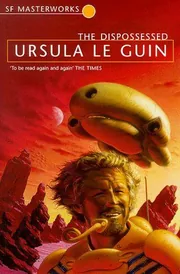
The Dispossessed
by Ursula K. Le Guin · 1974
Suits mature teens and adults who enjoy serious ideas in their fiction.
352 pages, about 5.5 to 8 hours.
An anarchist utopia, tested by a physicist who crosses worlds. 58% taste match
The story
The Dispossessed is a science fiction novel by Ursula K. Le Guin, first published in 1974. It belongs to her Hainish Cycle and is built around anarchism, utopian society and life on other planets. The story follows Shevek, a physicist who comes from a world of anarchists that has long been cut off from the rest of the civilized universe. Communal living is central to the society he knows, and the novel looks at how such a way of life is structured and what it asks of the people inside it.
Shevek's decision to act brings real cost, since he stands to lose his family and possibly his life. His journey carries him toward questioning accepted ways of living and challenging the barriers between worlds. The book also weighs ideas such as capitalism, individualism and collectivism, and revolutionary societies. It won the Hugo Award, along with the Locus and Nebula awards, and runs to about 352 pages in its typical edition.
Da war eine Mauer.
Characters
Shevek
Themes
AnarchismAnarquismoCiencia-ficciónCommunal livingFicciónFísicosLife on other planetsNovela utópica
- Want to read 343
- Reading now 13
- Read 75
Most people shelving it are saving it for later.
Of 431 readers who put it on a shelf, 80% want to read it, 3% are reading it now, 17% have finished it and 0% stopped before the end.
By the numbers
- The median edition runs 352 pages. Counting about 275 words a page and an adult reading pace of 250 words a minute, that is about 6.5 hours of reading.
- Open Library tracks 75 editions from 44 publishers, the earliest dated 1974 and the latest 2024, across 13 languages.
- On reader demand it ranks in the top 2% of the classic books in our catalog (8,749 of them).
- Libraries shelve it under Dewey [Fic] and Library of Congress class PS-3562.00000000.E42 D5 1975.
 BookWard’s take
An anarchist utopia, tested by a physicist who crosses worlds
Le Guin builds a whole society from its first principles and then makes you live inside it through Shevek, a physicist who stands to lose his family and possibly his life by acting. The book is led by its ideas, but Shevek's journey keeps it moving. The anarchist world of Anarres is wonderfully original and rigorously consistent, because the way its people live, share and work holds together. It is about as airtight as invented worlds get, and it stays well clear of familiar tropes. The exposition runs heavier than I'd like, since the politics are explained outright as well as dramatized. It is also demanding to read, trading speed for substance. If you want ideas with a human cost attached, this is a landmark of the form.
At about 352 pages it is mid-length for what it covers, longer than BookWard's tight ideal but not sprawling.
The book gives ideas room, so it moves at a considered pace, slower than BookWard's brisk preference.
A working anarchist utopia as the setting for a science fiction novel is original, and BookWard rewards that.
The prose is clear and measured rather than ornate, sitting near BookWard's plain-leaning middle.
Shevek's choices and inner conflict propel the book more than events do, in step with BookWard.
It holds real hope for how people could live together while admitting the price, close to BookWard's mildly hopeful outlook.
Its two-world construction gives it an unconventional shape, more experimental than BookWard's conventional-leaning middle.
It is a serious book about serious questions, with little comedy, which is more austere than BookWard's lighter taste.
See all 50 dialsEvery position, side by side with this book
Where it lines up
- OriginalityBookWard 9 · book 9
- Character depthBookWard 8 · book 8
- Familiar tropesBookWard 10 · book 9
Where it pulls apart
- OpeningBookWard 10 · book 5
- Story or ideasBookWard 3 · book 8
- LengthBookWard 1 · book 4
At about 352 pages it is mid-length for what it covers, longer than BookWard's tight ideal but not sprawling.
It opens with a physicist poised to act, which builds interest steadily rather than grabbing at once, a gentler start than BookWard prefers.
Its anarchist utopia and the physicist who crosses between worlds avoid familiar genre furniture, which fits BookWard's taste closely.
The society of Anarres is constructed so its customs and constraints follow from its principles, matching BookWard's love of airtight worlds.
The book gives ideas room, so it moves at a considered pace, slower than BookWard's brisk preference.
A working anarchist utopia as the setting for a science fiction novel is original, and BookWard rewards that.
Shevek's choices cost him family and possibly life, so he is drawn as a person rather than a mouthpiece, in line with BookWard.
It leans toward resolution without tying everything off, a little looser than BookWard's fully resolved taste.
The stakes are human but the book treats them with some restraint, close to BookWard's preference.
Its darkness comes from the cost of idealism and not from effect, which BookWard values.
It examines anarchism, capitalism and collectivism with real intellectual seriousness, close to what BookWard prizes.
Le Guin's sustained, thoughtful register is recognisably her own, which suits BookWard's liking for a distinct voice.
Ideas about anarchism and collectivism drive the book, though a human story carries them, which suits BookWard's story-led lean only partly.
Ideas about society are explained and debated as well as shown, more than BookWard's show-in-scene preference.
The weighty subject matter stays engaging, though some stretches of explanation slow momentum compared with BookWard's sustained ideal.
The prose is clear and measured rather than ornate, sitting near BookWard's plain-leaning middle.
Shevek's choices and inner conflict propel the book more than events do, in step with BookWard.
It holds real hope for how people could live together while admitting the price, close to BookWard's mildly hopeful outlook.
Its two-world construction gives it an unconventional shape, more experimental than BookWard's conventional-leaning middle.
It is a serious book about serious questions, with little comedy, which is more austere than BookWard's lighter taste.
It asks for steady attention to ideas about society, more demanding than BookWard's moderate preference.
The story follows one man at its center, narrower than the many-viewpoint tilt BookWard favors.
The book moves between its two worlds and times, shifting more than BookWard's linear-leaning middle.
It is science fiction on other planets, but grounded in believable social detail, near BookWard's middle.
It stays focused on a small circle around Shevek, matching BookWard's lean toward smaller casts.
It spans two worlds and a whole social question, so it feels bigger than BookWard's intimate lean.
Shevek's thoughts and doubts drive the book more than action, which suits BookWard's inner-leaning taste.
Argument and conversation carry much of the thinking, so dialogue is heavy, a touch above BookWard's lean.
Family and bonds matter, but romance is not the center, in line with BookWard's minor-romance lean.
Anarres and the world it is set against are fully unfamiliar, well beyond BookWard's already unfamiliar preference.
It is set on other worlds rather than the present, though its questions about politics feel current, tilting it past-facing.
Its questions about freedom and community outlast its 1974 publication, which BookWard rewards.
The narration is straightforward and trustworthy, far from the unreliable end BookWard leans toward.
It refuses easy answers about utopia and cost, leaving morality ambiguous in a way BookWard values.
It builds its worlds in rich, specific detail, a little richer than BookWard's middle setting.
Review written by BookWard, dial version 1, November 2026.
Who is The Dispossessed right for?
Suits mature teens and adults who enjoy serious ideas in their fiction. It deals with politics and with personal sacrifice, so younger readers may find it heavy.
It asks for steady attention to ideas about society, more demanding than BookWard's moderate preference.
Book CompanionThe Dispossessed: ideas, characters, themes
A physicist from a world of anarchists risks everything to challenge the walls that keep his people apart from the rest of the universe.
- A scientist at the center. Shevek is a brilliant physicist whose work sets him on a path of questioning and action.
- A society of anarchists. His planet is built on anarchism and communal living, long isolated from the wider civilized universe.
- A cost to acting. Choosing to act means giving up his family and possibly his life.
- Questioning the unquestionable. Shevek seeks answers to things his society treats as settled.
- Part of a larger cycle. The book belongs to Le Guin's Hainish Cycle and stands as a landmark award winner.
Characters
Shevek
Protagonist
A brilliant physicist who decides to seek answers and challenge his society's isolation, at great personal risk.
Themes
A society organized without central rule, and what that asks of its people.
The ideal community and the cost of keeping it alive.
The pull between personal freedom and shared life.
What it takes to change a society that resists questioning.
The walls of hatred and distance that cut one world off from others.
Discussion questions
- Is Shevek's choice to act worth what it costs him?
- What does a society of anarchists gain, and what does it lose?
- How does the book weigh individualism against collectivism?
- Does a utopia stay a utopia once it is cut off from everyone else?
- Which ideas in the book still feel pressing today?
Personalize your Book Companion
This is the general edition. In BookWard, the Companion is written for you: your reading profile, your notes, and spoiler-safe to the page you are on.
Buy, listen or borrow The Dispossessed
Each link opens a search for this book on that store, in a new tab.
Read on a device
Borrow
Reviews and community
If you liked The Dispossessed
Eight stories where one big idea drives everything
The Lathe of HeavenUrsula K. Le GuinA short, strange novel where one man's dreams rewrite the world
PlaygroundRichard PowersFour lives, one ocean, and a game that ate the world
A Memory Called EmpireArkady MartineA murder mystery wrapped in an empire that devours its neighbors
Sources: Open Library.
Track The Dispossessed and find your next favorite
Add it to your shelf, rate what you have read, and BookWard will recommend what fits you.
Free to start. No credit card needed.