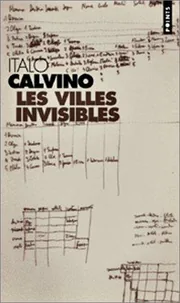
Le città invisibili
by Italo Calvino · 1972
Suited to adult and older teen readers who enjoy reflective, literary writing.
165 pages, about 2.5 to 4 hours.
Marco Polo describes cities to Kublai Khan, each one a riddle. 56% taste match
The story
Le città invisibili, by Italo Calvino, first appeared in Italy in 1972 from the publisher Einaudi. It is a postmodern novel that draws on historical figures, placing the young Venetian Marco Polo at the court of the emperor Kublai Khan, whose lifetime is given as 1216 to 1294. Polo's own dates are generally given as 1254 to 1323. The book belongs to the tradition of travel literature and stories of exploration, while also touching on kings and rulers and on the study of cities and urban life.
The narrative takes the form of a series of fragmentary portraits of cities. Marco describes the places he has visited on his expeditions, among them Armilla and Octavia, and the khan listens to him with close attention and curiosity. The cities may be real places, products of invention, or variations on Polo's native Venice, and the book leaves open how they should be read. Tarot also appears among its subjects. The setting ranges between China and Italy. In most editions the book runs to about 165 pages, and it has appeared in 46 editions.
Characters
Khan KublaiMarco Polo
Setting
ChinaItalyItalia
Themes
FicciónExplorersKings and rulersExploradoresTarotReyes y soberanosExplorationUrbanism
- Want to read 162
- Reading now 10
- Read 50
Most people shelving it are saving it for later.
Of 222 readers who put it on a shelf, 73% want to read it, 5% are reading it now, 23% have finished it and 0% stopped before the end.
By the numbers
- The median edition runs 165 pages. Counting about 275 words a page and an adult reading pace of 250 words a minute, that is about 3.0 hours of reading.
- Open Library tracks 46 editions from 27 publishers, the earliest dated 1972 and the latest 2023, across 8 languages.
- On reader demand it ranks in the top 5% of the classic books in our catalog (8,749 of them).
- Libraries shelve it under Dewey 858.914 and Library of Congress class PQ-4809.00000000.A45 C5.
 BookWard’s take
Marco Polo describes cities to Kublai Khan, each one a riddle
Calvino's 1972 novel is short, strange and exact. Marco Polo reports on cities to Kublai Khan, and each portrait is a compact invention, so the book never sags in the middle. Few books are as original, since nothing else reads quite like it. The voice is unmistakable, calm and precise. At 165 pages it is tight. This is not a book that prizes character depth: Polo and the Khan are shapes in a conversation, and the ideas lead. It also gives little of the pace that pulls you forward, though the opening is a hook, a full city described in the first sentence. Read it in small doses and it rewards you.
At 165 pages it is short and compressed, which matches BookWard's love of tight books.
Each portrait is brief and moves quickly, but the book is built for contemplation, not momentum.
A string of invented cities told as a dialogue between Polo and the Khan has few equivalents.
The prose is clear and lyrical without being ornate, a little richer than BookWard's middle.
There is almost no plot and the people are slight, so the book leans on neither strongly.
It is neither bleak nor cheerful, hovering in a reflective middle.
A frame conversation holds fragmentary city portraits, a more experimental design than BookWard usually prefers.
Wit is present but quiet, and the book is largely serious.
The mood is more melancholy than harsh.
Feeling is present but held back, which keeps the book restrained.
See all 50 dialsEvery position, side by side with this book
Where it lines up
- LengthBookWard 1 · book 1
- Familiar tropesBookWard 10 · book 10
- Shock for effectBookWard 9 · book 9
Where it pulls apart
- Rigor (nonfiction)BookWard 9 · book 3
- Story or ideasBookWard 3 · book 9
- Character depthBookWard 8 · book 3
At 165 pages it is short and compressed, which matches BookWard's love of tight books.
It opens by laying out a whole city in one sentence, which draws you in at once.
It avoids familiar story shapes entirely, which BookWard rewards.
Each city follows its own strict rule, though the frame leaves the larger logic open.
Each portrait is brief and moves quickly, but the book is built for contemplation, not momentum.
A string of invented cities told as a dialogue between Polo and the Khan has few equivalents.
Marco and the Khan are voices more than fully drawn people, which is below BookWard's preference.
The book closes on reflection, not a tidy resolution, which sits below BookWard's taste.
The tone is cool and precise, never sentimental, which BookWard values.
There is no shock for effect, only quiet strangeness earned by the ideas.
This is fiction, so rigor in the nonfiction sense barely applies.
Calvino's voice is distinctive, measured and unlike anyone else's, a strong match for BookWard.
The book is led by ideas about cities and imagination, far more than by plot.
The cities are often explained directly by Polo, so the book tells more than it dramatizes.
Short, varied portraits keep the whole book alive without a slack stretch.
The prose is clear and lyrical without being ornate, a little richer than BookWard's middle.
There is almost no plot and the people are slight, so the book leans on neither strongly.
It is neither bleak nor cheerful, hovering in a reflective middle.
A frame conversation holds fragmentary city portraits, a more experimental design than BookWard usually prefers.
Wit is present but quiet, and the book is largely serious.
It asks for patience and attention, more than BookWard's usual reading effort.
Nearly everything comes through Marco's reports, so the viewpoint is close to single.
The cities float outside ordinary time, so the sense of sequence is loose.
The cities are dreamlike and impossible, well above BookWard's middling pull toward the fantastical.
Two speakers carry the whole book, a very small cast.
Its subject is the whole range of cities, though told in a quiet conversation.
It is a book of reflection and description, not action.
Conversation frames the book, yet most of it is Polo's description, so dialogue is light.
Romance plays no part.
The imagined cities and the Khan's court are unfamiliar ground.
It is set in the thirteenth century, though written in 1972.
Its questions about cities and imagination feel as fresh as when it appeared.
Marco may be inventing, remembering or recombining, so the narrator is hard to trust.
The book offers no verdict, only possibilities, which fits BookWard's taste for ambiguity.
Each city is rendered in vivid, concrete image after image.
It reads closer to essayistic reflection than to plain storytelling.
The perspective is intimate in spirit but filtered through a frame.
It stands entirely on its own.
It has few plot turns, though each city brings a small surprise.
It unsettles assumptions about place and memory, which BookWard enjoys.
The mood is more melancholy than harsh.
Feeling is present but held back, which keeps the book restrained.
What humor there is stays dry and understated.
There is virtually no violence on the page.
Sexual content is almost absent.
Rulers and empire form the setting, but politics is not the focus.
The language is clear and plain despite the strange material.
Polo reports and reflects, but the narration stays fairly neutral.
It looks both back to Polo's era and forward to what cities may become.
It holds hope and doubt in balance without settling on either.
Review written by BookWard, dial version 1, November 2026.
Who is Le città invisibili right for?
Suited to adult and older teen readers who enjoy reflective, literary writing. It has little graphic content, but its abstract style asks for patience.
It asks for patience and attention, more than BookWard's usual reading effort.
The mood is more melancholy than harsh.
Feeling is present but held back, which keeps the book restrained.
There is virtually no violence on the page.
Book CompanionLe città invisibili: ideas, characters, themes
Through Marco Polo's accounts to Kublai Khan, the book asks whether a city is a place, a memory or an invention of the mind.
- The frame. Marco Polo describes cities from his travels to Kublai Khan, who listens with close attention.
- Fragmentary portraits. The book is built from short portraits of individual cities, such as Armilla and Octavia.
- Real or imagined. The cities may be real, invented, or repeated variations on Polo's native Venice.
- Travel and exploration. It belongs to the tradition of travel writing while questioning what an account of travel can promise.
- Cities as ideas. Urbanism is a subject throughout, with each city expressing a different way a city might exist.
Characters
Marco Polo
Narrator and traveler
The young Venetian who describes the cities he has visited.
Kublai Khan
Listener and emperor
The Tartar emperor who doubts some of what he hears but keeps listening.
Themes
The book blurs what is observed with what is invented.
Places are shaped by what is remembered and by what is desired.
A traveler's account is also an act of making.
An emperor learns of his realm only through another person's words.
Discussion questions
- Do you think the cities Marco describes are real, invented, or all versions of Venice?
- Why does Kublai Khan keep listening if he does not fully believe Marco?
- Which city portrait stayed with you most, and what idea did it carry?
- How does the lack of conventional plot change the way you read?
- What does the book suggest about how we describe the places we know?
Personalize your Book Companion
This is the general edition. In BookWard, the Companion is written for you: your reading profile, your notes, and spoiler-safe to the page you are on.
Buy, listen or borrow Le città invisibili
Each link opens a search for this book on that store, in a new tab.
Read on a device
Borrow
Reviews and community
If you liked Le città invisibili
A strange Kent tideline, and an object that won't hold still
Stories of Your Life and OthersTed ChiangEight stories where one big idea drives everything
The King in YellowRobert W. ChambersA slim 1895 horror collection built around a play that ruins its readers
PiranesiSusanna ClarkeA journal from an endless house of tides and statues
Sources: Open Library.
Track Le città invisibili and find your next favorite
Add it to your shelf, rate what you have read, and BookWard will recommend what fits you.
Free to start. No credit card needed.