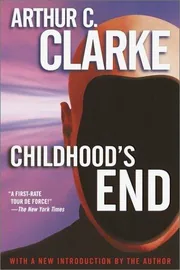
Childhood’s End
by Arthur C. Clarke · 1952
Its clear prose and big ideas suit curious teens and adults, and it reads well for readers who enjoy classic science fiction.
222 pages, about 3.5 to 5 hours.
A short, cool classic about utopia and what it costs. 58% taste match
The story
Childhood's End is a science fiction novel by the British writer Arthur C. Clarke, first published in 1952. It belongs to the tradition of human and alien encounter stories, and it also takes up the question of where humanity as a species might be headed.
Beings known as the Overlords appear above Earth and take control without bloodshed. Their rule is indirect, and they keep to their ships for years while governing from a distance. Wars stop, a single world authority emerges, and society settles into a long stretch of calm and plenty. People ask what these visitors are and what they want, but answers are slow in coming. The book moves across several decades and follows figures including Rikki Stormgren, Karellen, George Greggson and Jan Rodricks. Its closing movement turns to the youngest generation and to a change in human nature itself. The edition most readers meet runs a little over two hundred pages, and the book has appeared in more than eighty editions.
BEFORE SHE FLEW to the launch site, Helena Lyakhov always went through the same ritual.
Characters
Rikki StormgrenKarellenGeorge GreggsonJan Rodricks
Themes
Human-alien encountersLong Now Manual for CivilizationHuman evolutionHuman-Alien encounterExtraterrestrial beings
- Want to read 301
- Reading now 14
- Read 81
Most people shelving it are saving it for later.
Of 396 readers who put it on a shelf, 76% want to read it, 4% are reading it now, 20% have finished it and 0% stopped before the end.
By the numbers
- The median edition runs 222 pages. Counting about 275 words a page and an adult reading pace of 250 words a minute, that is about 4.1 hours of reading.
- Open Library tracks 81 editions from 43 publishers, the earliest dated 1952 and the latest 2021, across 6 languages.
- On reader demand it ranks in the top 3% of the classic books in our catalog (8,749 of them).
- Libraries shelve it under Dewey [Fic] and Library of Congress class PR-6005.00000000.L36 Ch10.
 BookWard’s take
A short, cool classic about utopia and what it costs
Childhood's End packs a huge span of time into 222 pages, and it is tightly compressed in a way that suits the material. Clarke cares more about the idea than the individuals, so this is a book driven by concepts rather than plot, and the exposition is explained outright rather than dramatized. The originality is real: peaceful occupation, a near-utopia and a final turn toward human transformation still feel unlike most alien stories. Character depth is thinner than I'd like, since people mostly serve as windows onto a century of change. The ending resolves with a sweeping, unsentimental logic that suits restrained, airtight work. Expect something cool, grand and thoughtful rather than warm or intimate, and a book that earns its strangeness.
At 222 pages it covers decades with economy, a compression BookWard prizes.
The book moves briskly through decades, jumping ahead rather than lingering in any one period.
A benevolent occupation ending in human transformation remains a distinctive shape for a story.
The prose is clear and measured, favoring precision over ornament.
Events and ideas drive the book far more than any one person's inner arc.
The utopia is real but costly, and the closing note is more awe than comfort.
Distinct parts leap across decades, a mildly unusual but still orderly layout.
The tone is serious and philosophical, with little room for humor.
The darkness is conceptual and cosmic rather than graphic.
Feeling runs quiet and awestruck rather than intense.
See all 50 dialsEvery position, side by side with this book
Where it lines up
- LengthBookWard 1 · book 1
- OriginalityBookWard 9 · book 9
- SentimentBookWard 8 · book 8
Where it pulls apart
- Story or ideasBookWard 3 · book 9
- ExpositionBookWard 2 · book 8
- OpeningBookWard 10 · book 7
At 222 pages it covers decades with economy, a compression BookWard prizes.
The Overlords' arrival is the premise from the start, though the tone is measured rather than urgent.
It helped set the template for alien-contact stories, yet its peaceful occupation still avoids the usual invasion tropes.
Each stage of Overlord rule and human response follows from the last with disciplined, cause-and-effect reasoning.
The book moves briskly through decades, jumping ahead rather than lingering in any one period.
A benevolent occupation ending in human transformation remains a distinctive shape for a story.
People serve mainly as vantage points on large change, so they stay lighter than BookWard prefers.
The final movement closes the book's central question completely, with a conclusion that feels inevitable.
Clarke keeps feeling in check and lets the ideas carry the weight, which suits BookWard well.
Its darkest turns grow out of the premise instead of existing for effect.
The calm, grand, slightly detached tone is recognizably Clarke's, though more composed than flamboyant.
The book is built around what contact does to humanity, with plot serving the argument.
Much of the big picture is delivered through explanation and conversation rather than scene.
Short and structured in parts, it holds its momentum from start to finish.
The prose is clear and measured, favoring precision over ornament.
Events and ideas drive the book far more than any one person's inner arc.
The utopia is real but costly, and the closing note is more awe than comfort.
Distinct parts leap across decades, a mildly unusual but still orderly layout.
The tone is serious and philosophical, with little room for humor.
The prose is easy to follow, though the ideas ask for some reflection.
Different figures carry each stretch of the story, passing the lens from era to era.
The story leaps forward by years and decades instead of running day by day.
Alien overlords and a psychic transformation put it firmly in speculative territory.
A rotating set of principals across generations makes the cast broader than the page count suggests.
The stakes are the future of the whole species, about as epic as fiction gets.
It balances social and global events with some reflection, leaning slightly outward.
Conversations carry much of the explaining, giving dialogue a solid but not dominant role.
Romance is not a concern of this book.
An Earth under alien guardianship is an unfamiliar setting, yet it stays recognizable.
Written in the early 1950s and set in an imagined future, it reads as a period piece of mid-century science fiction.
Its questions about progress, control and human destiny keep it fresh.
The narration is straightforward and trustworthy, with no tricks.
Whether the Overlords' peace is worth its price is left for the reader to weigh.
Description is functional and spare, serving ideas more than atmosphere.
It stands entirely on its own.
Several large revelations reshape what the reader thought was happening.
It unsettles comfortable ideas about progress and the human future.
The darkness is conceptual and cosmic rather than graphic.
Feeling runs quiet and awestruck rather than intense.
Any wit is dry and sparing.
The Overlords take over without bloodshed, and violence stays largely off the page.
Sexual content is essentially absent.
Questions of world government and authority run through the book without dominating it.
The language is plain and accessible.
Clarke lets the situation speak, with only mild editorializing.
The book is almost entirely about where humanity goes next.
It offers a vision of peace and wonder while staying clear-eyed about the cost.
Review written by BookWard, dial version 1, November 2026.
Who is Childhood’s End right for?
Its clear prose and big ideas suit curious teens and adults, and it reads well for readers who enjoy classic science fiction. The themes are philosophical rather than graphic, though the cosmic and unsettling ending may linger.
The prose is easy to follow, though the ideas ask for some reflection.
The darkness is conceptual and cosmic rather than graphic.
Feeling runs quiet and awestruck rather than intense.
The Overlords take over without bloodshed, and violence stays largely off the page.
Book CompanionChildhood’s End: ideas, characters, themes
A gentle, bloodless alien takeover brings human peace and plenty, but at the price of who humanity might have become.
- The Overlords arrive. Mysterious beings appear above Earth and govern from a distance rather than conquering openly.
- A world at peace. War ends, a single world authority forms, and society settles into prosperity.
- Questions unanswered. People ask what the visitors want, and the answers come slowly.
- Decades pass. The story spans many years, handing the focus from one figure to the next.
- A change in the young. The final movement turns to the youngest generation and a transformation of human nature itself.
Characters
Rikki Stormgren
Human figure in the Overlords' era
One of the people through whom the story follows life under Overlord rule.
Karellen
Overlord
A leading figure among the Overlords who governs from a distance.
George Greggson
Human figure
One of the people the story follows as the decades unfold.
Jan Rodricks
Human figure
One of the people the story follows as the book moves toward its close.
Themes
Whether perfect peace is worth what is given up to get it.
The idea that our species may be heading toward something beyond itself.
What it means to be governed by a power that will not fully explain itself.
How comfort and stability can wear away what makes a people distinct.
How meeting a vastly more advanced intelligence reshapes everything.
Discussion questions
- Is the world the Overlords create a good one, and who decides?
- Why might the Overlords keep to their ships for so long?
- What did humanity gain, and what did it lose, under their rule?
- Does the book treat the transformation of the young as hope or loss?
- How does the book's mid-century setting shape its picture of the future?
Personalize your Book Companion
This is the general edition. In BookWard, the Companion is written for you: your reading profile, your notes, and spoiler-safe to the page you are on.
Buy, listen or borrow Childhood’s End
Each link opens a search for this book on that store, in a new tab.
Read on a device
Borrow
Reviews and community
If you liked Childhood’s End
A million-year-old mystery, chased by five seekers across the stars
I, RobotIsaac AsimovNine robot puzzles that still out-argue most modern AI fiction
Children of TimeAdrian TchaikovskySpiders build a civilization while humanity's last ark ship closes in
Stories of Your Life and OthersTed ChiangEight stories where one big idea drives everything
Sources: Open Library.
Track Childhood’s End and find your next favorite
Add it to your shelf, rate what you have read, and BookWard will recommend what fits you.
Free to start. No credit card needed.