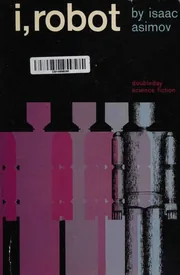
Suits teens and adults who like classic science fiction; the stories are short and approachable.
245 pages, about 4 to 5.5 hours.
Nine robot puzzles that still out-argue most modern AI fiction. 59% taste match
The story
I, Robot is a science fiction book by Isaac Asimov, first published in 1950. It gathers nine stories that ran in pulp magazines, including Super Science Stories and Astounding Science Fiction, across the 1940s. Gnome Press issued the collected volume. The stories are linked by a frame in which Susan Calvin, a fictional robot specialist, looks back on her career while speaking with a reporter in the 21st century. Each tale can stand alone, yet together they sketch an invented history of robotics.
The stories deal with how people and machines relate, and with questions of right and wrong. Titles include "Robbie," "Runaround," "Reason," "Catch That Rabbit," "Liar!," "Little Lost Robot," "Escape!," "Evidence," and "The Evitable Conflict." The cast features Susan Calvin and Alfred Lanning, along with the engineers Powell and Donovan. Settings range from New York City and the Museum of Science and Industry to the Finmark Robot Corporation, Mercury, Hyper Base, and Earth. Dates mentioned in the stories run from 1982 to 2052. Subjects touched on include space stations, asteroids, supercomputers, and the Frankenstein complex.
Vous voulez connaître un cauchemar d'écrivain?
Characters
RobbiePowellDonovan
Setting
New York CityMuseum of Science and IndustryFinmark Robot CorporationMercuryHyper Base
Period
21st Century20151982
Themes
smear campaignssupercomputerscomputersFrankenstein complexhyperspaceheisenbugsasteroidsShahada
- Want to read 1,496
- Reading now 96
- Read 325
Most people shelving it are saving it for later.
Of 1917 readers who put it on a shelf, 78% want to read it, 5% are reading it now, 17% have finished it and 0% stopped before the end.
By the numbers
- The median edition runs 245 pages. Counting about 275 words a page and an adult reading pace of 250 words a minute, that is about 4.5 hours of reading.
- Open Library tracks 99 editions from 73 publishers, the earliest dated 1950 and the latest 2021, across 11 languages.
- On reader demand it ranks in the top 1% of the classic books in our catalog (8,749 of them).
- Libraries shelve it under Dewey 813.54 and Library of Congress class PS-3551.00000000.S5 I13 2004.
 BookWard’s take
Nine robot puzzles that still out-argue most modern AI fiction
I, Robot is a short, tightly built collection where each story starts from a rule and follows it somewhere uncomfortable. Its internal logic is about as rigorous as fiction gets: every tale is a puzzle about how robots obeying fixed laws can still behave strangely, and the solutions hold up. The pace is quick, which makes sense for stories that began in magazines and get into trouble almost at once. Where I part company with it is in how it handles exposition. Ideas are often talked through in dialogue rather than shown, and the characters serve the premise more than the reverse. Susan Calvin's framing memoir gives the pieces a spine and a sense of history. If you like fiction that earns its conclusions through reasoning, this is a classic of the form.
At 245 pages of self-contained stories it is compact, which suits BookWard's liking for tight books.
Pulp magazine origins keep the stories brisk, a little short of BookWard's fast preference.
Its robot-ethics puzzles were fresh in 1950 and the premises still feel inventive, though imitators have dulled some edges.
The writing is plain and functional, a little plainer than BookWard likes, with ideas outweighing style.
Plot and puzzle lead throughout, a clear contrast with BookWard's lean toward character.
The tone is cautiously optimistic about humans and machines learning to coexist.
Linked stories with a framing memoir are mildly unconventional but not experimental.
There is some dry banter among the engineers, but the book is mainly serious.
Tension and unease appear, but the book is largely mild.
Feeling is kept low-key, with a few warmer moments among the puzzles.
See all 50 dialsEvery position, side by side with this book
Where it lines up
- Internal logicBookWard 10 · book 10
- EndingBookWard 8 · book 8
- Shock for effectBookWard 9 · book 9
Where it pulls apart
- Familiar tropesBookWard 10 · book 6
- ExpositionBookWard 2 · book 8
- Story or ideasBookWard 3 · book 8
At 245 pages of self-contained stories it is compact, which suits BookWard's liking for tight books.
It helped set the robot tropes later fiction leans on, so some now feel familiar, though the Three Laws twists stay sharp.
Every story turns on a rule and its consequences, and the reasoning holds together, which is exactly what BookWard prizes.
Pulp magazine origins keep the stories brisk, a little short of BookWard's fast preference.
Its robot-ethics puzzles were fresh in 1950 and the premises still feel inventive, though imitators have dulled some edges.
People mostly serve the puzzle, with Susan Calvin the fullest figure, so depth falls short of BookWard's taste.
Each tale resolves its puzzle cleanly, matching BookWard's liking for closure.
Warmth appears in places, notably the Robbie story, but the book mostly stays cool and analytical.
It earns its unease through logic rather than gore, which fits BookWard.
Asimov's plain, conversational style is recognizable but not showy, so the voice is clear without being unusual.
Ideas about robots and morality drive each tale more than character arcs, far more idea-led than BookWard prefers.
Characters often explain the logic outright in dialogue, which cuts against BookWard's wish to be shown rather than told.
Stories are short enough that none drags, though quality varies from tale to tale.
The writing is plain and functional, a little plainer than BookWard likes, with ideas outweighing style.
Plot and puzzle lead throughout, a clear contrast with BookWard's lean toward character.
The tone is cautiously optimistic about humans and machines learning to coexist.
Linked stories with a framing memoir are mildly unconventional but not experimental.
There is some dry banter among the engineers, but the book is mainly serious.
Easy to follow in short chunks, with only the logic puzzles asking for attention.
Different stories follow different people, held together by Susan Calvin's recollection.
The frame looks back across decades of robot history, so the order shifts between story and recollection.
Robots and space travel make it speculative, but the settings are treated as plausible near futures.
Recurring figures like Calvin, Powell and Donovan keep the cast manageable across nine stories.
It moves from a single household to global economic management, so scope grows over the book.
Action and problem-solving outweigh interior reflection, as engineers work through crises.
Much of the storytelling happens through conversation, as characters argue through each problem.
Robot-filled futures and off-world stations are unfamiliar settings for most readers.
Written in the 1940s and set in the future, it is a historical SF artifact.
The questions about machine ethics keep feeling relevant despite the dated trappings.
Calvin's account is straightforward, with no sense that the narration is deceiving us.
Each story probes where the Three Laws leave ethical gaps, so right and wrong are often unsettled.
Setting detail is functional and brief, with ideas taking priority over scenery.
Linked stories form a history and tie into Asimov's wider robot fiction, though this book stands alone.
Each story hinges on a reveal about why a robot behaved oddly.
It leans comfortable in tone but pushes readers to rethink assumptions about machines.
Tension and unease appear, but the book is largely mild.
Feeling is kept low-key, with a few warmer moments among the puzzles.
Humor, where it appears, is understated and wry.
Physical violence is rare and mostly implied.
There is essentially no sexual content.
Economic and political themes arrive late, especially in the final story, but stay in the background.
The language is plain and accessible throughout.
The framing narrator is mostly neutral, letting the stories make their own case.
It is oriented toward the future and what living with robots may mean.
Despite the problems, it believes that reasoned rules and human care can make the systems work.
Review written by BookWard, dial version 1, November 2026.
Who is I, Robot right for?
Suits teens and adults who like classic science fiction; the stories are short and approachable. Content is mild, with little violence or sexual material.
Easy to follow in short chunks, with only the logic puzzles asking for attention.
Tension and unease appear, but the book is largely mild.
Feeling is kept low-key, with a few warmer moments among the puzzles.
Physical violence is rare and mostly implied.
Book CompanionI, Robot: ideas, characters, themes
A set of linked stories explores how robots bound by fixed laws still produce surprising, sometimes troubling behavior, and what that means for people.
- A frame ties the stories together. Susan Calvin recalls her career to a reporter in the 21st century, giving nine separate tales a shared history.
- Each story is a puzzle. Most pieces present a robot behaving strangely and then work out why.
- Pulp origins. The stories first ran in magazines like Super Science Stories and Astounding Science Fiction between 1940 and 1950.
- Scope widens. The settings move from a family home to Mercury, space stations and finally global concerns.
- Ideas over action. The drama comes from reasoning and conversation more than from physical conflict.
Characters
Susan Calvin
Robot specialist
The fictional expert whose recollections frame the collection.
Alfred Lanning
Colleague
A fictional figure from the robotics world who appears in Calvin's history.
Powell and Donovan
Engineers
A pair of field engineers who deal with robots in difficult situations.
Robbie
Robot
A robot at the center of the opening story.
Themes
How people live with and depend on the machines they build.
Whether fixed laws can capture right and wrong.
The Frankenstein complex, or distrust of what we make.
What happens when logic leads somewhere unintended.
Discussion questions
- Do the robots' rules make them safer, or do they only create new problems?
- Which story best shows a flaw in the Three Laws, and why?
- Why might Asimov frame the stories as Susan Calvin's memories?
- How well do the ideas hold up now that real machines are more common?
- Do you care more about the characters or the puzzles, and does that change your enjoyment?
Personalize your Book Companion
This is the general edition. In BookWard, the Companion is written for you: your reading profile, your notes, and spoiler-safe to the page you are on.
Buy, listen or borrow I, Robot
Each link opens a search for this book on that store, in a new tab.
Read on a device
Borrow
Reviews and community
If you liked I, Robot
Asimov's robot stories, gathered into one clever, rule-bound whole
Robot DreamsIsaac AsimovAsimov's short fiction, from 1947 to 1986, in one volume
Short FictionH. Beam PiperPiper's magazine-era science fiction, from galactic empire to parallel timelines
Childhood’s EndArthur C. ClarkeA short, cool classic about utopia and what it costs
Sources: Open Library.
Track I, Robot and find your next favorite
Add it to your shelf, rate what you have read, and BookWard will recommend what fits you.
Free to start. No credit card needed.