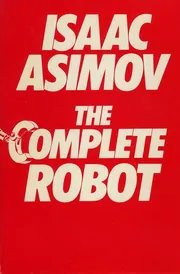
The Complete Robot
by Isaac Asimov · 1982
Suits curious teens and adults, and its clear style has made it popular with learners of English.
557 pages, about 9 to 13 hours.
Asimov's robot stories, gathered into one clever, rule-bound whole. 55% taste match
The story
The Complete Robot is a science fiction short story collection by Isaac Asimov, first published in 1982. It gathers thirty-one of his thirty-seven robot stories, which he wrote between 1939 and 1977. Most had already appeared in the earlier volumes I, Robot and The Rest of the Robots, while the remainder came from four uncollected pieces and several other anthologies. The stories are sorted into groups, such as immobile, metallic and humanoid robots, and together they trace Asimov's imagined history of robotics.
The stories turn on how people and machines deal with one another, and on questions of right and wrong that arise between them. The Three Laws of Robotics, which Asimov devised for these tales, run through the collection. Among the characters are Robbie, a robot, and the Weston family, including Gloria Weston and Mr. Weston. Settings include New York City, the Museum of Science and Industry and the Finmark Robot Corporation. The book runs to roughly 557 pages in its median edition, and it has appeared in sixteen editions, including versions prepared for foreign-language learners and a German translation.
Characters
RobbieGloria WestonMr. Weston
Setting
New York CityMuseum of Science and IndustryFinmark Robot CorporationXian dai
Period
1982
Themes
English languageRobotsText-books for foreign speakersText-booksfor foreign speakersMachine theoryAmerican literatureKe xue huan xiang xiao shuoXiao shuo ji
- Want to read 157
- Reading now 12
- Read 46
- Stopped 1
Most people shelving it are saving it for later.
Of 216 readers who put it on a shelf, 73% want to read it, 6% are reading it now, 21% have finished it and 0% stopped before the end.
By the numbers
- The median edition runs 557 pages. Counting about 275 words a page and an adult reading pace of 250 words a minute, that is about 10 hours of reading.
- Open Library tracks 16 editions from 14 publishers, the earliest dated 1982 and the latest 2023, across 4 languages.
- On reader demand it ranks in the top 3% of the modern books in our catalog (15,152 of them).
- Libraries shelve it under Dewey 813.54 and Library of Congress class PS-3551.00000000.S5 C616 1982.
 BookWard’s take
Asimov's robot stories, gathered into one clever, rule-bound whole
This is the full run of Asimov's robot fiction: thirty-one stories written between 1939 and 1977, grouped by kind of robot. Its main strength is internal logic. The Three Laws of Robotics work like a puzzle box, and story after story finds a new way to test them. That suits a reader who likes airtight setups. The openings land well too, since short stories have to hook fast. The cost shows in the prose and the characters: the writing is plain and the people serve the ideas. At 557 pages it runs long for a reader who likes things tight, but each piece is self-contained, so the middle never sags. It leans idea-led and explains its setups outright rather than dramatizing them.
Over 550 pages is long next to BookWard's love of tight books, though the short-story form keeps each piece brief.
The stories move briskly from setup to resolution without padding, close to BookWard's preferred speed.
The Three Laws and the robot-as-puzzle concept were fresh when written, though later imitation blunts them today.
Asimov writes in plain, functional sentences, a little plainer than BookWard's middling taste.
Plot and puzzle clearly lead over character, tilting away from BookWard's character-driven side.
The collection generally imagines humans and machines working things out, a mildly hopeful stance BookWard shares.
Thirty-one separate stories sorted into groups is a conventional collection layout, close to BookWard's taste.
Wry humor appears in some stories, though the tone is mostly serious and measured.
The tone stays mostly clean and cerebral, gentler than BookWard's middle position.
The register is cool and analytical, more restrained than BookWard's moderately intense taste.
See all 50 dialsEvery position, side by side with this book
Where it lines up
- Internal logicBookWard 10 · book 10
- EndingBookWard 8 · book 8
- PaceBookWard 8 · book 7
Where it pulls apart
- LengthBookWard 1 · book 6
- Familiar tropesBookWard 10 · book 6
- Story or ideasBookWard 3 · book 8
Over 550 pages is long next to BookWard's love of tight books, though the short-story form keeps each piece brief.
Each story has to set up its robot puzzle within a few pages, which BookWard rewards.
Asimov's ideas shaped later robot fiction, so some of it now feels familiar, which dulls the freshness BookWard wants.
The Three Laws drive every story, and each plot turns on working out exactly how they apply, which is airtight in the way BookWard likes.
The stories move briskly from setup to resolution without padding, close to BookWard's preferred speed.
The Three Laws and the robot-as-puzzle concept were fresh when written, though later imitation blunts them today.
People mostly serve as vehicles for the idea at hand, which falls short of the depth BookWard prizes.
Each story closes its puzzle with a clear answer, matching BookWard's taste for resolution.
Some tales lean warm, such as the one about a robot and a child, but most stay cool and analytical.
Darkness comes from logical consequences rather than gratuitous effect, which BookWard respects.
Asimov's plain, clear style is recognizable but not strikingly distinctive, short of BookWard's appetite for voice.
These are idea-led stories, each built around a question about robots, which suits BookWard's leaning toward story-first books less than usual.
Characters often talk through the logic outright, much more explaining than BookWard prefers.
Self-contained stories mean there is no long middle to sag, so energy holds throughout.
Asimov writes in plain, functional sentences, a little plainer than BookWard's middling taste.
Plot and puzzle clearly lead over character, tilting away from BookWard's character-driven side.
The collection generally imagines humans and machines working things out, a mildly hopeful stance BookWard shares.
Thirty-one separate stories sorted into groups is a conventional collection layout, close to BookWard's taste.
Wry humor appears in some stories, though the tone is mostly serious and measured.
The writing is clear and accessible, easier going than BookWard's slightly demanding preference.
A shifting set of human and robot characters across stories gives a fair range of viewpoints.
The stories trace a history of robotics across decades of imagined time, so the book as a whole moves across eras.
Robots and future settings make this speculative, a bit more fantastical than BookWard's middle ground.
Across thirty-one stories the cast is sizable, though each tale uses only a few characters.
Most stories are tightly focused, yet together they sketch a larger history of robotics.
The tales lean slightly toward events and problem-solving over interior thought.
Much of the logic is worked out in conversation, so dialogue is heavy, matching BookWard's liking.
Romance is essentially absent from the collection's central concerns.
Future worlds and robot-filled societies feel unfamiliar, in line with BookWard's taste for the unfamiliar.
The stories were written decades ago and set in an imagined future, so they sit away from the present day.
Questions about how people and machines coexist keep the stories relevant, which BookWard values.
Narration is straightforward and trustworthy, with no unreliable-narrator games, differing from BookWard's taste.
The stories probe where rules break down, so right and wrong stay contestable, which BookWard likes.
Description is spare and functional, serving the puzzle more than the scene.
The stories share the Three Laws and together form a connected history, so this leans toward series-like continuity.
Many stories hinge on a reveal about how the Laws applied, giving plenty of surprises.
The questions about machine morality are thought-provoking without being punishing.
The tone stays mostly clean and cerebral, gentler than BookWard's middle position.
The register is cool and analytical, more restrained than BookWard's moderately intense taste.
Humor, where present, is dry and understated rather than broad.
Little violence appears on the page, which sits below BookWard's middle.
Sexual content is essentially absent.
Some stories touch on society and robots, but politics is not the focus.
Language is plain and clear, easier than BookWard's middle setting.
Narration mostly lets the situations speak, staying fairly neutral.
Imagining future technology and its consequences makes this strongly forward-looking.
The collection believes reasoned rules can make things work, a moderately idealistic outlook.
Review written by BookWard, dial version 1, November 2026.
Who is The Complete Robot right for?
Suits curious teens and adults, and its clear style has made it popular with learners of English. Content is gentle, with little violence or sexual material.
The writing is clear and accessible, easier going than BookWard's slightly demanding preference.
The tone stays mostly clean and cerebral, gentler than BookWard's middle position.
The register is cool and analytical, more restrained than BookWard's moderately intense taste.
Little violence appears on the page, which sits below BookWard's middle.
Book CompanionThe Complete Robot: ideas, characters, themes
A collection of Asimov's robot stories uses the Three Laws of Robotics to explore how people and machines interact and where right and wrong blur between them.
- One collection, many stories. It gathers thirty-one of Asimov's thirty-seven robot stories, written between 1939 and 1977.
- Grouped by robot type. Stories are sorted into categories such as immobile, metallic and humanoid robots.
- The Three Laws. Asimov's rules for robot behavior run through the collection and drive its puzzles.
- A larger history. Read together, the stories tell Asimov's imagined history of robotics.
- Earlier collections. Most stories first appeared in I, Robot and The Rest of the Robots, with a few from other anthologies.
Characters
Robbie
A robot
A robot whose story features among the collection's best-known pieces.
Gloria Weston
A child in the Weston family
Connected with Robbie in his story.
Mr. Weston
Gloria's father
Part of the Weston family in Robbie's story.
Themes
Whether and how a machine can act rightly under fixed rules.
How strict laws produce unexpected results when applied.
How people feel about, trust and depend on machines.
How an invention develops across generations and changes society.
Discussion questions
- Do the Three Laws seem like sufficient rules for a robot, and where do they strain?
- Which story changed your view of what a robot could be?
- How do the stories treat humans compared with the machines?
- Does grouping the stories by robot type help you read them?
- What would a modern version of these laws need to cover?
Personalize your Book Companion
This is the general edition. In BookWard, the Companion is written for you: your reading profile, your notes, and spoiler-safe to the page you are on.
Buy, listen or borrow The Complete Robot
Each link opens a search for this book on that store, in a new tab.
Read on a device
Borrow
Reviews and community
If you liked The Complete Robot
Nine robot puzzles that still out-argue most modern AI fiction
Robot DreamsIsaac AsimovAsimov's short fiction, from 1947 to 1986, in one volume
Short FictionH. Beam PiperPiper's magazine-era science fiction, from galactic empire to parallel timelines
The Foundation TrilogyIsaac AsimovA galaxy-spanning idea novel that trades characters for the sweep of history
Sources: Open Library.
Track The Complete Robot and find your next favorite
Add it to your shelf, rate what you have read, and BookWard will recommend what fits you.
Free to start. No credit card needed.