Suitable for teens and adults, with clear prose and little graphic content.
447 pages, about 7 to 10.5 hours.
Asimov's short fiction, from 1947 to 1986, in one volume. 50% taste match
The story
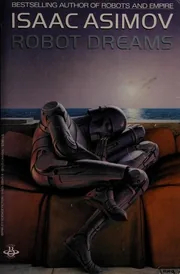
Robot Dreams is a collection of science fiction short stories by the American writer Isaac Asimov, first published in 1986 and illustrated by Ralph McQuarrie. It gathers twenty-one stories written between 1947 and 1986, running to roughly 447 pages in its typical edition. Robots are a central subject throughout, and the book has also been issued in a Russian translation.
The title story follows Susan Calvin as she comes across a robot whose dreams are unsettling. Asimov wrote it expressly for this volume, taking his cue from McQuarrie's cover illustration. The remaining stories had already appeared in earlier Asimov collections. Several belong to his robot series, among them "Little Lost Robot," "Sally," and "Light Verse." Others belong to the Multivac series, including "Franchise," "Jokester," "The Last Question," and "True Love." The rest stand on their own, with titles such as "The Martian Way," "The Feeling of Power," "The Ugly Little Boy," and "The Billiard Ball."
The book suits readers who want a broad sampling of Asimov's short fiction, from the late 1940s through the 1980s, in a single volume.
Measures on Hyper Base had been taken in a sort of rattling fury-the muscular equivalent of an hysterical shriek.
- Want to read 116
- Reading now 8
- Read 33
Most people shelving it are saving it for later.
Of 157 readers who put it on a shelf, 74% want to read it, 5% are reading it now, 21% have finished it and 0% stopped before the end.
By the numbers
- The median edition runs 447 pages. Counting about 275 words a page and an adult reading pace of 250 words a minute, that is about 8.2 hours of reading.
- Open Library tracks 26 editions from 23 publishers, the earliest dated 1986 and the latest 2014, across 5 languages.
- On reader demand it ranks in the top 7% of the modern books in our catalog (15,152 of them).
- Libraries shelve it under Dewey 813.54 and Library of Congress class PS-3551.00000000.S5R58 2004.
 BookWard’s take
Asimov's short fiction, from 1947 to 1986, in one volume
Robot Dreams collects twenty-one Asimov stories across nearly four decades, with the title story written new for this edition. The collection is driven by ideas: each story sets up a premise and follows its logic, so what matters most is whether the reasoning holds together and how clearly it is laid out. Asimov explains rather than dramatizes, and a reader who prefers things shown in scene will notice. The tone is plain and the stories are short, so they open fast and never drag the way a long novel's middle can. Characters tend to serve the puzzle more than they deepen. Some of the robot premises will feel well-worn now, since later writers borrowed so freely from this territory. Still, it is a tidy way to sample the Robot and Multivac strands together.
At 447 pages it is a substantial volume, though each story is short and self-contained, which suits BookWard's liking for tight work.
Each story moves briskly from setup to payoff, so the pace stays quick even across a long collection.
Many premises were genuinely early for their time, though readers who know the genre's descendants may find them less surprising.
The prose is deliberately plain and functional, closer to BookWard's plainer end.
Plot and premise drive nearly everything here, with character working in service of the puzzle.
The outlook is mixed but generally measured, with room for optimism about human ingenuity.
Conventional short-story form throughout, with the collection simply gathering stories from different decades.
Some stories have wry or ironic edges, but the overall register is serious and thoughtful.
Mostly thoughtful and mild, with little graphic or disturbing material.
The emotional register is restrained, with intellect leading over feeling.
See all 50 dialsEvery position, side by side with this book
Where it lines up
- Internal logicBookWard 10 · book 9
- PaceBookWard 8 · book 7
- EndingBookWard 8 · book 7
Where it pulls apart
- Familiar tropesBookWard 10 · book 4
- Story or ideasBookWard 3 · book 9
- ExpositionBookWard 2 · book 8
At 447 pages it is a substantial volume, though each story is short and self-contained, which suits BookWard's liking for tight work.
Short stories have to set up their premise quickly, so most open on the problem almost immediately, which BookWard rewards.
Robots and supercomputers were fresh when many of these were written, but decades of imitation make some setups feel familiar today.
These stories are built like puzzles, with outcomes that follow from stated rules, which is exactly what BookWard wants.
Each story moves briskly from setup to payoff, so the pace stays quick even across a long collection.
Many premises were genuinely early for their time, though readers who know the genre's descendants may find them less surprising.
Characters mostly exist to carry an idea, so depth is limited; Susan Calvin is the closest to a drawn figure.
Stories typically close on a clear resolution or a pointed final turn rather than leaving things open, which BookWard likes.
Asimov leans toward reasoned conclusions over emotional appeals, though a few stories allow some warmth.
These are fiction, but they work through technological and social premises with steady care.
Asimov's plain, conversational style is recognizable, though it is more clear than flamboyant.
The stories exist to explore a concept, with plot and people arranged around it, far from BookWard's story-led preference.
Asimov frequently explains the premise outright through dialogue and narration, which runs against BookWard's preference for showing.
Short, self-contained stories rarely have room to sag, though the collection as a whole has quieter entries.
The prose is deliberately plain and functional, closer to BookWard's plainer end.
Plot and premise drive nearly everything here, with character working in service of the puzzle.
The outlook is mixed but generally measured, with room for optimism about human ingenuity.
Conventional short-story form throughout, with the collection simply gathering stories from different decades.
Some stories have wry or ironic edges, but the overall register is serious and thoughtful.
The writing is clear and accessible, so the ideas are easy to follow even when the questions are large.
Twenty-one separate stories mean many perspectives and settings across the book.
These are science fiction premises, with robots, supercomputers and space travel, though built on plausible-sounding extrapolation.
Some stories are intimate and others, like the Multivac pieces, touch on humanity-wide questions.
Stories lean slightly toward events and problem-solving over interior reflection.
Asimov advances much of his plot through conversation, so dialogue carries a lot of the weight.
Romance is not a focus of these stories.
Settings range from near-future to space, so many are unfamiliar, though the premises are explained clearly.
Stories date from 1947 to 1986, so they read as mid-century visions of the future.
The central questions about machines and humans still resonate, even where the technology feels dated.
Narration is straightforward and trustworthy throughout.
Many stories pose ethical puzzles about machines and humans without pushing a single answer.
Asimov keeps scene-setting minimal, so the settings are sketched rather than painted.
Several stories belong to the Robot and Multivac series, but each reads on its own.
Many stories are built around a closing reversal or revelation, which BookWard enjoys.
The ideas provoke thought, though the delivery is comfortable and accessible.
Mostly thoughtful and mild, with little graphic or disturbing material.
The emotional register is restrained, with intellect leading over feeling.
Where humor appears, it tends toward dry irony rather than broad comedy.
Violence is minimal and rarely shown directly.
Sexual content is essentially absent.
Some stories touch on social and political themes, such as voting and labor, but as part of the premise.
The language is plain and clear throughout.
Narration mostly lets the premise speak, with occasional pointed commentary.
These stories look ahead to futures shaped by technology, though from a mid-century vantage.
They show faith in reason and human cleverness while acknowledging the risks of technology.
Review written by BookWard, dial version 1, November 2026.
Who is Robot Dreams right for?
Suitable for teens and adults, with clear prose and little graphic content. Some stories raise ethical questions about machines and society that reward discussion.
The writing is clear and accessible, so the ideas are easy to follow even when the questions are large.
Mostly thoughtful and mild, with little graphic or disturbing material.
The emotional register is restrained, with intellect leading over feeling.
Violence is minimal and rarely shown directly.
Book CompanionRobot Dreams: ideas, characters, themes
Across four decades, Asimov uses short stories to test what happens when humans build thinking machines and hand them power.
- A collection, not a novel. It gathers twenty-one stories from 1947 to 1986, so there is no single plot to follow.
- One new story. The title story, about Susan Calvin and a robot with unsettling dreams, was written for this volume.
- Robot stories. Several entries, including Little Lost Robot, Sally and Light Verse, belong to Asimov's robot series.
- Multivac stories. Franchise, Jokester, The Last Question and True Love belong to the Multivac series.
- Standalone pieces. Stories such as The Martian Way and The Ugly Little Boy stand apart from either series.
Characters
Susan Calvin
Robot psychologist
She is at the center of the title story, where she encounters a robot whose dreams are disturbing.
Themes
What it would mean for a robot to think, feel or dream.
The duties people carry when they create powerful technology.
How logic and emotion pull against each other in decisions.
How technology might reshape work, power and daily life.
Discussion questions
- Which story made its central idea feel most convincing, and why?
- How do the robot stories differ in tone from the Multivac stories?
- Do any of the older stories feel dated, and does that matter?
- What do you make of a robot having dreams?
- Which standalone story would you recommend to someone new to Asimov?
Personalize your Book Companion
This is the general edition. In BookWard, the Companion is written for you: your reading profile, your notes, and spoiler-safe to the page you are on.
Buy, listen or borrow Robot Dreams
Each link opens a search for this book on that store, in a new tab.
Read on a device
Borrow
Reviews and community
If you liked Robot Dreams
Nine robot puzzles that still out-argue most modern AI fiction
The Complete RobotIsaac AsimovAsimov's robot stories, gathered into one clever, rule-bound whole
Short FictionH. Beam PiperPiper's magazine-era science fiction, from galactic empire to parallel timelines
Foundation and EmpireIsaac AsimovTwo sharp novellas about empires, prophecy, and one thing the math missed
Sources: Open Library.
Track Robot Dreams and find your next favorite
Add it to your shelf, rate what you have read, and BookWard will recommend what fits you.
Free to start. No credit card needed.