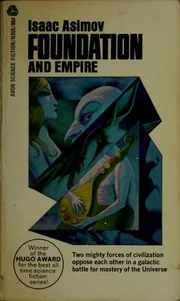
Foundation and Empire
by Isaac Asimov · 1945
Suits teens and adults who like ideas-first science fiction; the reading level is accessible.
253 pages, about 4 to 6 hours.
Two sharp novellas about empires, prophecy, and one thing the math missed. 52% taste match
The story
Foundation and Empire is a science fiction novel by Isaac Asimov, the second book in his Foundation series and the fourth in the order of its internal chronology. The stories first appeared in 1945 and were gathered into a book by Gnome Press in 1952. It is made up of two parts that began as separate novellas, and the second of them, "The Mule," received a Retro Hugo Award in 1996.
The setting is a galaxy in which the old Trantorian empire is fading but still holds enormous strength. The Foundation, a small world of scholars and scientists, owes its course to Hari Seldon and his science of psychohistory. In the first part, an ambitious general named Bel Riose sends imperial forces against it. The second part brings in the Mule, and the cast includes Bayta Darell and Ebling Mis, whose story opens with her arrival at Haven. A typical edition runs about 253 pages, and the book has appeared in 82 editions.
Bayta's first sight of Haven was entirely the contrary of spectacular.
Themes
PsychohistoryLife on other planetsAmerican literatureVie extraterrestreRomans, nouvellesPsychohistoireHari Seldon (Fictitious character)Long Now Manual for Civilization
- Want to read 302
- Reading now 24
- Read 244
Readers are split between finishing it and saving it for later.
Of 570 readers who put it on a shelf, 53% want to read it, 4% are reading it now, 43% have finished it and 0% stopped before the end.
By the numbers
- The median edition runs 253 pages. Counting about 275 words a page and an adult reading pace of 250 words a minute, that is about 4.6 hours of reading.
- Open Library tracks 82 editions from 49 publishers, the earliest dated 1945 and the latest 2022, across 8 languages.
- On reader demand it ranks in the top 2% of the classic books in our catalog (8,749 of them).
- Libraries shelve it under Dewey 813 and Library of Congress class PZ-0003.00000000.A8316 F686 1983.
 BookWard’s take
Two sharp novellas about empires, prophecy, and one thing the math missed
Foundation and Empire is idea-led science fiction that never lets the story stall. It is the second Foundation book, and its two novellas pit a fading galactic empire against a small world of scientists whose future depends on psychohistory. The characters tend to explain the stakes to one another in conversation, which I'm less keen on than a book that lets events carry the meaning. The real draw is the internal logic: the plot runs on a tidy, argued system, and it's hard to fault the book there. The people are closer to types than to deeply drawn characters, and that's where it gives ground. At 253 pages it stays lean, and the pace suits that. The second part, "The Mule," won a Retro Hugo in 1996.
At 253 pages it is compact for a story spanning a galaxy, and BookWard likes that economy.
The science of predicting history through mathematics is an inventive core, even if its trappings are of their era.
Sentences are plain and utilitarian, built to carry ideas and not to ornament them.
Events and strategy lead, and characters mostly react to them.
The Foundation's survival is in question throughout, leaving the outlook uncertain but not hopeless.
Two novellas gathered into one book give it a split shape, though each is told conventionally.
The tone is serious and strategic, with little room for jokes.
The stakes are high, yet the telling stays measured rather than grim.
The book keeps its emotional temperature low and its attention on ideas.
See all 50 dialsEvery position, side by side with this book
Where it lines up
- SentimentBookWard 8 · book 8
- LengthBookWard 1 · book 2
- PaceBookWard 8 · book 7
Where it pulls apart
- ExpositionBookWard 2 · book 9
- OpeningBookWard 10 · book 6
- Familiar tropesBookWard 10 · book 6
At 253 pages it is compact for a story spanning a galaxy, and BookWard likes that economy.
Empire, decline and hidden-hand prophecy were already familiar shapes in 1945 science fiction, and the book works within them.
The plot runs on a clearly argued system, psychohistory, so events follow from stated rules, which BookWard prizes.
The science of predicting history through mathematics is an inventive core, even if its trappings are of their era.
Figures serve the argument and the plot more than they are explored, which sits below BookWard's preference.
Each part reaches a clear point of resolution, though the larger series arc stays unfinished.
Feeling stays in the background while ideas and strategy lead, which BookWard welcomes.
Its reversals come out of the plot's logic rather than from gratuitous darkness, and BookWard values that.
The style is functional and clear rather than strongly personal, so the voice is recognizable but not striking.
Concepts about history, prediction and power drive the book more than individual stories do.
Characters often explain situations and theory aloud, which runs against BookWard's taste for showing in scene.
With two focused novellas, momentum holds across both parts without a long slack stretch.
Sentences are plain and utilitarian, built to carry ideas and not to ornament them.
Events and strategy lead, and characters mostly react to them.
The Foundation's survival is in question throughout, leaving the outlook uncertain but not hopeless.
Two novellas gathered into one book give it a split shape, though each is told conventionally.
The tone is serious and strategic, with little room for jokes.
The prose is easy, though keeping track of the political stakes asks for some attention.
Different figures and situations anchor each part, so no single perspective carries the whole book.
Events move forward in order, with the two parts picking up as the story advances.
Galactic empires, interstellar fleets and a science of predicting history put it well into invented territory.
A handful of named figures matter in each part, with a wider backdrop of factions behind them.
The fate of a galaxy-spanning empire frames the story, which is epic in sweep.
Conflict, politics and military pressure drive the book more than private thought.
Strategy and theory are largely worked out through conversation between characters.
Relationships are present around the edges but never steer the story.
A far-future galaxy of imagined planets and institutions is as unfamiliar as settings get.
It dates from 1945 and is set in a distant imagined future, so it reads as a period piece.
Its questions about empires, decline and prediction keep it relevant, even as the style dates it.
The narration is straightforward and trustworthy, telling events as they happen.
Right and wrong are not tidily split, since rival powers have their own arguments.
Setting is sketched economically, with little pausing over scenery.
It is the second Foundation book and leans on what came before, so it is not a place to start.
Each novella turns on reversals and surprises that upend what the characters expected.
The ideas are provocative but the reading is straightforward, so it stimulates more than it unsettles.
The stakes are high, yet the telling stays measured rather than grim.
The book keeps its emotional temperature low and its attention on ideas.
Humor is rare, and what there is stays dry.
Wars and conflicts drive events, but they are kept at a strategic distance.
Sexual content is essentially absent.
Power, empire and statecraft are the engine of the book, so politics is central.
The language is plain and direct, with no dense dialect to decode.
The narration mostly lets events speak, though it clearly favors reason and planning.
It looks ahead to the future of a civilization, even as it reflects on imperial decline.
It puts faith in knowledge and planning, with a clear-eyed sense of how power behaves.
Review written by BookWard, dial version 1, November 2026.
Who is Foundation and Empire right for?
Suits teens and adults who like ideas-first science fiction; the reading level is accessible. It includes wars and political violence handled at a distance, with little graphic content.
The prose is easy, though keeping track of the political stakes asks for some attention.
The stakes are high, yet the telling stays measured rather than grim.
The book keeps its emotional temperature low and its attention on ideas.
Wars and conflicts drive events, but they are kept at a strategic distance.
Book CompanionFoundation and Empire: ideas, characters, themes
A fading empire and a small world of scholars collide, testing whether a science of predicting history can survive what it did not foresee.
- A second volume. This is the second Foundation book, and it builds on the first, so reading in order helps.
- Two novellas. The book gathers two parts that began as separate novellas, each with its own central threat.
- Empire against Foundation. The first part pits an ambitious general, Bel Riose, and the imperial fleet against the small Foundation.
- Psychohistory under strain. Hari Seldon's science of predicting history shapes the Foundation's course and is tested by events.
- The Mule. The second part, which introduces the Mule, won a Retro Hugo Award in 1996.
Characters
Hari Seldon
Founder of psychohistory
The psychohistorian whose predictions shape the Foundation's course.
Bel Riose
Imperial general
An ambitious general who turns the imperial fleet toward the Foundation.
Bayta Darell
Figure in the second part
A central presence in the second part of the book, which opens with her arrival at Haven.
Ebling Mis
Figure in the second part
A character in the second part's cast, alongside Bayta Darell.
The Mule
Threat in the second part
The figure who gives the second novella its title and its disruption.
Themes
Whether the course of whole societies can be forecast by science.
How a great power declines yet remains dangerous.
The idea that scholars and science can stand against military might.
What happens when a careful design meets something it did not anticipate.
What ambition and vision do to the people who follow them.
Discussion questions
- Can a society's future really be predicted, and would knowing it change what people do?
- Why might a small world of scholars survive against a mighty fleet?
- How does the book treat the fading empire: as a villain, a warning, or something else?
- What does the second part change about the first part's assumptions?
- Does the book's reliance on explained ideas over character action make it stronger or weaker?
Personalize your Book Companion
This is the general edition. In BookWard, the Companion is written for you: your reading profile, your notes, and spoiler-safe to the page you are on.
Buy, listen or borrow Foundation and Empire
Each link opens a search for this book on that store, in a new tab.
Read on a device
Borrow
Reviews and community
If you liked Foundation and Empire
A galaxy-spanning idea novel that trades characters for the sweep of history
Robot DreamsIsaac AsimovAsimov's short fiction, from 1947 to 1986, in one volume
Forward the FoundationIsaac AsimovHari Seldon's forty years, told as linked episodes of a life
Foundation and EarthIsaac AsimovAsimov's long galactic road trip ends the Foundation saga
Sources: Open Library.
Track Foundation and Empire and find your next favorite
Add it to your shelf, rate what you have read, and BookWard will recommend what fits you.
Free to start. No credit card needed.