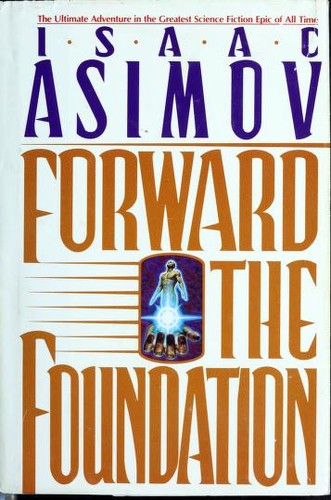
Forward the Foundation
by Isaac Asimov
★ Top 25 book of 1993 · #17 on Best Books of 1993
Isaac Asimov's 1993 Foundation novel follows about forty years in the life of Hari Seldon and his work developing psychohistory. Fans of the series get a deep look at the man behind the galaxy's fate.
Best for: Foundation series readers who want to know Hari Seldon's story
Forward the Foundation is #17 on BookWard's Best Books of 1993, out of 36 1993 books that cleared our data bar.
What Forward the Foundation is about
Hari Seldon has shaped the galaxy throughout the Foundation series, yet earlier books only hinted at him or visited him for historical background. Here he finally takes the centre of the story. The novel follows roughly forty years of his life as he works to develop psychohistory, a pseudo-mathematical science that might one day save the galaxy.
The tone is reflective and measured, more interested in ideas than in action. Questions of legacy and mortality run underneath, and the description suggests it was likely the last book Asimov wrote before his death. The closing pages give Seldon's final moments, said to mirror Asimov's own. A good fit for readers who love the series and want to meet its founding figure up close.
Forward the Foundation on the Best Books of 1993
Forward the Foundation came out in 1993. Of the 36 books first published in 1993 that met BookWard's data bar, it ranks #17 on our Best Books of 1993 list.
Why it made the list: 202 readers have shelved it on Open Library; readers rate it 4.1 out of 5 (50 ratings). The list ranks each year’s books on how many readers have picked them up, how highly readers rate them, and how many are reading them right now.
Nearby on the 1993 list
- Ageless Body, Timeless Mind Deepak Chopra, #15
- Mieko and the Fifth Treasure Eleanor Coerr, #16
- The Celestine Prophecy - an Adventure James Redfield, #18
- A Different Mirror Ronald Takaki, #19
See all Best Books of 1993 Best books by year
More years: Best Books of 1992 Best Books of 1994.
The numbers behind it
- Readers: 109 want to read it, 4 are reading it now and 89 have read it, according to Open Library.
- Ratings: 4.1 out of 5 from 50 Open Library ratings.
| Signal | This book (0 to 100) | Weight |
|---|---|---|
| Reach | 50 | 55% |
| Reader love | 81 | 25% |
| Being read right now | 8 | 20% |
Questions about Forward the Foundation
When was Forward the Foundation published?
Forward the Foundation by Isaac Asimov was first published in 1993.
Was Forward the Foundation one of the best books of 1993?
Forward the Foundation is #17 on BookWard's Best Books of 1993, out of 36 1993 books that cleared our data bar. 202 readers have shelved it on Open Library; readers rate it 4.1 out of 5 (50 ratings).
Why is Forward the Foundation on the Best Books of 1993 list?
202 readers have shelved it on Open Library; readers rate it 4.1 out of 5 (50 ratings).
More of the best books of 1993
- The Giver Lois Lowry, #1
- The Scam Debashis Basu, #2
- Along Came a Spider James Patterson, #3
- A Suitable Boy Vikram Seth, #4
- Girl, Interrupted Susanna Kaysen, #5
- Understanding Comics Scott McCloud, #6
See the full Best Books of 1993, the Top 100, or new books on Rising.
How we know
This page uses public data: Open Library reader counts and ratings, and Wikipedia page views for recent years. The description is paraphrased from real source text. Rankings reflect reading interest, not quality or sales, and can be affected by data gaps. Lists update monthly.
Suits older teens and adults, especially readers already invested in the Foundation series.
Depends on the edition you pick.
Hari Seldon's forty years, told as linked episodes of a life. 46% taste match
 BookWard’s take
Hari Seldon's forty years, told as linked episodes of a life
This is the Foundation prequel that finally puts Hari Seldon at center stage, following roughly forty years of his life as psychohistory takes shape. It is driven by ideas rather than plot, and talky, closer to a set of linked episodes than one forward-pushing story. Exposition is heavy: characters explain the science and the politics to each other rather than the book dramatizing them. The pace is brisk because the timeline jumps forward in chunks, which keeps the middle from sagging, though the same structure means the book keeps changing its footing as it moves through the decades. The prose is plain and functional. If you want Asimov's Seldon given a human face and a quiet, resolved ending, this delivers. If you need ornate language or breakneck action, look elsewhere.
Time jumps keep events moving, though talk-heavy scenes slow individual stretches, landing just under BookWard's preference.
The idea of predicting history mathematically is distinctive, though by this late entry it is an established part of Asimov's world.
Asimov writes plainly and functionally, plainer than BookWard's slightly ornate lean.
Seldon's life anchors the structure while events push it along, balancing character and plot.
Faith in psychohistory gives the story a cautiously constructive outlook, close to BookWard's mildly hopeful tilt.
Linked episodes across decades are a mild departure from a single straight narrative, close to BookWard's middle ground.
Dry asides appear but the tone stays serious, well below BookWard's leaning toward humor.
Conflict and loss are present but handled gently, a touch milder than BookWard's middle.
Feeling builds quietly, especially near the end, in line with BookWard's measured intensity.
See all 50 dialsEvery position, side by side with this book
Where it lines up
- EndingBookWard 8 · book 8
- Shock for effectBookWard 9 · book 8
- Internal logicBookWard 10 · book 8
Where it pulls apart
- Familiar tropesBookWard 10 · book 4
- OpeningBookWard 10 · book 5
- LengthBookWard 1 · book 5
Galactic empire politics and brilliant-scientist arcs are familiar territory, though Asimov's framing keeps them from feeling stock.
The psychohistory premise is applied consistently, which matches BookWard's love of airtight cause and effect.
Time jumps keep events moving, though talk-heavy scenes slow individual stretches, landing just under BookWard's preference.
The idea of predicting history mathematically is distinctive, though by this late entry it is an established part of Asimov's world.
Seldon gets real interiority across decades, but secondary figures lean toward functions, a little shallower than BookWard prefers.
Seldon's story closes with a clear sense of finality, which suits BookWard's taste for resolution.
It allows some warmth around Seldon's later years without turning syrupy, a middle path BookWard would call acceptable.
Darkness here is measured and consequential rather than sensational, which fits BookWard's dislike of shock for effect.
This is a novel, so the nonfiction rigor dial does not apply.
Asimov's clear, conversational manner is recognizable and consistent, close to what BookWard values.
Ideas about prediction, politics and legacy drive the book more than plot, leaning further toward ideas than BookWard does.
Characters often explain the science and the stakes aloud, far more than BookWard's show-in-scene taste.
Episodic jumps reset momentum regularly, so the middle rarely stalls, in line with BookWard.
Asimov writes plainly and functionally, plainer than BookWard's slightly ornate lean.
Seldon's life anchors the structure while events push it along, balancing character and plot.
Faith in psychohistory gives the story a cautiously constructive outlook, close to BookWard's mildly hopeful tilt.
Linked episodes across decades are a mild departure from a single straight narrative, close to BookWard's middle ground.
Dry asides appear but the tone stays serious, well below BookWard's leaning toward humor.
The ideas take attention but the language is easy, which suits BookWard's moderate effort.
The story stays close to Seldon with a few other perspectives around him, fewer than BookWard prefers.
Large jumps forward across forty years make time a defining feature, more shifting than BookWard's middle.
A far-future galactic empire puts this well on the speculative side, above BookWard's moderate setting.
A modest recurring group surrounds Seldon, in line with BookWard's smaller-cast preference.
The fate of a galaxy frames the story, much grander than BookWard's usual intimate-to-epic middle.
Seldon's reasoning and the conversations about it outweigh action, matching BookWard's inward lean.
Scenes are carried by conversation, which is heavier than even BookWard's dialogue-friendly taste.
Personal relationships appear around Seldon, but romance is not the engine of the story.
A far-future galactic setting is distinctly unfamiliar, fitting BookWard's taste for new worlds.
Written in 1993 and set in a distant imagined future, it is far from present day.
The central ideas about prediction and power still travel, though the style marks it as classic science fiction.
The narration is straightforward and trustworthy, well away from BookWard's unreliable lean.
Seldon's choices carry some gray, but the book generally knows where it stands.
Asimov keeps scenery brief and functional, sparser than BookWard's mid-level preference.
This is fiction, so the nonfiction style dial does not apply.
This is fiction, so the nonfiction perspective dial does not apply.
It is a late entry that fills in the Foundation saga and rewards familiarity with the series.
Developments arrive through political and scientific turns, a moderate amount of surprise.
It asks you to consider big ideas but stays accessible, more comfortable than BookWard's challenge lean.
Conflict and loss are present but handled gently, a touch milder than BookWard's middle.
Feeling builds quietly, especially near the end, in line with BookWard's measured intensity.
Humor is understated and dry, on the quieter side of BookWard's middle.
Violence is limited and rarely lingered on, below BookWard's middle.
Sexual content is essentially absent, below BookWard's middle.
Imperial intrigue and the politics of governing a galaxy are central, above BookWard's middle.
Language is plain and clear throughout, easier than BookWard's middle.
Asimov's narration mostly stays neutral and lets characters carry the argument.
The whole premise is about shaping the future, pointing forward more than BookWard's mild lean.
A belief that knowledge can steer history gives it a quietly idealistic core, matching BookWard.
Review written by BookWard, dial version 1, November 2026.
Who is Forward the Foundation right for?
Suits older teens and adults, especially readers already invested in the Foundation series. Content is mild, with little violence and no explicit material.
The ideas take attention but the language is easy, which suits BookWard's moderate effort.
Conflict and loss are present but handled gently, a touch milder than BookWard's middle.
Feeling builds quietly, especially near the end, in line with BookWard's measured intensity.
Violence is limited and rarely lingered on, below BookWard's middle.
Book CompanionForward the Foundation: ideas, characters, themes
Hari Seldon's decades of work on psychohistory, the science meant to guide a galaxy through collapse, are shown as the story of one man's life.
- Seldon takes center stage. The long-implied founder of psychohistory becomes the main figure rather than a distant presence in the series.
- About forty years. The book follows a stretch of Seldon's life, tracing how psychohistory develops over time.
- Idea-led storytelling. Conversations and explanations carry much of the story, more than action does.
- A late series entry. It fills in background for readers who already know the Foundation saga.
- A personal closing. The final pages treat Seldon's last moments with quiet resolution.
Characters
Hari Seldon
Protagonist and founder of psychohistory
The mathematician whose work to predict the future drives the book and whose life it follows.
Themes
Whether the future can be foreseen and who gets to act on that knowledge.
What one person's work leaves behind for people who never meet them.
How research collides with the demands of ruling an empire.
The shadow of a finite life over a plan meant to outlast it.
Discussion questions
- Does psychohistory feel more convincing or less once you see its creator up close?
- How does the episodic structure shape your sense of Seldon's life?
- What does the book gain, and lose, by explaining ideas through conversation?
- Is Seldon's faith in his science admirable, risky, or both?
- How does the ending change your view of the rest of the series?
Personalize your Book Companion
This is the general edition. In BookWard, the Companion is written for you: your reading profile, your notes, and spoiler-safe to the page you are on.
Buy, listen or borrow Forward the Foundation
Each link opens a search for this book on that store, in a new tab.
Read on a device
Borrow
Reviews and community
If you liked Forward the Foundation
Two sharp novellas about empires, prophecy, and one thing the math missed
Foundation and EarthIsaac AsimovAsimov's long galactic road trip ends the Foundation saga
The Foundation TrilogyIsaac AsimovA galaxy-spanning idea novel that trades characters for the sweep of history
DragonquestAnne McCaffreyPern's second Threadfall: dragons, politics, and a planet to save
Find your own best books
Add what you have read, rate it, and BookWard will recommend what to read next.
Free to start. No credit card needed.