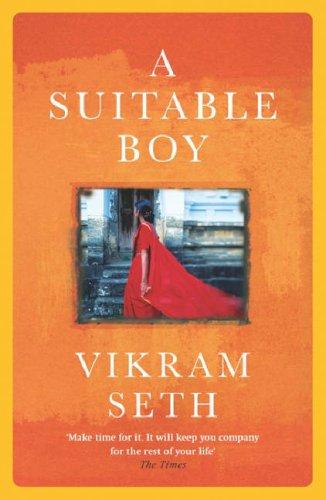
A Suitable Boy
by Vikram Seth
★ Top 5 book of 1993 · #4 on Best Books of 1993
Set in post-independence India, this novel follows Lata and her mother as they search for a suitable husband. Its four families also reflect a whole continent facing its first great General Election.
Best for: Readers who enjoy sprawling family sagas set in post-independence India
A Suitable Boy is #4 on BookWard's Best Books of 1993, out of 36 1993 books that cleared our data bar.
What A Suitable Boy is about
Mrs. Rupa Mehra has one great project: finding a husband for her younger daughter, Lata. Lata is nineteen, studying English literature at university, and not at all inclined to let her domineering mother or opinionated brother Arun decide her life. Three men are in the running: Kabir, Haresh, and Amit. After Lata falls in love with Kabir and learns he is Muslim, her mother learns of their meetings and takes her to Calcutta.
Vikram Seth's novel follows four families over eighteen months in a newly independent, newly partitioned India. It begins in the fictional town of Brahmpur, on the Ganges, and moves across several cities, taking in Hindu and Muslim tensions, caste, land reform, and the run-up to the first election of 1952. At well over a thousand pages, it is one of the longest single-volume novels ever published, yet it stays warm, witty, and humane. It rewards readers who want to settle in with a large cast and live there a while.
A Suitable Boy on the Best Books of 1993
A Suitable Boy came out in 1993. Of the 36 books first published in 1993 that met BookWard's data bar, it ranks #4 on our Best Books of 1993 list.
Why it made the list: 281 readers have shelved it on Open Library; readers rate it 4.6 out of 5 (13 ratings). The list ranks each year’s books on how many readers have picked them up, how highly readers rate them, and how many are reading them right now.
Nearby on the 1993 list
- The Scam Debashis Basu, #2
- Along Came a Spider James Patterson, #3
- Girl, Interrupted Susanna Kaysen, #5
- Understanding Comics Scott McCloud, #6
See all Best Books of 1993 Best books by year
More years: Best Books of 1992 Best Books of 1994.
The numbers behind it
- Readers: 243 want to read it, 19 are reading it now and 19 have read it, according to Open Library.
- Ratings: 4.6 out of 5 from 13 Open Library ratings.
| Signal | This book (0 to 100) | Weight |
|---|---|---|
| Reach | 75 | 55% |
| Reader love | 94 | 25% |
| Being read right now | 89 | 20% |
Questions about A Suitable Boy
When was A Suitable Boy published?
A Suitable Boy by Vikram Seth was first published in 1993.
Was A Suitable Boy one of the best books of 1993?
A Suitable Boy is #4 on BookWard's Best Books of 1993, out of 36 1993 books that cleared our data bar. 281 readers have shelved it on Open Library; readers rate it 4.6 out of 5 (13 ratings).
Why is A Suitable Boy on the Best Books of 1993 list?
281 readers have shelved it on Open Library; readers rate it 4.6 out of 5 (13 ratings).
More of the best books of 1993
- The Giver Lois Lowry, #1
- The Scam Debashis Basu, #2
- Along Came a Spider James Patterson, #3
- Girl, Interrupted Susanna Kaysen, #5
- Understanding Comics Scott McCloud, #6
- Trainspotting Irvine Welsh, #7
See the full Best Books of 1993, the Top 100, or new books on Rising.
How we know
This page uses public data: Open Library reader counts and ratings, and Wikipedia page views for recent years. The description is paraphrased from real source text. Rankings reflect reading interest, not quality or sales, and can be affected by data gaps. Lists update monthly.
Best for adult and mature teen readers who enjoy long, patient novels.
Depends on the edition you pick.
A vast, warm Indian epic built around one mother's marriage hunt. 54% taste match
 BookWard’s take
A vast, warm Indian epic built around one mother's marriage hunt
Vikram Seth's 1993 novel runs to 1,349 pages, and it earns that length by never feeling padded. A mother looks for a suitable husband for her daughter Lata, and around that quest Seth builds four families, a river town and a country about to hold its first general election. This is a book you commit to, not a quick read. But the characters are drawn generously, the viewpoints are many, and a sagging middle is a smaller risk than the page count suggests, since each of its 19 parts follows a different subplot. It is story-led and character-driven, with a voice that is unmistakably Seth's, and its politics sit right beside its romance.
At 1,349 pages it is one of the longest single-volume novels ever published, the opposite of BookWard's taste for tight books.
With this much ground to cover, it moves at a steady, unhurried pace and does not rush; BookWard prefers faster.
The scale, the rhyming-couplet contents page and the blend of domestic and national story make it distinctive, if not radical.
The prose is clear and readable with a playful streak, closer to plain than ornate.
The marriage plot matters, but the pull is in the characters and how their choices land.
It balances satire and hardship with warmth, and the overall tone leans gently hopeful.
Structurally it is a conventional realist novel, though the 19 parts with rhyming summaries add a playful touch.
It alternates satire and earnestness, with real comic energy in its family scenes.
Hindu-Muslim strife and caste inequality appear, but the book stays humane and often light.
Love, family duty and heartbreak carry real feeling without melodrama.
See all 50 dialsEvery position, side by side with this book
Where it lines up
- Authorial voiceBookWard 9 · book 9
- Story or ideasBookWard 3 · book 3
- Character depthBookWard 8 · book 9
Where it pulls apart
- LengthBookWard 1 · book 10
- OpeningBookWard 10 · book 6
- Familiar tropesBookWard 10 · book 6
At 1,349 pages it is one of the longest single-volume novels ever published, the opposite of BookWard's taste for tight books.
It opens at a wedding and moves into Lata's marriage question, an inviting start but a patient one rather than an instant grab.
An arranged-marriage plot has familiar shapes, though the political and social canvas around it keeps it fresh.
Its many threads across four families and a real election period hold together coherently without contradiction.
With this much ground to cover, it moves at a steady, unhurried pace and does not rush; BookWard prefers faster.
The scale, the rhyming-couplet contents page and the blend of domestic and national story make it distinctive, if not radical.
Four families and a large cast are drawn in the round, which matches BookWard's liking for deeply drawn people.
Lata's choice among her suitors is meant to be answered, so the book resolves its central question rather than leaving it open.
Warm and affectionate toward its characters, it leans more feeling than restrained, a mild mismatch with BookWard.
It is not built on shock; its drama comes from family, love and politics rather than manufactured darkness.
This is a novel, so the nonfiction rigor dial does not apply.
Seth's narration is a confident, distinctive presence, satirical in places and earnest in others, which BookWard rates highly.
It is firmly story-led, with ideas about caste, land reform and religion carried through its people.
The politics and social change are mostly dramatized through subplots, though the narration does step in to frame them.
A book this long could drift, but its 19 parts each give a different subplot its own momentum.
The prose is clear and readable with a playful streak, closer to plain than ornate.
The marriage plot matters, but the pull is in the characters and how their choices land.
It balances satire and hardship with warmth, and the overall tone leans gently hopeful.
Structurally it is a conventional realist novel, though the 19 parts with rhyming summaries add a playful touch.
It alternates satire and earnestness, with real comic energy in its family scenes.
The page count and cast ask for stamina, but the writing itself is accessible and friendly.
It follows four families across several cities, so many perspectives drive the story.
The story moves forward through eighteen months in a linear way.
It is firmly grounded in realistic post-independence India.
With four families and many suitors, relatives and politicians, the cast is very large.
It begins with one family's marriage hunt but widens to a whole country facing its first general election.
It balances private feeling with social and political events, sitting near the middle.
Family debates, courtship and political talk give it a good deal of conversation.
Lata's choice among Kabir, Haresh and Amit anchors the book, so romance is central.
For many readers 1950s India, with its towns, courts and elections, is an unfamiliar setting, explored in rich detail.
It is set in 1950s India, firmly in the past, despite its present-day questions.
Its themes of family, love, faith and nation have kept it widely read for decades.
The narrator is a steady, trustworthy guide rather than a deceptive one.
Questions of caste, religion and duty are handled with nuance rather than easy answers.
Cities, homes and customs are painted in generous, vivid detail.
It is a self-contained standalone novel.
It is more about unfolding choices than sudden reversals, though romantic fortunes shift.
It is warm and engaging, yet its length and social questions give it some challenge.
Hindu-Muslim strife and caste inequality appear, but the book stays humane and often light.
Love, family duty and heartbreak carry real feeling without melodrama.
The humour is mostly wry and satirical rather than slapstick.
Communal tension is part of the backdrop but violence is not the focus.
Romance is central but the treatment is mostly restrained.
The first post-independence election and land reform run straight through the plot.
The English is accessible, though many names, places and cultural terms take adjusting.
The narration has a clear, wry point of view on its characters and society.
It looks back at a pivotal national moment while watching a new India take shape.
It sees folly and prejudice clearly yet leans toward faith in people and in democracy.
Review written by BookWard, dial version 1, November 2026.
Who is A Suitable Boy right for?
Best for adult and mature teen readers who enjoy long, patient novels. It touches on communal strife and social inequality but treats romance with restraint.
The page count and cast ask for stamina, but the writing itself is accessible and friendly.
Hindu-Muslim strife and caste inequality appear, but the book stays humane and often light.
Love, family duty and heartbreak carry real feeling without melodrama.
Communal tension is part of the backdrop but violence is not the focus.
Book CompanionA Suitable Boy: ideas, characters, themes
One mother's search for a suitable husband for her daughter becomes a portrait of families and a nation at the dawn of Indian democracy.
- A marriage hunt. Mrs. Rupa Mehra sets out to find a suitable boy for her younger daughter Lata.
- Three suitors. Lata must choose among Kabir, Haresh and Amit, each offering a very different life.
- Four families. The story follows four families over eighteen months, tying private choices to public events.
- A nation votes. Events lead toward the first post-independence national election of 1952.
- Nineteen parts. Each part generally follows a different subplot and is summarized in a rhyming couplet on the contents page.
Characters
Lata Mehra
A 19-year-old university student
She resists pressure from her mother and brother and must choose among her suitors.
Mrs. Rupa Mehra
Lata's mother
She drives the search for a suitable husband for her younger daughter.
Kabir
One of Lata's suitors
A boy her own age whom Lata meets in secret.
Haresh Khanna
One of Lata's suitors
An ambitious shoe manufacturer who notices Lata at a train station.
Amit
One of Lata's suitors
An England-educated poet and the older brother of her sister-in-law Meenakshi.
Themes
How far love, duty and family expectation should decide a life.
Hindu-Muslim tension and how it shapes private lives.
The status of lower-caste people and the decline of feudal landlords.
A new nation learning to govern itself through its first election.
The pull and pressure of relatives on individual freedom.
Discussion questions
- Which of Lata's suitors seems most suitable to you, and why?
- How does Seth connect one family's story to national events?
- Does the novel's length strengthen or weaken its effect?
- How does satire work alongside earnestness in this book?
- What does the book suggest about tradition versus personal choice?
Personalize your Book Companion
This is the general edition. In BookWard, the Companion is written for you: your reading profile, your notes, and spoiler-safe to the page you are on.
Buy, listen or borrow A Suitable Boy
Each link opens a search for this book on that store, in a new tab.
Read on a device
Borrow
Reviews and community
If you liked A Suitable Boy
Four generations of a Korean family in Japan, told with patience
Gone With the WindMargaret MitchellA vast Civil War saga carried by one unforgettable heroine
The Poisonwood BibleBarbara KingsolverA family's undoing in the Congo, told by five women
BuckeyePatrick RyanA small Ohio town, two families, and one buried secret
Find your own best books
Add what you have read, rate it, and BookWard will recommend what to read next.
Free to start. No credit card needed.