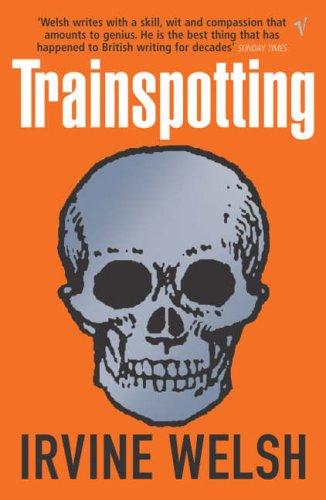
Trainspotting
by Irvine Welsh
★ Top 10 book of 1993 · #7 on Best Books of 1993
Irvine Welsh's debut novel gathers linked short stories about a circle of friends living in Edinburgh. Their drug use and daily struggles in the Scottish city drive the collection.
Best for: Readers who like gritty Scottish fiction about friendship, addiction and city life
Trainspotting is #7 on BookWard's Best Books of 1993, out of 36 1993 books that cleared our data bar.
What Trainspotting is about
Set in Leith, Edinburgh, in the late 1980s, Irvine Welsh's first novel follows a loose circle of friends bound together by heroin and by other habits that work much like addiction. Mark Renton, Sick Boy, Spud, Begbie and Tommy are among those we get to know, and the title is an ironic nod to the characters' frequenting of the disused Leith Central railway station. Mark tries to get clean, and the attempt does not go smoothly.
Welsh writes in Scots and Scottish English, so the voices come across raw and immediate, with a darkly comic edge. Beneath the humor sit working-class despair, shaky loyalty between friends, and real grief. Readers who like unflinching, voice-driven fiction about people on the margins will find a lot to take hold of.
Trainspotting on the Best Books of 1993
Trainspotting came out in 1993. Of the 36 books first published in 1993 that met BookWard's data bar, it ranks #7 on our Best Books of 1993 list.
Why it made the list: 328 readers have shelved it on Open Library; readers rate it 4.1 out of 5 (25 ratings). The list ranks each year’s books on how many readers have picked them up, how highly readers rate them, and how many are reading them right now.
Nearby on the 1993 list
- Girl, Interrupted Susanna Kaysen, #5
- Understanding Comics Scott McCloud, #6
- The Virgin Suicides Jeffrey Eugenides, #8
- Night of the Living Dummy Robert Lawrence Stine, #9
See all Best Books of 1993 Best books by year
More years: Best Books of 1992 Best Books of 1994.
The numbers behind it
- Readers: 276 want to read it, 13 are reading it now and 39 have read it, according to Open Library.
- Ratings: 4.1 out of 5 from 25 Open Library ratings.
| Signal | This book (0 to 100) | Weight |
|---|---|---|
| Reach | 83 | 55% |
| Reader love | 81 | 25% |
| Being read right now | 61 | 20% |
Questions about Trainspotting
When was Trainspotting published?
Trainspotting by Irvine Welsh was first published in 1993.
Was Trainspotting one of the best books of 1993?
Trainspotting is #7 on BookWard's Best Books of 1993, out of 36 1993 books that cleared our data bar. 328 readers have shelved it on Open Library; readers rate it 4.1 out of 5 (25 ratings).
Why is Trainspotting on the Best Books of 1993 list?
328 readers have shelved it on Open Library; readers rate it 4.1 out of 5 (25 ratings).
More of the best books of 1993
- The Giver Lois Lowry, #1
- The Scam Debashis Basu, #2
- Along Came a Spider James Patterson, #3
- A Suitable Boy Vikram Seth, #4
- Girl, Interrupted Susanna Kaysen, #5
- Understanding Comics Scott McCloud, #6
See the full Best Books of 1993, the Top 100, or new books on Rising.
How we know
This page uses public data: Open Library reader counts and ratings, and Wikipedia page views for recent years. The description is paraphrased from real source text. Rankings reflect reading interest, not quality or sales, and can be affected by data gaps. Lists update monthly.
Best suited to adult readers and older teens ready for mature material.
Depends on the edition you pick.
Heroin, Leith and a voice you cannot shake. 63% taste match
 BookWard’s take
Heroin, Leith and a voice you cannot shake
Trainspotting drops you into the lives of a group of heroin users in late 1980s Leith, written in Scots and Scottish English, and it never explains itself. That commitment to voice is its great strength: the author's voice is unmistakable and the dialect is hard going, but it is the point, not a decoration. The book runs on dialogue and shifting viewpoints, a collection of linked episodes rather than one tidy plot, so the structure is looser than it first looks. The darkness is real, with violence on the page and plenty of bodily detail, yet the book earns it rather than leaning on shock for effect. It is also surprisingly funny, in a broad, black way. Expect a demanding first few pages and a bracing reward for staying.
Scenes move quickly and the voices keep momentum up, a little looser than BookWard's brisk preference.
A heroin novel told in dense Scots, as linked voices, felt new and still reads as its own thing.
The language is vivid and rhythmic but built on speech, richer than plain and more textured than BookWard usually seeks.
Character and voice carry the book more than any single plot, matching BookWard's lean toward character.
The outlook is largely bleak, with only flashes of reprieve, darker than BookWard's mildly hopeful lean.
A set of linked voices and episodes rather than one continuous arc, more experimental than BookWard's usual taste.
The humour is black and frequent, running against the bleak subject and landing on the funnier side for BookWard.
Drug use, death and degradation run through the book, much darker than BookWard's midpoint.
The feeling is intense but delivered with black humour and edge, running a little hotter than BookWard's usual.
See all 50 dialsEvery position, side by side with this book
Where it lines up
- OriginalityBookWard 9 · book 9
- Character depthBookWard 8 · book 8
- ExpositionBookWard 2 · book 2
Where it pulls apart
- Internal logicBookWard 10 · book 6
- LengthBookWard 1 · book 4
- EndingBookWard 8 · book 5
It opens mid-scene in the characters' world with no warm-up, which is exactly the immediate pull BookWard rewards.
Its Scots-voiced, unsentimental view of addiction avoids the usual redemption and cautionary-tale tropes, matching BookWard's dislike of the familiar.
The world holds together through consistent voices and consequences, though the episodic form trades some tight plotting for texture.
Scenes move quickly and the voices keep momentum up, a little looser than BookWard's brisk preference.
A heroin novel told in dense Scots, as linked voices, felt new and still reads as its own thing.
Renton, Sick Boy and the rest are drawn from the inside with real contradiction, a strong fit for BookWard.
It refuses to soften its characters or their choices, far more restrained than sentimental, which BookWard values.
The grim material comes from the characters' lives, not stunts, so the darkness feels earned rather than gratuitous.
This is fiction, so a rigor rating does not apply.
The Scots and Scottish English narration is unmistakable and unlike almost anything else, a top match for BookWard.
It is led by people and episodes rather than an argument, leaning story-first as BookWard prefers.
Nothing is explained to the reader; the world is shown through scene and speech, exactly BookWard's preference.
The linked episodes vary in intensity, so the middle holds up well but is a touch less even than BookWard's ideal.
The language is vivid and rhythmic but built on speech, richer than plain and more textured than BookWard usually seeks.
Character and voice carry the book more than any single plot, matching BookWard's lean toward character.
The outlook is largely bleak, with only flashes of reprieve, darker than BookWard's mildly hopeful lean.
A set of linked voices and episodes rather than one continuous arc, more experimental than BookWard's usual taste.
The humour is black and frequent, running against the bleak subject and landing on the funnier side for BookWard.
The dialect and episodic form ask real effort early on, more demanding than BookWard's easier-reading preference.
Different residents of Leith each take a turn, giving a wide spread of voices, more than BookWard needs but a good fit.
It is firmly grounded in the real streets and flats of Leith, with nothing fantastical.
A group of friends and acquaintances shares the book, a larger and more varied cast than BookWard's usual.
The story stays close to flats, pubs and individual lives, firmly intimate rather than epic.
The book moves between action and inner thought almost evenly, close to BookWard's slightly inward lean.
Speech drives much of the book and carries its voice, heavy on dialogue, as BookWard likes.
The heroin scene of late 1980s Leith will be unfamiliar to most readers, which suits BookWard's taste for the new.
It is set in the late 1980s, a step back from the present day, less contemporary than BookWard's lean.
Its voice and subject have kept it a cult favourite, a strong match for BookWard's taste for staying power.
The narrators justify and deceive themselves, making them less reliable than BookWard's already comfortable range.
The book declines to judge its characters, leaving moral questions open, in line with BookWard's taste for ambiguity.
The sensory detail of rooms, bodies and streets is rich and specific, more than BookWard's moderate lean.
This is a novel, so a nonfiction style rating does not apply.
This is a novel, so the personal versus detached perspective rating does not apply.
It has a prequel and sequels in the same world, so it sits more toward series than standalone.
The episodes are driven by character and consequence, not plot surprises, so twists are limited.
The material and language are confronting and uncomfortable, well above BookWard's moderate challenge.
Drug use, death and degradation run through the book, much darker than BookWard's midpoint.
The feeling is intense but delivered with black humour and edge, running a little hotter than BookWard's usual.
The jokes are coarse and broad rather than dry, a touch above BookWard's midpoint.
Violence appears with real bodily detail, more than BookWard's midpoint but not the book's centre.
Sex is frank and unglamorous, appearing more openly than BookWard's midpoint.
It carries social critique of class and place without becoming a political tract, so politics sit slightly above neutral.
The Scots and Scottish English is the whole texture of the book, at the dense extreme of language difficulty.
The narrators hold strong, sometimes self-glorifying views, so the narration is opinionated.
The book is rooted in a specific past moment, looking back more than forward.
It is cynical and unsparing about its characters and their world, far from idealistic.
Review written by BookWard, dial version 1, November 2026.
Who is Trainspotting right for?
Best suited to adult readers and older teens ready for mature material. It contains frank drug use, death, strong language, violence and sexual content.
The dialect and episodic form ask real effort early on, more demanding than BookWard's easier-reading preference.
Drug use, death and degradation run through the book, much darker than BookWard's midpoint.
The feeling is intense but delivered with black humour and edge, running a little hotter than BookWard's usual.
Violence appears with real bodily detail, more than BookWard's midpoint but not the book's centre.
Book CompanionTrainspotting: ideas, characters, themes
A group of friends in late 1980s Leith orbit heroin and other destructive habits, and the book gives each of them a voice without judging or excusing them.
- A world of linked voices. The novel moves through the lives of Leith residents who use heroin, know the core group or have addictions of their own.
- Written in Scots. The prose uses Scots and Scottish English, making dialect central to how the characters think and speak.
- Withdrawal and relapse. Early episodes show Mark trying to come off heroin and slipping back when the symptoms set in.
- Grief and unresolved loss. The death of an infant leaves the group unsure how to respond, and some are shaken more than others.
- An ironic title. The title refers to the characters' habit of spending time at the disused Leith Central railway station.
Characters
Mark Renton
Central voice among the group
Heroin user who tries to quit and repeatedly falls back when withdrawal takes hold.
Simon (Sick Boy)
Mark's friend and fellow user
Chases girls and drifts into self-glorifying nihilism, yet is shaken by a tragedy later.
Johnny Swan (Mother Superior)
Dealer
The man Mark and Simon go to when they need heroin.
Nina
Mark's cousin
Pretends indifference after a family death, then breaks down without realising.
Stevie Hutchinson
Partygoer
Cannot stop thinking about his girlfriend Stella until she returns by train.
Themes
The pull of heroin and other destructive habits over choice and relationships.
How life in Leith shapes opportunity, attitude and voice.
The loyalty and self-interest that coexist in the group.
How characters cope, or fail to, when loss arrives.
Dialect as a marker of who the characters are.
Discussion questions
- How does reading the book in dialect change your sympathy for the characters?
- Does the novel judge its characters, or refuse to?
- Why might the author use short linked episodes instead of one plot?
- What do the moments of grief reveal that the humour hides?
- Is the book a warning, a portrait, or something else?
Personalize your Book Companion
This is the general edition. In BookWard, the Companion is written for you: your reading profile, your notes, and spoiler-safe to the page you are on.
Buy, listen or borrow Trainspotting
Each link opens a search for this book on that store, in a new tab.
Read on a device
Borrow
Reviews and community
If you liked Trainspotting
Two centuries of one family, from Sand Creek to Oakland
DispatchesMichael HerrVietnam as one reporter lived it, in prose that burns
The Bluest EyeToni MorrisonA short, devastating debut about beauty, shame, and who gets seen
Hell's AngelsHunter S. ThompsonThompson rides with the Angels and files a gonzo classic
Find your own best books
Add what you have read, rate it, and BookWard will recommend what to read next.
Free to start. No credit card needed.